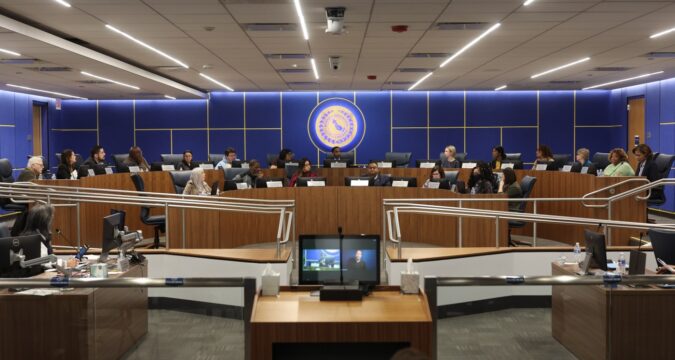
Serving as a member of the Chicago Board of Education can mean upward of 25 hours per week attending meetings, reviewing hundreds of documents, visiting schools and hosting office hours. All on a volunteer basis.
Two board members have left full-time jobs. Others say it’s difficult to juggle the demands of the role with personal and professional responsibilities.
But a new bill in the Illinois House would pave the way for board members to receive compensation, a change advocates say could broaden representation as it transitions to a fully elected body.
State law currently bars Illinois school boards from paying members. The bill would lift that restriction, allowing a more diverse slate of parents, educators and community members to lead Chicago Public Schools, according to state Rep. Marcus Evans, who is sponsoring the proposal. It also has implications across the state: Suburban school boards have long been elected nonpaying positions.
All 21 seats of Chicago’s first elected school board will be on the ballot in November. Eight months before the election, education groups are still debating how to ensure it reflects the city it serves.
“It’s a very large, complicated district that requires a lot of time,” said Evans, a Chicago Democrat. “For $0, what type of person are you going to get on the board? Are you going to get working-class people? I think we all know the answer.”
The bill is backed by several public education advocacy groups, along with the Chicago Teachers Union. A CPS spokesperson did not respond to a request for comment.
It’s not the first time legislators have floated the idea of paying Illinois school boards. State Sen. Robert Martwick, a Chicago Democrat who helped craft the city’s elected school board model, has sponsored two nearly identical bills in the past three years. Those measures ultimately failed to advance.
But advocates say the proposal is now better positioned to move forward, in part because Chicago has seen firsthand the demands of the role. In August, for example, the hybrid board approved a $10.25 billion budget.
“The budget alone is insane,” said Corrina Demma, a senior organizer with nonprofit Educators for Excellence. “We want our best people protecting our kids. We want to make sure that everyone has access to that job.”
Hal Woods, chief of policy at Kids First Chicago, also pointed to the money already pouring into November’s school board races. Last year, campaign spending topped $13 million, according to an analysis by Chalkbeat, with top contributors including CTU and pro-school choice groups like the Illinois Network of Charter Schools.
“Right now it feels like, unless you have six figures, seven figures behind you, you can’t realistically run,” Woods said. “We want the conditions where the everyday parent can participate in the process, and can reasonably run for election without having to be completely beholden to special interests.”
CTU Vice President Jackson Potter put it more bluntly: “It’s a question of guaranteeing community representation instead of billionaires corrupting the board,” he said in a statement to the Tribune.
Chicago Teachers Union Vice President Jackson Potter speaks at a rally outside Chicago Public Schools headquarters on Feb. 26, 2026. (Antonio Perez/Chicago Tribune)
The elected model was long championed by progressives as a vehicle for equity and democratic governance.
Previously, the board was made up of seven mayoral appointees. It is currently composed of 11 appointed and 10 elected members. Though they don’t receive salaries, members can be reimbursed for job-related expenses.
Opponents argue that compensation may attract candidates motivated by profit rather than public service. The bill doesn’t set a salary; instead, it allows individual school districts to determine pay if they choose to do so. That could become a debate in rural and suburban districts across Illinois — which are each a fraction of CPS’ size.
Funding may also be a question in a district like CPS, which will face a projected $520 million deficit next budget season.
“Almost every public school in the United States right now is on a pretty tight purse string,” said Rachel White, an associate professor at the University of Texas at Austin who studies school boards. “I like to think of it as, what is the return on investment for kids?”
There’s also virtually no research on whether compensating school board members actually diversifies a board’s makeup, White said. But studies have shown that diverse school boards are more likely to allocate money in ways that invest in racially diverse students.
Within the 10 largest school districts in the U.S., only two — the New York City Department of Education and Houston Independent School District — have unpaid boards.
Board members at the Los Angeles Unified School District without outside employment receive the largest salary, more than $125,000. At Miami-Dade County Public Schools, which recently surpassed CPS as the third-largest school district, the board members receive about $55,000. At Clark County School District in Las Vegas, which is similar in size to CPS, members are paid a $9,000 annual stipend.
Meanwhile, in Chicago, aldermen receive between $123,000 and $152,000 per year, though they are technically considered part-time employees. The seven appointed board members at the Chicago Transit Authority are paid $25,000. Board members at the Chicago Housing Authority are unpaid.
Drawing Chicago’s elected board
Representation was always central to the push to transition Chicago’s school board to an elected body, according to Martwick, the state senator. Legislators drew 20 districts to reflect the city’s diverse communities, and also curb the influence of outside money in elections, he said.
But while lawmakers focused on who could run and how districts were drawn, compensation was ultimately left out of the final proposal. Earlier drafts of the final 2021 bill included pay for board members, but the provision was removed.
“I’ve talked to my colleagues in the General Assembly, and I will get pushback from time: ‘Oh, it’s about public service,’ to which I say, ‘That’s true. And so is serving in the General Assembly. Do you waive your pay?’” Martwick said.
Martwick also introduced two other CPS-related bills in the Illinois Senate this session, both tied to the district’s finances. One would require the district to contribute to a municipal pension fund that covers nonteaching CPS employees. The other would shift all costs of the district’s teacher pension fund onto the state.
He said revisiting board pay is part of a broader effort to refine the new governance structure as it takes shape.
“I never expected the Chicago school board to be a once-and-done,” Martwick said. “I think there’s going to be growing pains, and I would expect, just like every other form of government, we will find things that we’ll say ‘we should change this’ or ‘we should tweak that.’”
CPS parent Claiborne Wade has closely followed the transition to an elected board — as well as the decision not to include pay in the initial legislation. But the Austin resident called compensation a “parent priority.”
“For a lot of parents like myself, if I want to run, and if I were to win, I need compensation to take care of my family, because I’m not wealthy or rich,” said Wade, who sits on Kids First’s Parent Advisory Board. “Everybody deserves compensation for the work they do.”
https://www.chicagotribune.com/2026/03/09/should-chicago-school-board-members-be-paid/


