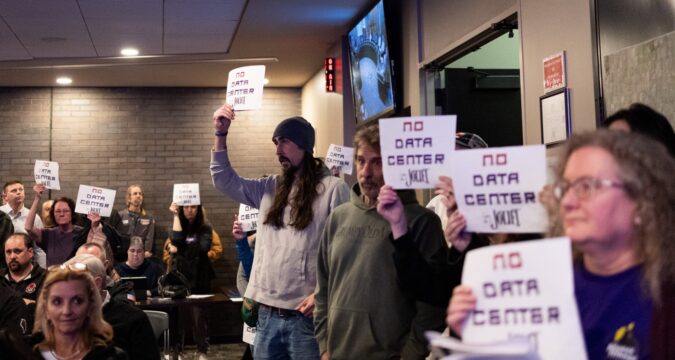
Despite residents’ objections, Joliet plan commissioners advanced a proposal Thursday for what would be the state’s largest data center.
Hundreds turned out for a public hearing, where the vast majority of public speakers expressed opposition to the development. The 795-acre site sits on top of an underground aquifer that’s running dry after 150 years of pumping.
Many residents expressed concern over water usage, noise pollution, demands on the electrical grid and traffic. Others described a “lack of transparency” from the city on the plans and urged commission members to vote no, or at least “no for now” to seek better information.
“It’s just not the right time to go ahead with this,” resident Rita Renwick said.
Dallas-based Hillwood Investment Properties and PowerHouse Data Centers, a Virginia-based developer, said the 24-building project would be constructed in four phases, each consisting of six-buildings and a power substation. The center also will include a switching yard to pull electricity from nearby high-power transmission lines.
When fully built out, the Joliet Technology Center would use 1.8 gigawatts of electricity, or enough to power all the households in Chicago. Mark Pruitt, a consultant for the developers, told commissioners that ComEd has evaluated the plans and determined it would not adversely affect service in northern Illinois.
PJM, a regional energy transmission organization that comprises 13 states, including Illinois, also reviewed the project and determined that there is enough capacity within the grid to supply the data center’s projected energy needs, Pruitt said.
A closed-loop system will be used to cool all the buildings in the development. Each building’s cooling system will require an initial fill of 100,000 gallons of water. When fully built out, the center’s daily usage is not expected to exceed 150,000 gallons of water a day.
Many residents questioned if the data center will drive up electricity prices for homeowners. Others asked why Joliet was considering the project at a time when the city is in the midst of building a pipeline to bring in Lake Michigan water as the city’s aquifers dry out.
“We are effectively handing a giant straw to a private entity during a regional water crisis,” said Felix Ortiz, a lifelong resident of Joliet.
Plan commissioners voted 7-1, with little discussion after the lengthy hearing, to recommend approval of the plans. John Kella, who heads the plan commission, cast the only dissenting vote echoing some of the concerns raised by objectors.
“There’s too many questions in the back of my mind,” Kella said.
After the meeting, Kella suggested Joliet should follow Aurora’s lead. Aurora placed a moratorium on data centers to allow the city to craft rules and regulations for such developments.
While many objected to the proposal, several union leaders spoke in favor of the project, noting it would bring jobs to the area and bolster property tax revenue.
“We’re going to hopefully put a lot of people to work out here,” said Tom White, executive director of the Three Rivers Construction Alliance.
Pipefitters Local 597 President Doc Gregory noted that many of his union’s members are traveling out of state to work construction jobs at another data center project in Pleasant Prairie, Wisconsin.
“We need a project like this in our backyard,” he said, noting that the last construction project of this magnitude was decades ago when the nuclear power facility in Braidwood was built. “We have a lot of guys and girls who need jobs.”
Joliet City Council members are expected to vote on the project at their March 16 meeting. Information on the data center proposal can be found on the city’s website.
Alicia Fabbre is a freelancer.


