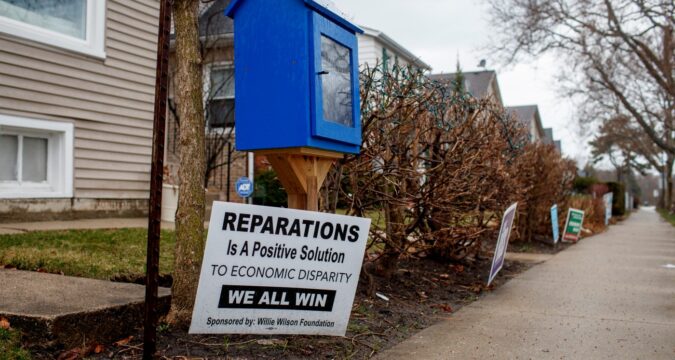
More than five years after Evanston’s Reparations Program made national history as the first-ever government-funded initiative to compensate longtime Black residents for suffering housing discrimination, the question facing city leaders is how to pay for them now that the funding source, cannabis tax revenue, is producing less revenue than expected.
The way forward is also somewhat clouded until a lawsuit is resolved.
Members of the Evanston Reparations Committee took up the question of funding at their March 5 meeting, exploring additional funding avenues that could support payments to the 44 direct descendants expected to receive $25,000 each from the program this year for housing-related expenses.
Two proposals emerged as contenders: The first, to allocate $310,000 from the sale of 2221 Keeney Avenue, Evanston, an abandoned building in the 9th Ward, and another to advance consideration of a municipal tax on Delta-8 THC products.
The committee in part proposed a tax on Delta-8, a psychoactive hemp-derivative commonly sold in the form of vape cartridges, edibles and gummies, because revenue from the city’s cannabis tax has fallen short of expectations, city officials said.
“We all know that we’re not bringing in as much revenue as the city initially projected, and I think both of these items on the agenda are an effort to try to provide more benefits to the many descendants that are waiting,” said Ald. Bobby Burns, 5th.
“Among those descendants are people who are older in age, and we all would agree that it’s important to try our best to get benefits to those recipients in particular, not that we can prioritize them…but the quicker we can get through the full list, the quicker we can make sure that everybody is receiving the benefits when they’re living strong and healthy lives.”
The recipients include Black Evanston residents who lived in Evanston between 1919 and 1969 or their direct descendants.
Evanston currently collects a 3% Cannabis Retailers Occupation Tax on recreational cannabis sales and uses the revenue to fund the reparations program, alongside funding from its real estate transfer tax.
In 2019, the city pledged to donate $10 million in total to the reparations fund. While Illinois law prohibits the disclosure of how much revenue has been generated for the fund from its cannabis tax, over $275,000 has been generated for reparations from the real estate transfer tax as of Jan. 31.
Tax revenue from cannabis sales may be low in part because Evanston currently has only two active dispensaries open – Zen Leaf at 1804 Maple Avenue and OKAY Cannabis at 100 Chicago Avenue.
Delta-8 products are considered one of the more affordable “cannabinoids” and are more widely accessible than their traditional Delta-9 counterparts, partly because they aren’t held to the same legal restrictions.
“Hemp is not the same as cannabis. Hemp products, some of them are legal, [but] cannabis is legal under the restrictions and regulations the state has laid out,” said Ald. Matt Rodgers, 8th, at the March 5 meeting.
Per Evanston’s corporation counsel, the city operates as a “home rule unit,” and has the authority to impose a new tax on products without having to wait for state or federal approval.
While committee members were unable to move either recommendation forward because a quorum of members was not present for the vote, Ald. Krissie Harris, 2nd, confirmed that both proposals would be reviewed again at the next meeting on April 2.
In order to tax Delta-8 products, the committee will have to submit a further referral to City Council with support from at least two Council members before being presented to the referrals committee for formal consideration, according to committee members.
“This is on the table for consideration; we will keep our eye on it, because if it has the potential to provide some funding to get through this system…those things weren’t thought about, those things weren’t happening when the legalization of cannabis was happening,” Harris said. “So we will keep you all updated as we know any information.”
Harris confirmed at the meeting that of the total of 456 descendants who have applied for reparations since 2021, Evanston residents with numbers from 127 to 171 should now expect to be contacted by the city to receive their payment.
If payments are disbursed to the 44 additional recipients this year, a total of over $4 million will have been distributed for 171 of 456 descendants.
All residents at the time of application were randomly assigned a number signifying their place in line to receive their payment. Harris said the committee has already met with and allocated compensation for descendants numbered one through 126.
“As a rapid response to (disbursed) direct benefits, the funding is really being passed through as we get it,” said Robin Rue Simmons, former 5th Ward Alderwoman and reparations committee member.
“We’re not holding onto a pot of money,” Assistant to the City Manager Tasheik Kerr added.
100% of the money in the reparation fund will go towards that purpose, Kerr clarified.
Harris acknowledged that the process for handing out reparations has moved more slowly than anticipated and that she was hesitant to reopen the applications to additional qualifying residents, especially since committee members were “still learning from the current process for things that make sense, don’t make sense, how to make it more equitable.”
“Until we get further down that line of 456 [descendants], I don’t feel it’s appropriate, I don’t know if anybody else has input, but we’ve got to work through who we’ve already promised and had communication with before we start communication with somebody else.”
Compounding the shortfall in cannabis tax revenue, the program has also faced legal challenges that have cast uncertainty over its future.
In May 2024, conservative activist group Judicial Watch filed a class action lawsuit against Evanston arguing the reparations program violated the 14th amendment’s equal protection clause by using race as an eligibility requirement.
“The program’s use of a race-based eligibility requirement is presumptively unconstitutional, and remedying societal discrimination is not a compelling government interest,” Judicial Watch stated in a response to the city’s motion to dismiss.
“Among the program’s other fatal flaws is that it uses race as a proxy for discrimination without requiring proof of discrimination.”
Judicial Watch originally filed the suit on behalf of six non-Black individuals whose ancestors also lived in Evanston during the same time period. According to Civil Rights Litigation Clearinghouse records, the case is still ongoing as of January 2026.
Committee members are expected to reconvene April 2 to further review both the 2221 Keeney sale and Delta-8 THC tax recommendations for consideration of additional reparations funding.


