Hawthorne Race Course, which bills itself as the oldest horse-racing venue in Illinois, filed for Chapter 11 bankruptcy protection on Feb. 27.
Financial difficulties have plagued the track in west suburban Stickney, which has been the only facility of its kind in the Chicago area since Arlington International Racecourse closed in 2021.
The course — which used to attract tens of thousands of fans to its derbies — now has competition that didn’t lawfully exist in previous decades. High- and low-rollers have other options in Chicago for placing their bets since casinos and sports gambling have been legalized. And many don’t even have to leave their homes due to the availability of wagering online or via mobile apps.
Here’s a look back at Hawthorne’s more than 135 years of hosting the sport of kings.
This newsletter is possible thanks to Neil Milbert, who covered horse racing and other sports during his 40-year career with the Tribune.
May 20, 1891
Edward Corrigan, center in crop marks, who died in 1924 at the age of 82, was one of the two dominant figures of Chicago turf circles in the 1880s and 1890s. He was the original owner of the Hawthorne Race Course and his filly Modesty won the inaugural American Derby in 1884. Editors’ note: This historic print shows hand painting and cropping around the central figure. (Chicago Tribune archive)
Hawthorne Race Course opened on 119 acres of land. The new Chicago Racing Association track hosted five races, which had delayed starts due to slow railroad accommodations for patrons.
“Chicago racing equaled that of New York and everything else in the country for the quality of its meetings and the grade of the horses which they attracted,” the Thoroughbred Record reported.
Two of the events were won by horses owned by Edward Corrigan.
“There were six thousand people at the track and the betting ring and grand-stand were too small for them,” the Tribune reported. “The track was in fair shape, and after all the work in and around the stands is finished the new park will be the best minor one in America.
Brookwood won the Chicago Derby for 3-year-olds.
May 30, 1902
A crowd is gathered at the grandstand for a race at Hawthorne Race Course in 1902. (Hawthorne Race Course)
The grandstand was destroyed by fire. That day of racing had been the most successful in the track’s young history, the Tribune reported, but in less than an hour, it was “changed from a scene of festivity to one of ruins.” The damage was estimated at more than $100,000 (or roughly more than $3 million in today’s dollars). There was not even “enough water to extinguish a lighted cigar,” according to Sheridan Clark of the jockey club.
“Chicken Pete” Rask — described by the Tribune as a stable boy — was killed in the blaze. He had been atop the roof, splashing it with water, when it collapsed and he fell into the blaze below. Others among the crowd of 10,000 escaped with injuries. Witnesses said two men were seen leaving the grandstand’s cupola, where the fire started.
Racing returned on Aug. 18, 1902.
April 29, 1905
The finish wire at Hawthorne Race Course in 1902. By 1905, racing had halted at the track. (Hawthorne Race Course)
The expected start of the season was called off and racing was effectively banned, forcing the closure of all local tracks.
“It is though this will be the last talk of racing in Cook County during 1905,” the Tribune reported.
“The trend was set,” Milbert wrote in 1999. “Interludes of dazzling excellence followed by depressing relapses.”
Motorcycle races were held at Hawthorne until horse racing returned legally on Sept. 30, 1922, after several efforts.
May 19, 1909
Thomas Carey, owner of Hawthorne Race Course, circa 1909. (Chicago Tribune archive)
Hawthorne was acquired by Thomas Carey — owner of the Carey Brick Co. and former alderman for the 29th Ward — from the bankrupt Corrigan family for $2,000 in cash and a $24,000 note.
July 15, 1916
The American Derby at Hawthorne Race Course in 1916. (Chicago Tribune archive)
The American Derby — the first horse race in Chicago since 1904 at Washington Park — opened at Hawthorne. The races were held by the new Illinois Jockey Club, which had been incorporated in Springfield.
More than 25,000 people watched as 3-year-old Dodge won by half a dozen lengths over his nearest rival.
Sept 30, 1922
A groundskeeper waters down the track in front of the grandstand at Hawthorne Race Course, circa 1920s. (Chicago Tribune historical photo)
Racing returned to Hawthorne — and so did a reported 20,000 “race hungry Chicagoans” — but betting was not allowed.
“Those of this crowd who thought they could bet saw six of the men to whom they entrusted their wagers led away by minions of the law,” Tribune reporter Harvey T. Woodruff reported.
July 14, 1923
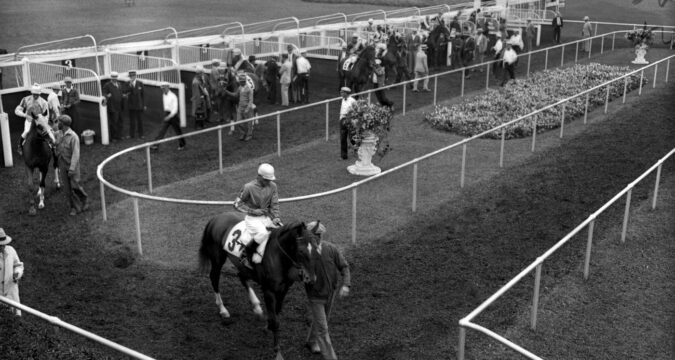
A crowd is gathered in the grandstand and the paddock at Hawthorne Race Course just before the inaugural Illinois Derby featuring 3-year-old thoroughbred horses in 1923. (Chicago Air Park Photo)
In Memoriam won the first running of the Illinois Derby before 35,000 spectators in a track record time of 2:04 1/5 for 1 1/4 miles.
Feb. 8, 1924
The second race at Hawthorne Race Course in Stickney on July 3, 1924, was won by Arrowhead, who “came with a rush on the outside, and just got up. Top o’ the Morning was caught in the barrier and ran a winning race. Simplicity quit.” The three-quarters mile race had a purse of $1,000. Arrowhead came in first, Top o’ the Morning in second place, and Simplicity came in third. (Chicago Herald and Examiner)
Chicago Business Men’s Racing Association took over Hawthorne until a lease agreement expired in 1945. One of the group’s leaders was Charles W. Bidwill.
The Carey family resumed control of Hawthorne in 1946, and continues to own the track.
Oct. 7, 1929
The view from the grandstand at Hawthorne Race Course, circa 1920s. (Chicago Tribune historical photo)
Sun Beau scored the first of three consecutive Hawthorne Gold Cup victories. The Daily Racing Form called it the “Greatest Race of 1929.”
Sept. 7, 1935
The view of the open air paddock at Hawthorne Race Course in 1931 in Stickney. (Chicago Herald and Examiner)
Myrtlewood — a world record-holder for 6 furlongs — met Clang —a world record-holder for 7 furlongs — in a $5,000 6-furlong match-race. Myrtlewood won by a neck in 1:10 4/5.
Sept. 11, 1954
Barn number 6 was leveled by a fire at Hawthorne Race Course that killed 30 horses, including 24 thoroughbreds valued at $250,000, on Sept. 11,1954. Photo taken on Sept. 12, 1954. (Swain Scalf/Chicago Tribune)
The barn 6 went up in flames, causing the deaths of 30 horses.
“The blaze spread so quickly that guests at a wedding reception in the nearby track restaurant, attempting to free the horses, were able to release only nine before they were driven off by the flames,” the Tribune reported.
Sept. 24, 1955
A fire at Hawthorne Race Course destroyed a large portion of the stables on Sept. 24, 1955. Two horses died. (William Vendetta/Chicago Tribune)
About 10,000 spectators watched as a large portion of Hawthorne’s stable was destroyed by fire just 45 minutes before post time. Two horses died.
Oct. 15, 1960
Robert F. Carey, right, managing director of Hawthorne Race Course, shows other members of the board of directors of Hawthorne’s new improvements on Sept. 3, 1957, in Stickney. With Carey are William Carey, from left, Gene Carey and George Barry. (Chester Gabrysiak/Chicago Tribune)
Kelso won the Hawthorne Gold Cup as a 3-year-old, en route to the first of his five North America Horse of the Year titles.
April 14, 1970
Responding to a heavy whip from Bill Beckley, Teddy Rip (6) edges Apollo Fifteen in the featured $20,000 Suburban Downs Inaugural Pacing Series Final at Hawthorne Race Course on Feb. 15, 1976. The winner was timed at 2:00. (Chicago Tribune archive)
First harness racing events took place at Hawthorne.
Feb. 4, 1970
Flames shoot through the floor from a false ceiling below at Hawthorne Race Course on Feb. 4, 1970, in Stickney. Firemen working in front of the Gold Cup Room got a hose caught in the fire. No one was hurt. (Arthur Walker/Chicago Tribune)
Sparks from a welder’s torch started a fire that spread through more than 100 feet of the grandstand and clubhouse. The most serious damage was to the track’s Gold Cup restaurant.
Nov. 19, 1978
A firefighter works at an early morning fire at Hawthorne Race Course on Nov. 19, 1978, in Stickney. (Ernie Cox Jr./Chicago Tribune)
Fire destroyed much of Hawthorne’s grandstand and clubhouse. Rebuilding cost millions and was made possible by bonds issued by the Village of Stickney.
The Carey family could only insure the facility for $3 million due to its advanced age.
Sept. 29, 1980
Managing Director Robert F. Carey, from left, track announcer Phil Georgeff and Thomas Carey look over a model of the new Hawthorne Race Course in April 1979. (Walter Kale/Chicago Tribune)
The grandstand reopened after reconstruction.
Tom Carey, a former Notre Dame quarterback, was named president and general manager. His brother Bob Carey became his assistant.
Nov. 25, 1987
Spectators watch the track at Hawthorne Race Course on April 20, 1972, in Stickney. (Phil Mascione/Chicago Tribune)
Restaurateur Christ Boutsikakis and a syndicate of friends who bought a $1 Super Bet ticket hit an all-time Illinois record betting jackpot of more than $1.5 million.
1995
Emil Stipsky, of Chicago, looks over the racing form after the results of the race are posted on the screen behind him at Hawthorne Race Course on July 3, 1999. (Terry Harris/Chicago Tribune)
Hawthorne became the first Illinois track to conduct full-card simulcasting on out-of-state races after the state legalized it on May 30.
From June through December, 55% of all money bet in Illinois during thoroughbred programs and 31% during harness cards was on out-of-state simulcasts.
December 1995
Fred Nichols, right, owner of the horse Restless Waters, center, shakes the hand of jockey Mark Guidry as they stand in the winner’s circle after placing first in the second race on March 1, 1998, at opening day in Sportsman’s Park. Co-owner Bryan Mazey, left, stands nearby. Guidry was a five-time Hawthorne jockey champion nicknamed the “King of Chicago.” (John Lee/Chicago Tribune)
Five-time Hawthorne jockey champion Mark Guidry — nicknamed the “King of Chicago” — rode a track record 118 winners during the season. Guidry broke his own record of 117 in 1994.
Oct. 11, 1998
Awesome Again, ridden by Pat Day, holds off Unruled, ridden by Gary Boulanger, during the Hawthorne Gold Cup on Oct. 10, 1998. (Wes Pope/Chicago Tribune)
Undefeated Awesome Again prepped for a victory in the Breeders’ Cup Classic by winning the Hawthorne Gold Cup.
July 30, 2020
Horses run in the third race of the day on April 6, 2024, at Hawthorne Race Course in Stickney. (Vincent Alban/Chicago Tribune)
The Illinois Gaming Board gave Hawthorne authority to build the state’s first racing and casino facility — or “racino” — at its track.
Course officials have yet to receive financing for the project.
Want more vintage Chicago?
Become a Tribune subscriber: It’s just $1 for a 1-year digital subscription.
Thanks for reading!
Subscribe to the free Vintage Chicago Tribune newsletter, join our Chicagoland history Facebook group, stay current with Today in Chicago History and follow us on Instagram for more from Chicago’s past.
Have an idea for Vintage Chicago Tribune? Share it with Kori Rumore at krumore@chicagotribune.com.
https://www.chicagotribune.com/2026/03/05/vintage-chicago-tribune-hawthorne-race-course-history/


