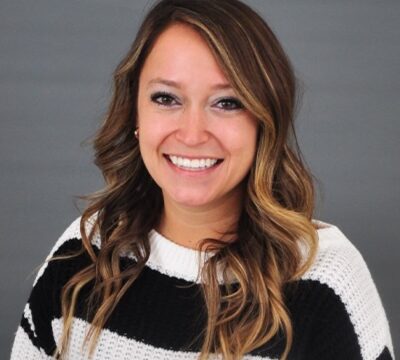
Jerika Gill, a special education teacher at Julia S. Molloy School Education Center located in Morton Grove, has been nominated for a 2026 Golden Apple Award for Excellence in Teaching.
The nomination was given to 30 finalists who teach 4th through 8th grade out of 600 nominations statewide, according to a Feb. 25 press release from nonprofit Golden Apple Foundation. The award honors teachers who have made a positive, lasting impact on their students and school community.
Gill’s path to a career in special education started early. Growing up in Rochester, New York, when she was in second grade, she remembers a student with disabilities joining her classroom with the support of a student aide, and that has always stayed with her, she told Pioneer Press in an interview.
“I just thought it was so neat that he was able to join our class for art and all of these different activities,” she said. “That was my first experience.”
After working in applied behavior analysis, providing therapy to students with autism and behavioral needs one-on-one, Gill took up a suggestion from a friend to explore working in a school setting.
Gill currently teaches 4th through 6th graders at Julia S. Molloy Education Center, with a class size of around six to eight students supported by two student aides. She helps students who need support with a variety of needs including communication, social, emotional and learning.
“My initial reaction was just so happy for her, because it is just so deserved,” said Marie Sheedy, principal at Julia S. Molloy Education Center. “She is not just an excellent teacher and educator, but she’s a great person as well and brings so many things to the table when it comes to educating our students.”
One example of Gill’s impact in the classroom is that she helped reduce a student’s behavioral incidents from 12 a day to two or three by teaching them to use an Augmentative and Alternative Communication device to request breaks. Gill’s nonverbal students are given the communication devices to express their specific needs in the classroom.
She noted challenging behavior from students is often the result of frustration rather than defiance.
“Some behaviors that you see are simply just because the kid isn’t able to express what he wants or what he is looking for,” she said. In situations where students show problems with behavior, Gill added that it is important for her to keep composure and understand the root cause instead of reacting to it.
“If we’re seeing behaviors, there’s a reason for it,” she explained. “It’s not because the kid wants to act out.”
Sheedy emphasized that Gill’s communication strategies for increasing student learning in the classroom have been substantial to the school community. “Let’s say a student has 12 incidents a day. It impacts their ability to access curriculum and therefore their learning process is impacted. So, by teaching them the tools that they need, they are able to grow academically, socially and emotionally,” she said.
In addition to helping students with additional needs, Gill also mentors staff members and models trauma-informed practices to help colleagues better respond to students who need special attention.
For Gill, the best part of teaching special education is being able to see the milestones for her students, both inside and outside of the classroom.
“We’re able to go out into the community a lot, even on trips to Target or Aldi,” she said. “Some parents say they can rarely leave the house with their kids, but then we are able to practice it and work on different skills, which not only helps their life at school, but also life outside of school.”


