
In its latest union negotiations update, BP announced its plan for the Whiting refinery’s environmental department and proposed strategies for employee compensation.
According to its union updates page, the BP refinery has 30 environmental technicians, nine of whom are company employees. With its proposal, the company plans to shift the nine technicians’ work to its “incumbent specialized contractor,” claiming it is standard practice for the industry.
“BP is committed to safety at our refinery — safety for our people, the community, and the environment,” the update said. “The BP Whiting refinery wants to make it clear: we are NOT eliminating our Environmental Department.”
In its update, BP also announced that it has proposed a new job advancement structure “that focuses on skills and competency development.” The company also plans to enhance training programs to upskill the workforce and improve its performance.
“We are negotiating our total compensation package to compete with the external market,” BP’s update said. “As part of that, the average wage increase proposed over the next four years of the contract is over $7.00 per hour or the equivalent of a 13% increase. Our average hourly earner is among the top 10% in the state of Indiana.”
The refinery proposed new overtime management rules to “help ensure overtime is distributed equitably and allows better work-life balance,” according to the update.
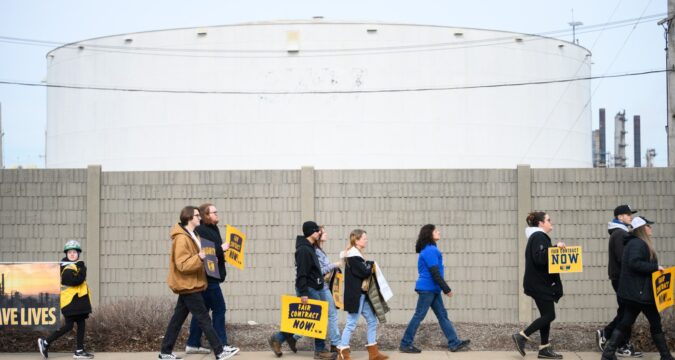
United Steelworkers and supporters march past BP Refinery property as they prepare to rally in front of the company’s Whiting headquarters amid contract negotiations on Saturday, Feb. 14, 2026. (Kyle Telechan/for the Post-Tribune)
United Steelworkers Union 7-1 President Eric Schultz responded to BP’s claims in a statement.
“(BP) is attempting to put a glossy label on their proposals and make deep union concessions sound like standard industry practice, when they are anything but that,” Schultz said. “Outsourcing critical environmental work and maintenance functions, rewriting overtime rules, and pushing a long contract with a lengthy ‘industrial peace’ clause are not about ‘stability.’ They are about shifting risk onto workers and our community, with less accountability. Our members aren’t coming in from Louisiana every week to work here — we live this work every day. Northwest Indiana is our home. We know what keeps this refinery safe, what protects the public, and what sustains middle-class jobs here.”
In his statement, Schultz said that environmental monitoring and compliance are “core refinery safety functions,” and outsourcing the work is not standard. He claims the move would reduce BP’s responsibility for staffing, training and institutional knowledge.
Schultz also claimed that BP’s offered wage package is untrue.
“It is a fact that they have formally proposed to reduce the base wage rate for every job classification in the refinery except for two,” Schultz said. “When their ‘wage increases’ are factored in, the average refinery wage would actually see their hourly rate reduced by $4.18. They cannot ignore what they want to take from us.”
In his statement, Schultz also addressed BP’s sought-after six-year contract term, claiming it’s a one-sided demand that limits workers’ leverage. The union is also prepared to discuss improvements to the overtime rules that would protect workers’ safety, the statement said.
“We remain committed to bargaining in good faith and reaching an agreement that supports safe operations, protects the community, and maintains family-sustaining union jobs,” Schultz said. “We’ve always been the people who keep this refinery running safely — through every challenge. We want an agreement that respects that reality, not one that outsources accountability and calls it ‘modernization.’”
On Jan. 5, BP and the union started negotiations for a new collective bargaining agreement, according to Post-Tribune archives. The previous agreement expired at 11:59 p.m. Jan. 31, and the two parties couldn’t reach an agreement by deadline.
Both parties have since agreed to rolling 24-hour extensions of the agreement for Whiting refinery workers.
USW announced on Feb. 5 that it was prepared for a strike or lockout at the BP Whiting refinery, citing its desire for a “fair agreement.” No update on a strike or lockout has been given since the announcement.
The company has held more than 40 documented bargaining sessions with the union since Jan. 5, according to a previous email from its spokesperson. The parties have also met in informal settings to discuss the proposals.
In its previous negotiations update, BP announced that it was seeking a six-year contract term and a 150-day notice before any union strike or lockout.
BP has also trained replacement workers, consisting of current and former employees, to operate the refinery safely and in compliance with regulations if a work stoppage occurs, according to a previous email.
The union encouraged members to remove personal belongings from the workplace, schedule any medical, dental or vision appointments, refill prescriptions with 90-day supplies and postpone major purchases or financial obligations until an agreement is reached.
According to the BP website, if employees are absent from work because of a strike or lockout, they will not be eligible for employee benefits, adding that they can still receive benefits through alternative means, including COBRA.
On Feb. 6, the USW reached an agreement with Marathon for a four-year national pattern, which covers about 30,000 union oil workers for dozens of employers. Affected workers are represented through the USW National Oil Bargaining Program, and they work in more than 200 units that include refining, production, pipelines, maintenance, storage, petrochemical and renewable facilities.
BP said in a Feb. 6 statement that the company “is, in no way, obligated to follow the ‘pattern.’”
Negotiations updates from BP are available online, whitingnegotiations.com.
mwilkins@chicagotribune.com
https://www.chicagotribune.com/2026/02/27/bp-shares-plans-for-environmental-department-compensation/


