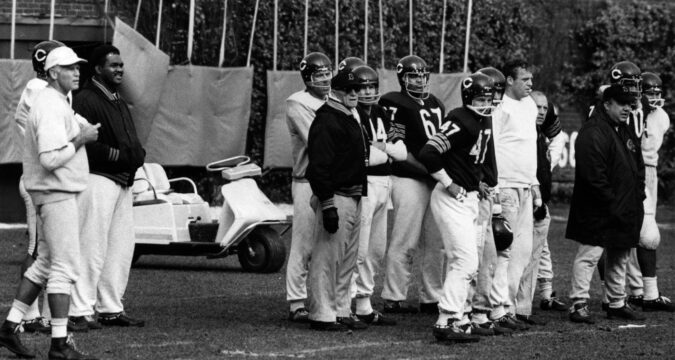
Lawmakers from several states are trying to woo the Bears away from Chicago.
Arlington Heights in Illinois, Hammond, Gary, Portage in Indiana — and even Iowa have pitched stadium plans. Indiana Gov. Mike Braun signed a bill Thursday that outlines a financial structure for a Chicago Bears stadium in Hammond.
Indiana governor signs Chicago Bears stadium bill into law as Illinois inches closer to a tax deal
The team reaffirmed on Feb. 20, however, that its recently renovated practice facility and corporate headquarters — Halas Hall — will remain in Lake Forest.
The Bears offices and training grounds have not always been housed in the same location. Here’s a look back at where the team has “Bear-ed down” from Decatur to Chicago.
What to know about the Chicago Bears’ possible move from Soldier Field
Staley Field (1919-1920)
George Halas, center in front row, and the 1920 Decatur Staleys. They moved to Chicago and became the Bears. (Chicago Tribune archive)
The Bears’ origin story began three hours south of Chicago. The A.E. Staley Manufacturing Co. — then one of the largest starch-making plants in the world — sponsored its own sports teams in the 1900s. Some of these rosters included the company’s own employees. Everything was named for the company, including the practice and playing ground and the team itself: the Decatur Staleys.
Vintage Chicago Tribune: 10 key moments in George Halas’ life on the 40th anniversary of his death
The 1920 season was the Staleys’ second, but first in professional football. George Halas, a University of Illinois graduate and World War I veteran, was an end and coached the team, but he was also a founding father of what became the National Football League. He and representatives from 11 other teams met in the showroom of Hay’s Hupmobile Agency in Canton, Ohio, and formed on Sept. 17, 1920, the American Professional Football Association.
The Staleys proclaimed themselves the new league’s champions after a 0-0 tie against Akron on Dec. 12, 1920, at Wrigley Field.
Wrigley Field (1921-1970)
The Chicago Bears offensive line practices at Wrigley Field before their battle against the Green Bay Packers on Nov. 17, 1963. They are, from left, Mike Ditka, Bob Wetoska, Jim Gadile, Mike Pyle, Ted Karras, Roger Davis and John Farrington. (Chicago Tribune historical photo)
There was one major problem with the championship team — it didn’t make much money. A.E. Staley believed, according to the Staley Museum in Decatur, more of it could be made in a bigger market.
The company gave Halas control of its football team, $5,000 and permission to move to Chicago if Halas agreed to keep the Staleys name for a year. It was a deal, and Wrigley Field (or Cubs Park as the Tribune called it back then) remained the team’s home stadium for the next 50 years (with Soldier Field serving as an alternate site). Wrigley Field was often used for team practices, too, since the Bears didn’t have their own dedicated facility.
From Wrigley Field to Soldier Field: Where the Chicago Bears have played home games since 1921
The Staleys won the 1921 league championship. With no more obligation to the starch company, Halas was free to make the team his own.
“I considered naming the team the Chicago Cubs out of respect for Mr. William Veeck, Senior, and Mr. William Wrigley, who had been such a great help,” Halas wrote in his 1979 autobiography, “Halas By Halas.” “But I noted football players are bigger than baseball players; so if baseball players are cubs, then certainly football players must be bears!”
On Jan. 28, 1922, the two-time championship team became the Chicago Bears — joining the Chicago Cardinals as the city’s second NFL team.
The team played its last game at Wrigley Field on Dec. 13, 1970. The NFL had been pressuring the Bears to move because seating capacity was less than 50,000 — one of the parameters the league created after the AFL-NFL merger — and because the stadium lacked lights.
“The one huge failure of Halas was his lack of foresight in building a stadium,” Tribune reporter Don Pierson wrote in 1993. “Satisfied with Wrigley Field for too long, Halas did not push the issue sufficiently with the late Mayor Richard J. Daley, who would have been able to sell it during the stadium boom of the 1960s much easier than his son could today. It was Halas who signed the Soldier Field lease running until the year 2000 that his grandson terms horrible.”
Downtown (1947-1992; 2018-present)
Yes, Chicago Bears tickets were sold at the store operated by the team’s owner. When George Halas Co. opened in December 1947 at 233 W. Madison St., it also sold fine jewelry and watches, according to this advertisement. (Chicago Tribune)
Wrigley Field provided a consistent field for the team to practice and play its home games, but it lacked space for its owner and executives to work.
Halas initially used his West Garfield Park home as his office, then another space at 37 S. Wabash Ave.
The George Halas Co., 233 W. Madison St., Chicago, hosted a meet-and-greet with Bears quarterback Johnny Lujack on Nov. 11, 1949 according to this advertisement. (Chicago Tribune)
A three-story building at 233 W. Madison St., then occupied by International Business Machines (IBM), was purchased for $290,000 (or about $4.3 million in today’s dollars) by Halas in March 1947. The team’s offices were on the second floor, and May & Halas sporting goods store was on the first.
Chicago Bears coaches Phil Handler, left, and George Halas, center, get a report on Sept. 12, 1960 from scout Bill Wightkin on the Pittsburgh Steelers’ attack before their meeting at Soldier Field. (Chicago Tribune historical photo)
Workers scoop up ice from the street in front of the Chicago Bears’ offices at 233 W. Madison St., Chicago after a fire engulfed the building on Jan. 30, 1961. (Chicago American)
Chicago Bears owner George Halas, left, and employees Jimmy and Max Swiatek sort through files that were destroyed on Jan. 30, 1961, by a fire in the team’s offices at 233 W. Madison St. The team’s new offices are at 173 W. Madison St. (Ray Gora/Chicago Tribune)
Film records of the team’s games going back to 1930 were among the notable items burned by a fire that broke out in the basement of the Bears offices on Jan. 30, 1961, and spread upward. Three firefighters were injured during the blaze, but Halas and his secretary, Frances Osborne, escaped after flames were detected.
The team headquarters —minus the store — moved 500 feet east to 173 W. Madison St. post-fire and remained there until 1975. Fans could still walk in and buy tickets to Bears games.
Reporters and cameras surround George Halas, lower left, as he announces the new Chicago Bears head coach Mike Ditka, center bottom, on Jan. 20, 1982, at 55 E. Jackson Blvd. in Chicago. (Carl Hugare/Chicago Tribune)
The Tribune’s David Condon reported the team moved to 55 E. Jackson Blvd. just in time for Halas’ 81st birthday. The team retained offices there until 1992, according to Tribune archives.
About 35 Bears employees moved their offices from Soldier Field to 123 N. Wacker Drive in September 2018. It was the first time the team occupied traditional office space downtown in more than a quarter of a century.
Ferry Hall (1975-1978)
Ferry Hall in Lake Forest celebrated 100 years in 1969, when this photo was taken. The 12-acre campus provided a college preparatory curriculum for girls before it merged with Lake Forest Academy. (Quentin C. Dodt/Chicago Tribune)
When a 106-year-old school for girls — whose alumnae included actress Jean Harlow (then known as Harlean Carpenter) and former Illinois comptroller Judy Baar Topinka — merged with Lake Forest Academy, the Bears moved their meeting and locker rooms to Ferry Hall. The team also used the former boarding school’s indoor pool for workouts.
The team’s main practice field, Lake Forest’s South Park, was two miles away. Whenever it snowed, the Bears were forced to hop on buses for a 45-minute drive to practice at Northwestern University’s Dyche Stadium (now Ryan Field), inside a field house at Evanston Township High School or within a storage barn in Mundelein.
Chicago Bears coach Jack Pardee, right, led a team practice in the snow at Nortwestern’s Dyche Stadium on Dec. 8, 1977. (Phil Mascione/Chicago Tribune)
“When my contract is up, I’d have to consider a better job if it’s offered,” Bears coach Jack Pardee told the Tribune in December 1977. “We’re lacking the facilities other teams have.”
“If you play in a junk heap, you’re going to play that way,” Pardee said about practice and game-day conditions. (He and the Bears parted ways in January 1978.)
Ferry Hall was, soon thereafter, sold to a developer who reimagined the campus buildings — even the school’s chapel — as condominiums called Mayflower Park.
Lake Forest College (1979-1996)
The Chicago Bears return to Halas Hall on the campus of Lake Forest College on Oct. 15, 1987, to meet with team officials after a 24-day strike by NFL players ended. (Bob Langer/Chicago Tribune)
One month after Pardee’s departure, the Bears announced they would construct a new, private practice facility in the suburbs. Why not downtown?
“Practically, there’s easier access to and from a suburban location during your week days,” George “Mugs” Halas Jr. said in February 1978.
Talks of a new stadium for the Bears, who moved their home games to Soldier Field in 1971, had stalled. But Halas Jr. had another reason for building a training complex separate from the stadium.
Chicago Bears receiver Ron Morris jumps rope at practice on Nov. 11, 1988, in Lake Forest as Dennis Gentry, left, tries to sneak in on the action. (Bob Langer/Chicago Tribune)
“By practicing elsewhere, we’ll be using a new stadium only on game days,” he said. “That means the stadium would be available for outside rentals almost any time needed.”
The year-round, two-story training structure — which became known as Halas Hall — was built on the grounds of Lake Forest College for about $1 million (or about $5 million in today’s dollars). The fields, which the Bears often used for training camp during the summer, were provided by the college. Finally — almost 60 years since the team’s founding — the Bears had offices, meeting rooms and practice areas in one location.
Halas Hall (1997-present)
Workers set up the weight room on Feb. 26, 1997, inside the new Halas Hall in Lake Forest. (Bob Langer/Chicago Tribune)
The Bears moved into their new, 98,000-square-foot building — more than three times bigger than their previous offices at Lake Forest College — on an isolated .38-acre plot of land in Lake Forest in early March 1997. The price tag for the facility at 1920 Football Drive: $23 million (roughly $40 million in today’s dollars). It included multiple outdoor practice fields — including one that was heated — and an indoor practice field. Players now had access to a hot tub and steam room in addition to a weight room that was four times the size of the team’s old one.
Chicago Bears Chairman of the Board George McCaskey and his mother, Bears owner Virginia McCaskey, stand beside the team’s Lombardi Trophy from Super Bowl XX in 1986 while meeting with Bears season ticket holders at Halas Hall in Lake Forest on June 8, 2011. (Chris Sweda/Chicago Tribune)
An expanded Halas Hall was completed in August 2019. The enlargement included a 162,500-square-foot football operations addition plus a 30,600-square-foot remodeling project on the building’s northeast side.
The additions and renovations to the team’s headquarters in Lake Forest offer a new player entrance and a 1,700-square-foot locker room expansion. The weight room increased by 2,000 square feet, and a 3,250-square-foot players lounge was created.
Chicago Bears players entrance during the media tour of the Halas Hall expansion in Lake Forest on Aug. 29, 2019. (José M. Osorio/Chicago Tribune)
The organization quadrupled its sports medicine space, which features two hydrotherapy pools, two plunge pools, a float pod, a sauna and a steam room. A 13,000-square-foot indoor turf training space also was added on the north end of the campus.
The Chicago Bears locker room during the media tour of the Halas Hall expansion in Lake Forest on Aug. 29, 2019. (José M. Osorio/Chicago Tribune)
The Chicago Bears hydrotherapy pool during the media tour of the Halas Hall expansion in Lake Forest on Aug. 29, 2019. (José M. Osorio/Chicago Tribune)
Want more vintage Chicago?
Become a Tribune subscriber: It’s just $1 for a 1-year digital subscription.
Thanks for reading!
Subscribe to the free Vintage Chicago Tribune newsletter, join our Chicagoland history Facebook group, stay current with Today in Chicago History and follow us on Instagram for more from Chicago’s past.
Have an idea for Vintage Chicago Tribune? Share it with Kori Rumore at krumore@chicagotribune.com.
https://www.chicagotribune.com/2026/02/26/vintage-chicago-tribune-bears-halas-hall/


