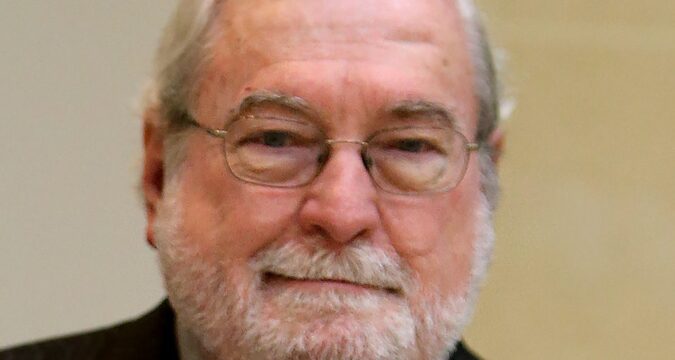
For 35 years, Philip Hablutzel was a professor at Chicago-Kent College of Law, where he specialized in teaching difficult subjects like business law, financial securities law and international finance.
Philip Hablutzel. (Antonio Perez/Chicago Tribune)
“Phil arrived at Kent with a group of powerful intellects who really transformed that school from a local night school to a nationally recognized institution,” said Chicago-based freelance sports journalist and lawyer Lester Munson, a friend and law school classmate.
“He quickly established himself as the school’s top professor in courses involving business, international finance, financial services, securities and commercial law,” Munson said. “He also was instrumental in developing a curriculum on the laws governing not-for-profit organizations.”
Hablutzel, 90, died of complications from progressive supranuclear palsy on Jan. 6 at Duke University Hospital in Durham, North Carolina, said his wife of 45 years, Nancy.
He had lived in Durham since 2016 and prior to that had lived in Streeterville and Hyde Park.
Born in 1935 in Flagstaff, Arizona, Hablutzel was the son of a physicist father who relocated his family from Flagstaff to Albuquerque, New Mexico, when Hablutzel was 7 years old.
Hablutzel then lived with his family in San Jose, California, for a year before moving to Shreveport, Louisiana, where he attended Bird High School for one year before transferring to the now-shuttered Kemper Military School in Missouri.
Eyeing a career as a physicist, Hablutzel earned a bachelor’s degree in physics from Louisiana State University in 1956. By the end of his undergraduate studies, however, Hablutzel found himself drawn to philosophy, and he headed overseas to study both philosophy and law at the University of Heidelberg in Germany. Upon his return, he earned a master’s degree in political science from the University of Chicago in 1961.
Hablutzel encountered a legal issue while researching his master’s thesis — which was about Greek military leader and philosopher Xenophon — and his thesis adviser suggested that he attend law school, Nancy Hablutzel said. Hablutzel enrolled at the U. of C.’s law school, getting a degree in 1967.
Classmates included future U.S. Attorney General John Ashcroft, future New Zealand prime minister Geoffrey Palmer and future American Bar Association President Roberta Ramo.
After law school, Hablutzel worked for four years for the Chicago-based American Bar Foundation, where he was a deputy project director and wrote a book, “Model Residential Landlord-Tenant Code,” which eventually was adopted by 21 states and some cities.
In 1971, Chicago-Kent hired Hablutzel to be a law professor, just two years after the law school had merged with the Illinois Institute of Technology.
Hablutzel also served as the founding president of the Chicago School of Professional Psychology, a role he held from the school’s 1979 opening until 1983. He also served as its attorney prior to its opening and oversaw seven accreditation processes for the school.
At Chicago-Kent, Hablutzel soon gained a reputation for teaching some of the law school’s toughest courses, including banking law, international capital markets, international commercial arbitration, money laundering, securities regulation and business torts.
Hablutzel was an expert on international finance and on nonprofit law, and he integrated those interests into Chicago-Kent’s offerings, both in founding a graduate program in financial services law — a program that he led as its director from 1985 until 1996 — and serving as the faculty sponsor for an annual conference on nonprofit groups.
“He was a major, major contributor to the law school’s development,” said Martin H. Malin, a retired Chicago-Kent law professor. “He led the law school’s master’s program in financial services law, and his area was corporations and finance and the like, but he also developed a course in Roman law, which was pretty amazing.”
Munson recalled Hablutzel as a “sought-after presenter” at continuing legal education seminars on corporate and commercial law, particularly because of how accessible he made subjects to his audience.
“He avoided the abstruse abstractions that so many law professors wallowed in and produced a perfect mix of theory and background, interpretation of black-letter language and practical suggestions,” Munson said.
Munson said Hablutzel took his work seriously, and cast his gaze at worlds far beyond the law.
“At a time when professors would show up in hoodies and jeans and sneakers, Phil was the consummate professional — always a tie, frequently three-piece suits,” Munson said. “He was interested in things far beyond what he taught. Keep in mind, we are talking about a guy with college and advanced degrees in physics, philosophy, political science, the classics and the law.”
Hablutzel also worked overseas while at Chicago-Kent as an international exchange professor in China, Germany, Thailand and the UK. And he was awarded a Fulbright research grant in 1992 and spent time teaching in Mainz, Germany, in 1993.
Hablutzel’s knowledge of nonprofit law led him to serve in an of-counsel capacity to his wife’s law firm, helping to advise a number of their clients. He assisted with the Illinois Secretary of State’s advisory subcommittee on nonprofit law, which from 1984 until 1987 rewrote the state’s not-for-profit corporation act.
Hablutzel also “was a master of the language of the law,” Munson said, and he was an expert on for-profit law as well, drafting business statutes and helping to rewrite for-profit business laws.
Beginning in 2006, he was director of the Institute of Illinois Business Law — the successor to the Secretary of State’s corporation acts advisory committee — and he was the institute’s chair from 2016 until 2018.
Starting in 1990, Hablutzel served on a state subcommittee on limited liability companies that led to the creation of the state’s first limited liability companies law in 1992.
Hablutzel wrote or co-authored several books, including a two-volume text on international banking law.
Outside of the legal profession, Hablutzel enjoyed sailing, traveling and photography, and he sold prints of his photographs at the 57th Street Art Fair in Hyde Park.
After moving to North Carolina in 2016, Hablutzel served on the finance committee for the North Carolina Opera, and he took numerous Osher Lifelong Learning Institutes classes with his wife.
In addition to his wife, Hablutzel is survived by a daughter, Margo; a son, Robert; two granddaughters; and a sister, Caroline Anaya.
A celebration of life service was held in North Carolina.
Goldsborough is a freelance reporter.
https://www.chicagotribune.com/2026/02/19/philip-hablutzel-chicago-kent-obituary/


