
While Bradley Akubuiro was in a late-night meeting with Rwanda’s president and the Rev. Jesse Jackson, his phone died.
Akubuiro, then a policy advisor for Jackson’s Rainbow/PUSH Coalition, said they discussed progress made in the African country since the genocide. But, as the 2011 meeting in downtown Chicago dragged on for hours, he couldn’t reach his girlfriend, eventually missing their date.
Noticing that Akubuiro was distraught, Jackson lent him his phone and said “Well, give her a call.” When Akubuiro’s girlfriend didn’t pick up, he dialed his mom instead to give her an update.
“Rev. Jackson snatched the phone from me as soon as she had said hello and — thinking it was my girlfriend still — he said, ‘Please forgive Bradley. This is my fault,’” Akubuiro said. “He gave me back the phone and gave me this big wink and his winning smile that he always has. And he was so sure he’d solved the problem.”
“He was talking to my mother,” Akubuiro laughed.
The civil rights icon and founder of the Kenwood-based Rainbow/PUSH coalition died Tuesday morning at 84, “peacefully” and “surrounded by his family.” Jackson’s health has been in decline for years, and he recently spent weeks in the hospital for progressive supranuclear palsy, a rare neurological disorder.
Tributes from across the city and country poured in Tuesday, from across all walks of life. He was remembered for his commitment to civil rights and “generous” personality. His family, meanwhile, called Jackson in a news release a “servant leader” who championed the oppressed, voiceless and overlooked around the world.
A Baptist minister born in South Carolina, Jackson was a protege of the Rev. Martin Luther King Jr., who participated in the Selma to Montgomery marches. He continued the fight for social justice and civil rights through the coalition, and campaigned twice unsuccessfully for president. He stepped down as the president of Rainbow/PUSH in 2023.
Tribune columnist Steve Daley called him in 1990 a “political force of nature” who is both an “eloquent voice for the dispossessed and a relentless manipulator of events and issues, hopscotching from coal strike to South Africa to statehood for the District of Columbia.”
‘Very personable’
But for Junelle Speller, 51, he was her next-door neighbor on South Constance Avenue in South Shore for about a decade. Her family hosted him for barbecues and he was supportive of her three daughters. He felt like an extension of her family, Speller said.
Speller recalled how Jackson shared stories about the Civil Rights movement and his presidential campaign. She said it was surreal to live next door to someone who made such an impact and felt like Jackson was an extension of her family.
“He was absolutely wonderful,” Speller said. “Very personable, genuine, generous with his time.”
Akubuiro said he’ll remember that his “hero” made the time to care about “small things” — like a missed date — in between all the “big things” he was juggling.
“He cared about me as an individual, and I always found that to be just so moving and a model for what leadership really looks like,” the 36-year-old West Town resident said.
Akubuiro first met Jackson when he was a college student at Northwestern University, protesting in support of Roxana Saberi, a journalist who was jailed in Iran at the time, a cause Jackson also championed. He got a job at the Rainbow/PUSH coalition, where he stayed for about two years, focusing on a campaign to reduce interest rates on federal student loans.
Akubuiro, who now works in corporate communications, spent time with Jackson while he was hospitalized in November. While he did most of the talking because of Jackson’s condition, he shared how much his mentor meant to him and the confidence he instilled in him. Akubuiro thanked him for taking a chance on him when he was just 19.
“America needs his voice right now,” Akubuiro said. “We are losing a leader at a time when it’s unclear who’s going to pick up that mantle.”
Mourners gather at Jackson’s home
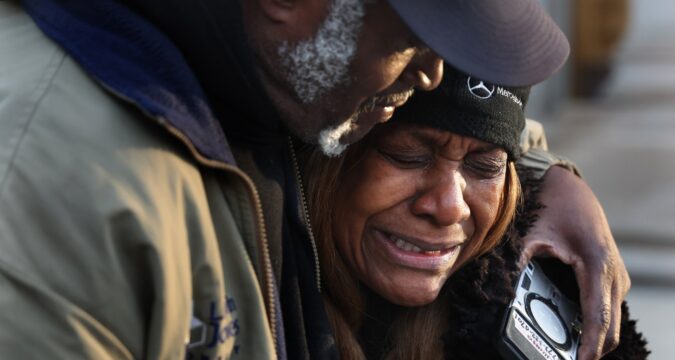
Outside Jackson’s home and the Rainbow/PUSH Coalition office on the South Side, mourners left cards, flowers and balloons. Carolyn Dunbar said she’d been awake since 4 a.m., processing the news of Jackson’s death. The 70-year-old University Park resident drove to the office first thing this morning, carrying flowers she picked up from Jewel-Osco.
“Once I stepped out of the car, something overcame me, like I was at a funeral,” Dunbar said.
Growing up in her mom’s home, there were three portraits hanging in the living room — King, John F. Kennedy, and Jackson, Dunbar said. Her mom was one of Jackson’s “number one fans,” Dunbar said.
“One of the last great leaders of the modern 20th century — gone. For me, it hurts like he was just in my living room, part of my family. He touched so many people,” Dunbar said, adding that it’s fitting that such an important Black figure died during Black History Month.
Dunbar said she helped out with the Southern Christian Leadership Conference’s Operation Breadbasket, a group focused on promoting economic growth for Black people that Jackson briefly led. She said young people need to understand what Jackson and others of her generation went through to push for progress.
She remembers going to a gas station as a child and not being able to use the restroom because she was Black. She had to pee behind a car or a bush.
“Our young people don’t understand what we went through just to get the vote, just to live in decent housing, just to get a decent job, a decent car,” she said. “These young people today don’t realize the shoulders that they aren’t even standing on, they’re kind of turning their backs.”
Harold Hall said he’s known Jackson since the 1960s from “picketing people who didn’t want to treat us the right way in terms of sharing the pie.” Hall said he, Jackson and others worked to keep Kenwood safe during that time.
Hall also remembered Jackson playing basketball in the neighborhood in the late ’60s to try to reach young people. He used to live a few blocks away from the Jackson home.
“I’m so hurt this morning,” Hall said. “This is hard for many of us. He was a trailblazer, and he will be missed.”
Joy Jones, a 66-year-old nurse from Roseland, also came to Jackson’s house to say thank you. Although she didn’t know him personally, she said he impacted the lives of all Americans. She stood in front of the house for a few minutes, looking up at its white walls.
Jones added that she feels confident Jackson would have been a vocal voice against President Donald Trump if he was well enough to do so. She said his activism leaves big shoes to fill.
“But they can still be filled,” Jones said. “Dr. King left big shoes, but Jesse stepped in there. He took his place, and he didn’t go down. Even to the last, he didn’t go down without fighting.”
Jackson was also known for capturing the media’s attention. Darrell Green, the owner of Pearl’s Place in the Grand Boulevard neighborhood, said Jackson loved to shake hands and smile for the cameras after sitting down for a meal in the restaurant. Green said he especially enjoyed Pearl’s fried chicken, collard greens and mac and cheese — which also happened to be a favorite of King.
Green pointed Tuesday morning to a framed black and white picture of Jackson and King side by side. Green said Jackson had personally given him that image.
“We loved him, he was a friend of ours,” Green said.
Pam Morris-Walton, a WVON radio host who has known Jackson for decades, was also working Tuesday morning at Pearl’s. In between showing off images on her phone of her with Jackson, she crafted her broadcast for Sunday.
“We’ve had a great loss,” she wrote. “We have to move on and not forget what he stood for. We got to keep living and be kind.
Freelance reporter Bob Goldsborough contributed reporting.
https://www.chicagotribune.com/2026/02/17/rev-jesse-jackson-remembered/


