The Trump administration on Thursday repealed the scientific determination that underpins federal greenhouse gas regulations, delivering one of the most dramatic reversals of U.S. climate policy.
For months, the administration has signaled its plans to go after the 2009 endangerment finding, the determination by the U.S. Environmental Protection Agency concluding that several greenhouse gases pose a threat to public health and welfare. That finding has since provided the legal basis for most federal emission regulations for vehicles, power plants and other sources under the Clean Air Act.
“The Trump EPA has finalized the single largest act of deregulation in the history of the United States of America,” EPA Administrator Lee Zeldin announced at the White House. “The 2009 Obama EPA endangerment finding led to trillions of dollars in regulations that strangled entire sectors of the United States economy, including the American auto industry.”
The reversal drew an immediate outcry from environmentalists and other critics, who said it comes as climate change intensifies. In the Midwest, this is fueling extreme heat, toxic algal blooms in the Great Lakes and tornadoes across Illinois. The move is widely expected to upend numerous U.S. policies aimed at curbing pollution.
“ This is a really profound and utter rejection of decades of scientific consensus. It shows a willingness to sacrifice the lives of Americans to boost the profits of the oil industry,” said the Sierra Club’s Illinois Chapter Director Jack Darin. “Just like we regulate ozone or particulate matter or lead, we need to be protected from carbon and other greenhouse gases as well.”
The final rule will remove all federal regulations to measure and report federal greenhouse gas emission standards for motor vehicles. It also will repeal all compliance programs, credit provisions and other similar reporting requirements in the vehicle industry.
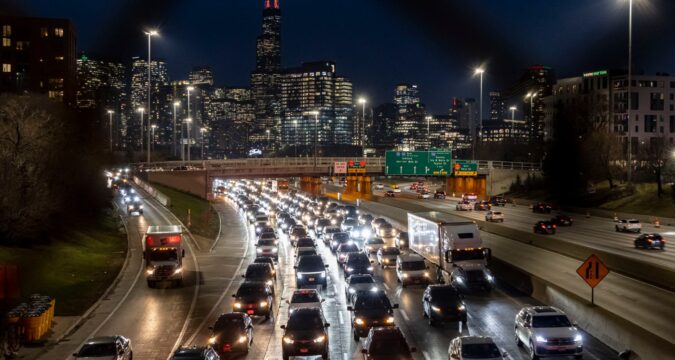
Vehicles crawl along the Eisenhower Expressway as a CTA Blue Line train rolls past during morning rush-hour traffic in Chicago on Feb. 12, 2026. (Antonio Perez/Chicago Tribune)
Zeldin said Thursday that the rule will save more than $1.3 trillion in taxpayer money and reduce costs by up to $2,400 for popular light-duty cars, SUVs and trucks “What that means is lower prices, more choices and an end to heavy-handed climate policies,” he said.
State and local politicians and environmentalists in Illinois were quick to condemn the administration’s action.
“Here in the Midwest, the real-world impacts of climate change are impossible to ignore — extreme heat, derechos and more intense and more damaging storms. By repealing the evidence-based endangerment finding, the Trump EPA is creating uncertainty for businesses and communities, leaving Americans exposed to worse human health threats and rising insurance costs,” said Howard Learner, the CEO and executive director of the Environmental Law and Policy Center.
The EPA decision comes after the Trump administration signed an executive order that directed the agency to submit a report reviewing the legality of the finding.
The 2009 finding concluded that atmospheric concentrations of six key greenhouse gases — carbon dioxide, methane, nitrous oxide, hydrofluorocarbons, perfluorocarbons and sulfur hexafluoride — threaten the public health by driving high temperatures and air quality issues,
Scientists have linked the rise in greenhouse gas emissions to human health issues. A recent report from the National Academies of Sciences, Engineering, and Medicine found that these pollutants commonly contribute to respiratory and cardiovascular diseases, heat-related illnesses, climate-sensitive infectious diseases, and threats to mental health.
“There are a lot of parts of the country that are experiencing high air pollution currently, so rolling back these standards and repealing these long-standing rules is only going to exacerbate that air pollution problem,” said Kristina Hamilton, director of advocacy for the American Lung Association in Illinois.
In the Lung Association’s 2025 annual “State of the Air” report, it found that Chicago and U.S. residents continue to be exposed to high concentrations of ozone and particle pollution. The report ranked the Chicago area as 15th worst in the nation for ozone pollution, with an average of 20.3 unhealthy days each year.
“ We have advocated for the strength of the Clean Air Act and the U.S. EPA for decades, and we will continue to do that and continue to empower communities to contact their elected officials, contact administration officials to voice their ongoing concerns to reverse the harms of this recent reversal,” Hamilton said.
Environmental advocates say the onus must fall on local governments to strengthen and protect climate policies if the federal government fails to act.
Coal moves on barges through Starved Rock Lock and Dam down the Illinois River, Nov. 3, 2021. (Brian Cassella/Chicago Tribune)
“ We’ll need Illinois to do more as the U.S. EPA does less in terms of new limits on pollution and the power to enforce them,” the Sierra Club’s Darin said.
In Illinois, the Climate and Equitable Jobs Act has already set binding goals to phase out carbon emissions from power generation by 2045, while expanding EV rebates and clean transit.
The Clean and Reliable Grid Affordability Act, signed into law last month, also advances renewable energy and battery storage growth — further supporting the state’s emission-reduction goals.
Related Articles
Trump EPA moves to eliminate landmark scientific rule that’s the basis for climate regulations
Illinois could be only 5 years away from electricity shortages and higher bills, report says
Environmentalists push back against US EPA plan to extend coal plant closings
Environmental groups say they will challenge the rollbacks, first in the U.S. Court of Appeals for the D.C. Circuit.
“Once the D.C. circuit has had its say, then the next step would be the Supreme Court. I think everyone expects that that’s ultimately where the final disputes will be had,” said Brian Lynk, a senior attorney with the law and policy center.
The original EPA finding stemmed from the 2007 landmark Supreme Court case Massachusetts v. EPA, which enabled the agency to regulate greenhouse gases as air pollutants under the Clean Air Act.
By 2022, the EPA had denied 14 petitions for reconsideration of the endangerment finding, submitted between 2009 and 2019. The Court of Appeals previously upheld the scientific determination in favor of the EPA in 2012.
“ You can imagine, there won’t just be one petition for review for judicial review of this. There will likely be many,” said Lynk, who also served at the Environmental Defense Section of the U.S. Department of Justice.
The final rule from Thursday marks a significant victory for the fossil fuel industry, which has long pushed for rolling back climate regulations. Since returning to office, the Trump administration has commonly framed the growing reliance on fossil fuels as essential to economic growth in the country.
What to know about EPA decision to revoke a scientific finding that helped fight climate change
In just a year, the administration has also loosened air and vehicle emissions standards, narrowed Clean Water Act protections for streams and wetlands and cut enforcement and environmental justice programs.
“Science has proven — over and over again — that the climate crisis is real. And because our nation followed the science, we put in place critical rules and regulations that ensured that chemical pollutants did not clog our air,” U.S. Sen. Dick Durbin told the Tribune in a statement. “More than a decade later, it’s a dark day in Washington as President Trump shreds the very principle that EPA relies on to protect Americans’ health and the environment from climate pollution.”
U.S. Rep. Mike Quigley, who serves as the co-chair of the House Sustainable Energy & Environment Coalition, shared those sentiments in a statement: “I’ve said it before: Donald Trump is allergic to science. Now he’s ignoring settled climate science and abandoning the government’s responsibility to protect Americans.”
Jerry Wu is a freelancer.
https://www.chicagotribune.com/2026/02/12/epa-endangerment-finding-climate-change/


