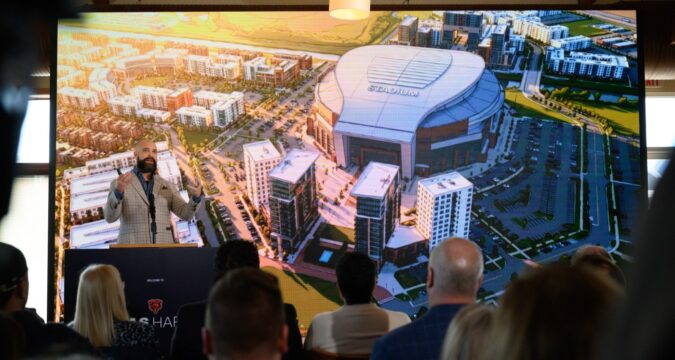
Not to be outdone by competitors in Arlington Heights, Hammond, Gary and even Iowa, Portage officials made their pitch Wednesday to lure the Chicago Bears away from Soldier Field with a $5 billion stadium.
“We’re prepared to give them everything they want with no taxpayer dollars,” Portage Economic Development Corp. Executive Director Andy Maletta said.
Financier Lou Weisbach, who has stadium-building experience, is in Portage’s playbook.
“We offered it in a way that has never been done before,” he said.
WeCreate Media CEO Wade Breitzke helped quarterback Wednesday’s news conference at Marina Shores on the city’s north side, within sight of the site where the stadium would be built. The city is calling the proposed site Halas Harbor.
Shovels could be in the ground as soon as June 2026, he said. “When you’re ready to act, there’s nothing standing in the way.”
Visitors gather around a rendering of a proposed stadium and development area during a news conference concerning a plan to attract the Chicago Bears to Portage on Wednesday, Feb. 11, 2026. (Kyle Telechan/for the Post-Tribune)
June is extremely optimistic, considering the construction drawings for a new stadium haven’t been drafted, but the hyperbole fit the optimistic mood at Wednesday’s news conference.
“This stadium is not about fitting into an existing footprint,” Breitzke said. The city’s Redevelopment Commission owns hundreds of acres where the stadium could be built.
“When that snow melts, you’d better get your shovels out, because we’ll be ready,” Breitzke said.
He spun a tale of walkable retail and dining options, condominium buildings connected to the stadium by tunnel, and a stadium “designed and ready to host the Super Bowl.”
The site is 45 minutes by highway, with both Indiana Toll Road and Interstate 90/94 exits nearby, he said. By South Shore Line trains, it’s a 55-minute ride from downtown Chicago, or 85 minutes by boat, he said,
“You’ve heard of tailgating, but have you heard of sail-gating,” Breitzke said.
Specifics are still fuzzy; Portage is selling a concept rather than a fully designed stadium. It would be at least 70,000 seats, which is a Bears requirement.
“This is rent-free to the Chicago Bears,” Breitzke said.
While the city’s Redevelopment Commission owns the land now, the future ownership would be determined after the Bears pick the site as their final choice, Mayor Austin Bonta. Right now, Portage officials are still salivating over the prospect, not nailing down all those details. “We are open to negotiating everything that would be the best deal for the Bears,” he said.
Portage Mayor Austin Bonta speaks during a news conference concerning the proposed Chicago Bears stadium and development in the city on Wednesday, Feb. 11, 2026. (Kyle Telechan/for the Post-Tribune)
Related Articles
Portage proposes Chicago Bears stadium on city land
Gov. JB Pritzker talked Bears with NFL commissioner, says progress is being made to keep team in Illinois
Long-beleaguered Gary is serious about the Bears. Are the Bears serious about Gary?
Indiana unions: Chicago Bears stadium bill cuts us out
Chicago Bears stadium bill passes Indiana Senate, but changes likely
“We have the land, we have the water, we have the location, we have the financing,” Bonta said.
“We feel we’ve got as good a chance as anybody,” Maletta said, though when the Bears initially chose Arlington Heights, Portage officials hit the snooze bar for dreams of bringing the Bears to Portage.
“The Bears are definitely aware” of the Portage proposal, Bonta said, but didn’t have an obvious presence at the news conference Wednesday.
He didn’t know whether Portage was a stop on the tour when NFL Commissioner Roger Goodell was in Chicago for the Bears-Packers playoff game Jan. 10. Before the game, Goodell joined Bears President and CEO Kevin Warren and Chair George McCaskey on a tour of the Arlington Heights site the team already owns and sites in Northwest Indiana, including one near Wolf Lake in Hammond.
Portage began working on the stadium pitch Dec. 17, Bonta said.
Maletta wouldn’t give a figure on how much the pitch cost. “It wasn’t cheap, I can tell you that.”
From the beginning, Bonta said, Portage’s pitch wasn’t going to depend on the Indiana General Assembly passing any law favorable to attracting the stadium.
“We absolutely appreciate the state of Indiana is as gung-ho about it as we are,” he said.
Weisbach said his team has filed patents on the securitization plan to finance the stadium. “It’s really the financing plan of the future,” he said.
The plan would give the Bears full revenue opportunities, Weisbach said.
Like Soldier Field, the proposed stadium would be used for more than a handful of Bears games over the course of a year. Concerts and other big events would be held there as well.
Before making the pitch for the stadium, the Redevelopment Commission was working on connectivity in the area, including a bridge over Burns Waterway. Burns Parkway would be extended to facilitate development there.
“The Bears give us the opportunity to have the development and the connectivity happen simultaneously,” Bonta said.
An area of woods that would be part of a proposed development to attract the Chicago Bears to Portage can be seen beyond the docks at Marina Shores on Wednesday, Feb. 11, 2026. (Kyle Telechan/for the Post-Tribune)
He considers Portage a part of Chicagoland and solid Bears country. The Indianapolis Colts are far more distant than the Bears. During Bears/Packers games, “It’s a violation of city ordinance to wear Packers hats,” he quipped.
The prospect of 70,000 people visiting Portage excites Bonta. But Chicagoans are already familiar with Portage, flocking to the Indiana Dunes National Park beaches in the city.
“West Beach is a very, very attended beach,” and Portage Lakefront Park is the most-visited beach in the national park, he said.
“Every summer, our beaches get full of people coming from Chicago,” Bonta said. West Beach’s parking lots often fill up on hot summer days.
“There’s a strong muscle memory to get to the region,” Bonta said.
The area where the stadium would be built is already zoned for residential and commercial use. The proximity to the South Shore Line station puts a transit development district – especially a tax increment financing district on steroids – where the stadium would go.
Almost all of Portage’s residents live south of Interstate 94. North of there is primarily industrial and commercial. The proposed location is along the Burns Waterway, where U.S. Steel’s Midwest plant in Portage spilled 300 pounds of hexavalent chromium in 2017.
The undeveloped land, part of which was planned for a SportResort that never got off the ground, is close to the national park and the South Shore Line station, making it a prime location for an inn serving the national park as well as residential and commercial developments.
“It really is a new city, something that can be based around the train,” Bonta said. “It really is a distinct part of our city,” Bonta said.
Hammond’s pitch for the stadium includes noting that George Halas’ first professional football team was in Hammond. Gary has sites that would work, too.
The Des Moines Register reported Tuesday on a state Senate bill unveiled that day that would expand one of Iowa’s biggest economic programs to bait the Bears, providing financial incentives for a National Football League team to build a stadium in Iowa.
Indiana Gov. Mike Braun “is determined to get the Bears here” in Indiana, Bonta said.
Illinois legislators are working on legislation that would make it easier for the bears to negotiate with local governments over property taxes, sources told the Chicago Tribune.
The Indiana legislation would require an NFL team to enter into a lease of at least 35 years for a new stadium. At the end of the lease, the team would have the option to purchase the stadium for $1 if certain conditions are met.
The Bears said the Indiana legislation is “a significant milestone in our discussions around a potential stadium development in Chicagoland’s Northwest Indiana region.”
“We’re not naïve. We know they ideally would like to stay in Illinois,” Maletta said.
But Indiana has its attractions, including a business-friendly tax climate. Then there’s the location. “We are part of Chicagoland. We always have been,” he said.
Portage Mayor Austin Bonta speaks to financier Lou Weisbach during a news conference concerning the proposed Chicago Bears stadium and development in the city on Wednesday, Feb. 11, 2026. (Kyle Telechan/for the Post-Tribune)
The fight isn’t over in Illinois.
As competition for a new Chicago Bears stadium intensifies, suburban fans and leaders planned to rally Wednesday night to bring the team to Arlington Heights — with a new urgency to fight off a bid from Indiana.
The Indiana Senate recently passed a bill to create a northwest Indiana sports stadium authority to finance, build, and lease an arena.
Rolling Meadows Mayor Lara Sanoica, who supports bringing the Bears to neighboring Arlington Heights, issued a statement that the proposed Indiana law would be a bad deal for workers.
“Indiana’s sales pitch is that you can build a world-class stadium by shortchanging the workers who build it,” Sanoica said. “Illinois doesn’t work that way. We know our families deserve better than a race to the bottom.”
The Indiana bill prohibits project labor agreements on the stadium project. Such agreements, Sanoica said, ensure that construction workers receive union-scale wages, retirement benefits and apprenticeships. The Indiana Senate also eliminated participation goals for minority-owned and women-owned businesses.
In contrast, the Illinois Mega Projects Bill that the Bears want requires a project labor agreement and a goal of awarding 20% of contracts to minority-owned businesses.
The Mega Projects bill would allow the Bears, or any other sponsor of a major development, to negotiate long-term property taxes with local taxing bodies.
It wouldn’t cost the state a dime. The Bears propose paying for their own $2 billion enclosed stadium. But team officials want the state to help pay for an estimated $855 million in infrastructure costs for things like new roads, rail access and water mains.
Arlington Heights Mayor Jim Tinaglia said he thinks Illinois lawmakers are making progress to counter Indiana’s offer.
“This is no longer Arlington Heights versus Chicago,” he said. “This is about doing what we need to keep the Bears here in Illinois.”
Chicago Tribune reporter Bob McCoppin contributed.
Doug Ross is a freelance reporter for the Post-Tribune.
https://www.chicagotribune.com/2026/02/11/portage-makes-pitch-to-host-bears/


