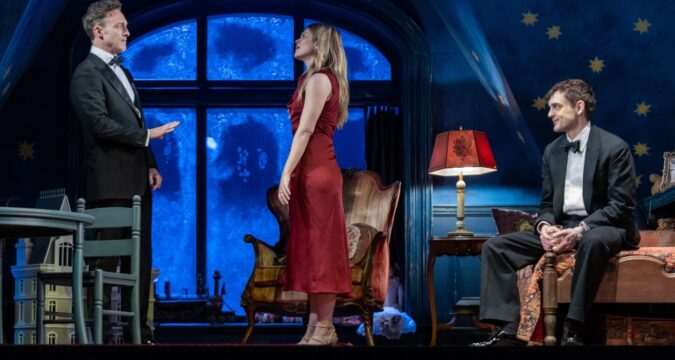
For fans of the late Richard Greenberg, his final work, “Holiday,” is an unfettered Goodman Theatre delight, a painful but not-to-be-missed reminder that nobody, but nobody, in the American theater better understood the ennui of the adult children of the American urban rich or had a firmer grasp on the existential paradox of their condition. Other playwrights usually want to take them down, especially if that is whence they came. Greenberg didn’t just understand them; he offered them tenderness.
“What is more privileged than being sad about being privileged?” observes the truth-teller of this particular Fifth Avenue family, inured by alcohol as one of his siblings finds that teaching kids in Red Hook, Brooklyn, has provided no actual escape from her destiny, a destiny as pre-determined as if she were Antigone.
Such wry observations, often accompanied by a disarmingly sudden sadness, pepper this likely Broadway-bound premiere of Greenberg’s adaptation of Philip Barry’s 1928 romantic comedy “Holiday.” It’s an updating of the caper-ish, star-friendly plot about a self-made guy from nowhere, Johnny Case, who falls in love with a young woman, Julia Seton, without knowing her identity — only to show up at her place and find himself as the disrupter of a patriarchally broken family that masks its fundamental fragility with wit, sure, but also toxic, pecunious dominance.
“Holiday” is on the marquee, Robert Falls is back in the director’s chair, praise the theater gods, and the erudite Barry legacy of swank society comedies, much loved in Hollywood in the mid-20th century, certainly underpins the show’s themes. But this is really a whole new play, set very much in the here and now and remarkably comfortable there.
Johnny (Luigi Sottile) and Julia (Molly Griggs) met in a resort where they had been stripped of their phones and biographies (and apparently did not Google each other when they got home). Julia’s sister Linda (Bryce Gangel) is a sardonic single woman, disdainful of Julia’s nascent, daddy-funded entrepreneurship. Brother Ned (Wesley Taylor, in one stunner of a performance) is the booze-soaked seer of this struggling crew, the wise Tiresias observing the Creon-like dominance of Edward (Jordan Lage) over his now motherless children, threatening to sign the “giving pledge” whenever he disagrees with their adult choices.
There are various Fifth Avenue hangers-on, some self-aware (Jessie Fisher’s Susan and Christiana Clark’s Nikka) and some not (Erik Hellman’s Seton and Alejandra Escalante’s Laura), as well as Rammel Chan’s Walter, the family’s hopeful personal chef, serves as a reminder of how the intimacy and opportunity offered by the seemingly liberal elite often is merely illusory. But if the original Barry play was most interested in Johnny, Greenberg’s main attention falls on the three Seton siblings, bereft of a loving mother, desperately trying to find their way in a world where everyone accuses them of having their collective thumb on the scale.
“Some survive and some succumb,” Walter observes, pretty much summing up life in the few similar families I know, and who would likely flock to such a “White Lotus”-like play on Broadway that mines them for schadenfreude, for sure, but that also knows them. And we all like to be known.
“Holiday” is very funny. The play is stacked with laugh lines and Greenberg’s deliciously writerly digressions. “Do you know the real meaning of ‘enormity’ is monstrous wickedness?” someone observes at one point, apropos of nothing other than the writer’s intellectual curiosity, tickling me pink nonetheless.
Falls’ production is very shrewdly cast with New York and Chicago-based actors and plays out on an expansive, Falls-ian set from Walt Spangler, a clever design that focuses on how this class of Americans often tries to buy a happy childhood for their troubled kids, only to find that utterly elusive. Aside from Taylor, who feels essential to any future for this play, the other very notable performance comes from Griggs, in something of a thankless role. She nails her character to the wall without resorting to any pleas for sympathy, however much it is deserved.
The show is about a love triangle and yet I did not believe that Griggs, Gangel and Sottile, all impressively au fait with the play’s verbosity, had any sexual attraction to each other. Indeed, sex is the one crucial, overall element missing so far in a production that needs more of a relationship with desire — a classless if complex preoccupation of one’s late 20s and early 30s. And there are moments here where the necessary updating strains credulity a bit; we have to believe, for example, that Edward, a child of the 1980s, sees Red Hook as some kind of slum, when any New Yorker from that era would know their way around the hipster map. In that same vein, you have to buy a plot that relies heavily on characters lacking information about each other at a moment when, well, we lack information for about a nanosecond, especially when the stakes of love or money are high. Some of that could use massaging, especially in a second act that is somewhat less secure.
‘Holiday’ comes to the Goodman, directed by Robert Falls and no longer a zany comedy
But in the end, the play is just too beautifully and wisely written, and Falls’ production is just too much fun, for any of that to be particularly bothersome. Intermission comes as an irritation, not a relief.
One last thing. I’m not privy to how much Greenberg did or did not know about his health when he was writing this piece but his many fans will detect a note of intense melancholy in the writing, especially that penned for brother Ned. Such notes hardly are new for Greenberg, of course, but this time they arrive with a jolting immediacy, such as when Ned describes cancer as “the emperor of all maladies,” a line demonstrably capable of shocking a theater into silence, before Ned shakes off the death of his mother once again, returns to his roles of observer and surrogate father to his lost sisters and pours himself another drink.
Chris Jones is a Tribune critic.
cjones5@chicagotribune.com
Review: “Holiday” (4 stars)
When: Through March 1
Where: Goodman Theatre, 170 N. Dearborn St.
Running time: 2 hours, 20 minutes
Tickets: $34-$104 at 312-443-3800 and goodmantheatre.org
https://www.chicagotribune.com/2026/02/10/review-holiday-goodman-theatre/


