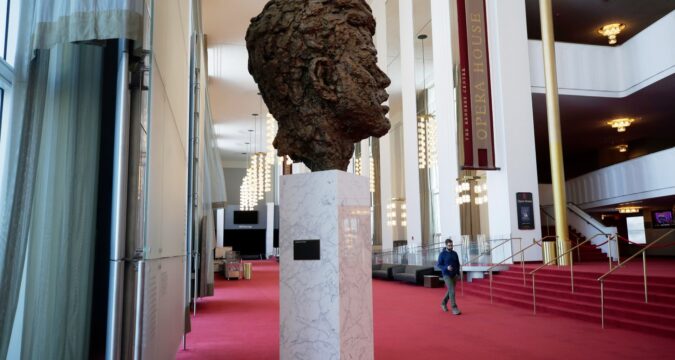
Chicagoans might reasonably ask why turmoil at the Kennedy Center in Washington should concern us. After all, we have our own great institutions: Lyric Opera, the symphony, world-class museums and neighborhood theaters that punch far above their weight.
But what is happening to the Kennedy Center is not a parochial arts dispute. It is a warning about how quickly cultural stewardship can be dismantled — and how much a city, and a country, loses when that happens.
For more than 40 years, I lived in the Washington area. The Kennedy Center was not an occasional treat; it was part of civic life. My husband and I attended regularly, donated consistently and watched the institution go through multiple renovations. Those changes felt like care: investment in continuity, not reinvention for its own sake.
What appears to be unfolding now feels very different. It looks less like evolution than hollowing-out — a rapid stripping of institutional identity and seriousness, justified as “change.” When cultural memory is treated as disposable, the damage is not just aesthetic, it is civic.
We often talk about infrastructure as something concrete: roads, bridges and transit lines. Cultural institutions are infrastructure of a different kind. They train people to sit still, to listen, to tolerate ambiguity, and to encounter ideas and emotions that don’t fit neatly into slogans or talking points. Those habits matter, especially in a democracy that increasingly rewards speed, outrage and simplification.
A strong cultural institution creates a shared space where strangers practice attention together. You don’t have to agree with the work onstage, but you do have to stay in the room with it. That discipline — of listening before reacting — is precisely what public life is losing.
When an institution like the Kennedy Center is destabilized, the consequences ripple outward. Donors get skittish during times of uncertainty. Artists plan careers around stability, not volatility. Young audiences never form the habit of attendance when the place they might have grown into becomes a battleground or a shell.
This matters to Chicago because no institution is immune. If a national cultural center can be gutted abruptly, regional flagships should take note. The lesson audiences absorb is blunt: Serious art is optional, and the people who care about it are expendable. That lesson undermines every company trying to build trust, loyalty and long-term engagement.
There is also the quieter loss that rarely makes headlines: grief. Cultural institutions hold decades of personal memory. We mark anniversaries there. We take visiting friends there. We learn, over time, how to listen. When such a place is hollowed out, the loss lands like a death — sudden, disorienting and strangely private, because grief for culture is often dismissed as indulgent.
Chicago understands this better than most cities. We know what it means to fight for institutions that anchor civic identity. We also know how fragile they can be without vigilant stewardship. The question is not whether arts organizations should change — they must — but whether change is guided by care, continuity and public trust, or by political expediency and contempt.
Calling this moment “just a programming dispute” misses the point. What is at stake is whether cultural memory is treated as a shared inheritance or as a disposable asset. Once continuity is broken, it is painfully hard to rebuild. Donor confidence evaporates. Talent looks elsewhere. Audiences drift.
The Kennedy Center was meant to symbolize a national commitment to serious culture in public life. If that commitment can be dismantled so casually, the responsibility on cities like Chicago grows. We must defend our institutions not as luxuries, but as civic necessities.
A city — and a country — that cannot protect its cultural anchors chooses a thinner public life. That is not renovation. It is demolition.
Helmut Paul is the founder The Vanguard Initiative for the Arts and Enterprise, which supports artists and organizations working at the intersection of culture and civic life.
Submit a letter, of no more than 400 words, to the editor here or email letters@chicagotribune.com.
https://www.chicagotribune.com/2026/02/10/opinion-kennedy-center-closing-impact-chiacgo-arts/


