If someone has never attended a symphony orchestra concert before, this is the weekend to give it a try.
At a glance, the Chicago Symphony’s weekend program, led by Esa-Pekka Salonen, hardly seems representative of the art form. It juxtaposes the music of just two composers: one alive, the other a long-gone titan of the repertoire. But few programs have better embodied classical music’s questing spirit — that, despite the “classical” tag, this art form has always searched for new sounds and the means to realize them.
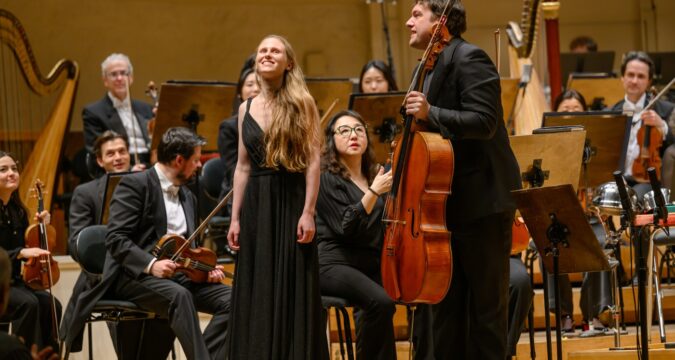
Representing the newer side of things was composer Gabriella Smith, still in her 30s but already championed by Salonen and prestigious groups like the Los Angeles Philharmonic and Kronos Quartet. Her “Lost Coast,” written for cellist (and North Shore native) Gabriel Cabezas, was inspired by a hike on the California trail of the same name, north of where she grew up in the San Francisco Bay Area. The work’s title has taken on a double meaning as Smith uses her musical pulpit to speak uncompromisingly about climate change, as she did during Thursday’s concert.
Like much of Smith’s work, “Lost Coast” is a dance between specificity and freedom. The score often instructs musicians to choose their own adventure within particular sections. One direction, at the top of the second movement: “Can use a pencil instead of a bow if preferred.” Another: “I like to hold the violin like a guitar here … but feel free to use whatever method you prefer.” Still another asks musicians to sound like Morse code, so long as their dispatch differs from their neighbor’s.
Smith’s directions might be genial, but on Thursday, “Lost Coast” was every bit as incisive as her pre-performance address. Cabezas is amplified throughout, as is a percussion station of household objects in the third movement, manned by the CSO’s Cynthia Yeh. The solo part is rarely conventionally virtuosic: Smith writes lots of fuzzed-out harmonics and slow, excruciating slides between notes, like the music is melting off the page. But the combination of the score’s emotional rawness, the CSO’s focus and Cabezas’s own deeply embodied advocacy gave the music an avant-rock thrill.
The music seemed to have lodged itself just as deeply in Salonen, who conducted with a balm-like sense of ease and authority. Salonen himself was recently tied to the Bay Area through his leadership of the San Francisco Symphony, a relationship that imploded last season.
Not only has the Finnish conductor and composer plainly taken some of the city with him on the road, via “Lost Coast” and other Bay Area-related works, but he’s more than landed on his feet. The past year has seen him accrue various curational roles at his former Los Angeles Philharmonic, the Philharmonie de Paris, and, as of last week, the Tanglewood Festival of Contemporary Music.
“Lost Coast” was placed in the middle of two pieces by the 20th century French modernist-slash-impressionist Claude Debussy: his piquant “Images” suite and tone poem “La mer.” Like Klaus Mäkelä’s smart Beethoven program in December, the arrangement and presentation of the works rejected lazy programming conventions placing the newest work at the front or rear of the concert. Instead, Salonen presented the three works as being in fluid conversation.
You could hear it, too. “Images” also has the violins and violas strum their instruments like a guitar, and a horn chorale near the end of “Lost Coast” sounds, for all the world, like it was plucked out of “La mer.”
Conductor Esa-Pekka Salonen leads the Chicago Symphony Orchestra in its first performance of Smith’s “Lost Coast” with cellist Gabriel Cabezas. (Amy Aiello)
Salonen’s sleek “La mer” and “Images” sometimes called back to the prior week, when he led the music of a very different composer: Anton Bruckner. Itself not unlike a rugged coast, Bruckner’s Symphony No. 4 — here in an edition by Leopold Nowak — is often approached as something to be tamed, given its length and awkward transitions.
But even in vastly different repertoire, one could identify common denominators in Salonen’s approach. Perhaps both Debussys never dissolved into a full dream-state, floating outside of time as the composer’s music so readily can. But they did take on an uncommon lyricism and linearity, as though the string corps were made up of singers rather than instruments — singers who, of course, need to breathe.
That forward focus likewise gave the Bruckner shape, clarity and even elegance, even if the CSO’s playing could be somewhat rough around the edges at ground level. The symphony grows from its opening bars — a horn solo — but on Jan. 29 it mostly transcended that opening rather than emerged from it, with a staid opening line by principal horn Mark Almond.
Pianist Daniil Trifonov joined the CSO for that program, playing Beethoven’s Piano Concerto No. 2. After recent appearances in bigger-boned repertoire, Trifonov’s appearance was a musical and attitudinal pivot. This was not the brooding Trifonov but a boyishly delighted one, as though he was rediscovering Beethoven’s ingenuity in real time.
His left hand supplied much of the interpretation’s energy and emotion throughout—sometimes romping, sometimes tolling, something cushioning, as though wrapping the melody line in cotton padding. Later, in the cadenza — Beethoven’s own, clustering atop itself in a boisterous fugue — it quieted so much it sounded like a response from backstage.
Last week’s performance also called attention to Trifonov’s (seriously underrated) sense of humor, which is not at all at odds with his interpretive eloquence. In the first upper-register echo of the theme, his body curled inward as though entreating the sound to shrink along with him — and it did. The same thing happened in the rondo finale: After much earthy exuberance, Trifonov brought the whole thing to a cheeky, tiptoeing close.
Speaking of surprises, Trifonov offered up one with his encore: former CSO composer-in-residence Osvaldo Golijov’s “Levante,” a solo piano riff on a movement from the composer’s “Pasión según San Marcos.” In truth, “Levante” wasn’t all that left-field for Trifonov: The pianist announced over the holidays that his Christmas gift was a new piece by Golijov — likewise derived from the “St. Mark Passion” — which he will record shortly in São Paolo.
After that, in October, Deutsche Grammophon releases Trifonov’s album “My American Story: South,” focusing on Latin American music and inspired by travels with his wife, Dominican pianist Judith Ramirez.
Either way, it was a tantalizing glimpse of a new chapter for the pianist. At times, Trifonov seemed to test the outer limits of the work’s polyrhythms — more musical cheek, if sometimes muddling its tango groove. The grinning CSO corps behind him seemed just as bemused by the bonbon. This art form may be old, but newness is everywhere you look.
Hannah Edgar is a freelance critic.
“Salonen Conducts La mer” repeats 1:30 p.m. Friday and 7:30 p.m. Saturday at Symphony Center, 220 S. Michigan Ave.; tickets $39-$299 at 312-294-3000 and cso.org
https://www.chicagotribune.com/2026/02/06/review-cso-salonen/


