Connie Martin always knew who her ancestors were growing up.
“There was a big picture of (her great-grandmother) in grandma Lizzie’s bedroom. … She’s the first born enslaved person in our family. Her name is Delcy, which was Lizzie’s mother, and there’s a big, huge, 20-by-20-by 26 picture of her on the wall in black and white, with her piercing eyes that used to scare us to death when we were little girls.”
But it was not until the Aurora resident was in her 30s with children of her own that she learned the secret language her ancestors communicated in during the Antebellum period in the 1850s.
It was a language few knew about because it could result in death, she said. Those who did know it used it sparingly. It was a visual language — one that relied on messages relayed through the symbols sewn into quilts for communication. A language that could be displayed outside and help other enslaved people (or “freedom seekers,” as she calls them) find their way to emancipation.
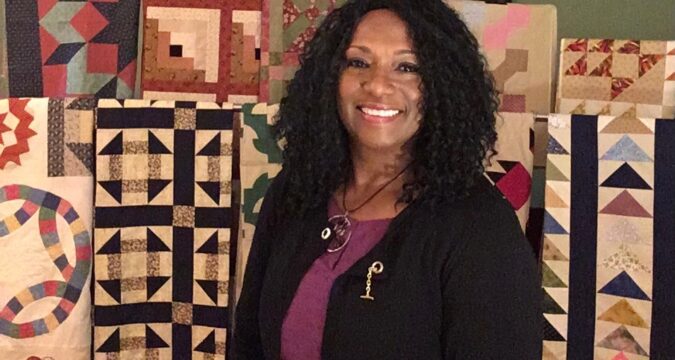
Aurora resident Connie Martin, an Illinois Humanities’ Road Scholar lecturer, stands in front of the dozen replica quilts her mother made that were part of her presentation in Batavia last month. Martin’s talk draws heavily on her own family history. (David Sharos/For The Beacon-News)
Since 2016, Martin, an Illinois Humanities Road Scholar, has been sharing the story of how her ancestors and abolitionists used quilts to direct freedom seekers to routes through the Underground Railroad.
On Wednesday, Feb. 11, Martin will give a presentation on the quilts and her family’s story at Naper Settlement in Naperville. Last year, Martin’s presentation at the Settlement was “Hidden Messages and Negro Spirituals on the Underground Railroad,” a lecture on how music helped people escape slavery, which was also based on her family stories.
“When (Martin) came to our site, it was super engaging, super interesting,” said Jessica Toran, director of education for Naper Settlement. “After she had spoken about the fact that she also does another presentation with Civil War quilts, we had so many guests that came up to us after and begged us to have her come back again.”
The talk at Naper Settlement is one of many Martin will be giving for Black History Month.
“My February calendar is completely booked,” Martin said. “I only have three days that I don’t have a presentation in the whole month. … And March is halfway booked because people book me for Women’s History Month.”
Before Martin started giving talks on her family history, her mother Clarice Boswell did the same for nearly 16 years. Her mother also wrote a book on how her family survived slavery called, “Lizzie’s Story: A Slave Family’s Journey to Freedom.”
For the quilt lecture, Martin uses a combination of stories passed down to her grandmother Lizzie and information found in an old family Bible.
“My mother was a fifth-generation descendant so we never needed ancestry.com,” Martin said. “We can go all the way back until we can’t go back anymore, which is really a rare thing for African-Americans in this country. There’s not that many African-Americans who can do what we can do — go all the way back like that.”
Her great-great-grandparents, Eli and Leah, were brought to the U.S. and forced into slavery in the 1850s. They worked on a plantation in Kentucky, where an enslaved blacksmith and midwife would help them not only acclimate to the life of slavery, but also help other enslaved people on the plantation get to freedom.
The blacksmith and midwife also taught Eli and Leah the quilt codes. Each quilt would have a distinctive pattern or image that would provide crucial guidance for freedom seekers, such as directions to safe houses or where to find food and water.
“There could be a quilt code that can tell you to watch for bear paw tracks in the wet banks in the spring, that will lead you to springs and water to get food to eat,” Martin said.
People who were fleeing slavery knew where to look for the quilts, but slaveholders never learned about them and the secret codes. Abolitionists were strategic with how they used and placed quilts on the plantation, Martin said. For example, they would never be hung on a clothesline by themselves, but rather mixed in with other laundry so they did not look out of place.
The codes were so secretive that not all enslaved people knew about them. Only those who decided to seek freedom would be given the information by the abolitionists.
Martin has given her presentation to countless audiences, including programs at schools, churches, park district and twice for the American Medical Association.
“People are curious about African-American history, which is American history,” Martin said. “People are curious and want to know about how freedom seekers, in many ways, fought for freedom.”
She hopes her talks not only teach people more about Black history, but spark an interest in their own family history.
“That’s my main happiness is to have people take a closer look at their family connections and what they could find out while people in their family are still alive,” Martin said.
cstein@chicagotribune.com
https://www.chicagotribune.com/2026/02/05/martin-quilts-slaves-messages-settlement-naperville/


