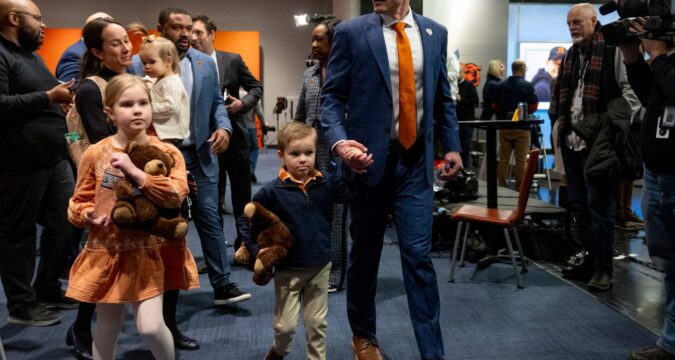
Ben Johnson walked past George Halas’ fedora, sitting inside a glass case in the main entryway at Halas Hall in Lake Forest.
It was Jan. 21, 2025, and it was Johnson’s first day as head coach of the Chicago Bears. Circling the entryway stood a ring of Bears employees who broke into applause as Johnson strode to the center of the room. The Lombardi Trophy from Super Bowl XX sat in a case in front of Johnson as he addressed the room.
The Bears had landed the most in-demand coaching candidate in years. His presence loomed over the 2024 season. As the Detroit Lions offensive coordinator, he was in charge of the NFL’s best offense.
And here he was, in the Halas Hall lobby. Johnson spoke to the crowd with his wife, Jessica, and their three young children beside him.
“This is going to be a challenge,” he said. “I’m well aware of that.”
A year later, almost to the day, Bears quarterback Caleb Williams had the football in his hands in overtime with a chance to lead his team to the NFC championship game.
In between those two moments, Johnson reignited Chicago’s football passion. Shirts with Johnson’s postgame rallying cry — “good, better, best” — flew off the shelves. Wild comebacks became the team’s calling card, earning it the “Cardiac Bears” moniker.
By the time the playoffs began, the Bears had become the surprise team that seemingly everybody was rooting for. Their divisional playoff game against the Los Angeles Rams was the most-watched prime-time event in America since last year’s Super Bowl, with an average viewership of 45.4 million and a peak of 52.6 million.
The Bears lost that game in heartbreaking fashion as Williams threw a costly interception in overtime that turned the tide.
“I’ve been saying that Chicago deserves a winner and just hoping that we gave this city something to be proud about,” safety Kevin Byard III, a team captain, said the next morning.
Johnson is one of five finalists for the NFL Coach of the Year award that will be announced Thursday night in San Francisco. A lot had to happen to bring his vision to life. Much like a fourth-quarter comeback, it didn’t happen all at once.
“There is no detail too small,” said Declan Doyle, Johnson’s offensive coordinator until late last week.
From the moment Johnson set foot in Halas Hall, his intense energy and attention to detail, his dedication to the relationship with his quarterback and his ability to foster a never-say-die attitude sparked a turnaround. All three showed up when the Bears pulled off the greatest postseason comeback in franchise history against the Green Bay Packers in the wild-card round.
Johnson laid it out in its simplest form on that first day in the Halas Hall lobby. Nothing was more important than the locker room, he said, and the franchise would need everybody to pour everything they had into serving the players.
“And if we do that, the wins are going to come,” Johnson said. “The playoffs are going to come.”
Coaching with ‘a chip on his shoulder’
Bears coach Ben Johnson, left, and offensive coordinator Declan Doyle prepare for a game against the Eagles on Nov. 28, 2025, at Lincoln Financial Field in Philadelphia. (Brian Cassella/Chicago Tribune)
Doyle traveled north to Detroit. It was 2022 and he had an interview with Lions coach Dan Campbell and the team’s newly appointed offensive coordinator: Ben Johnson. Doyle, then an offensive assistant for the New Orleans Saints, had previous experience working with Campbell in New Orleans.
He did not, however, have any experience with Johnson. The interview was for a job coaching the Lions tight ends that Johnson had vacated when he was promoted to coordinator.
“I went up, I interviewed, I thought I did really well,” said Doyle, who last week left the Bears to become the Baltimore Ravens offensive coordinator. “The only one in the interview that I felt like didn’t like me was Ben because he was very on me about everything that I was presenting. He had a question for (everything).”
Doyle didn’t land the gig, but it wasn’t because Johnson didn’t like him. Doyle later realized it was a glimpse into the level of detail Johnson required of his coaches.
Doyle spent one more year in New Orleans before following Sean Payton to the Denver Broncos, where he became the tight ends coach. When Johnson landed the job in Chicago, he knew he would need an offensive coordinator who could think like he could.
He turned to Doyle, who at 28 became the NFL’s youngest offensive coordinator.
“I think he himself coaches and lives his life like he has a chip on his shoulder,” Doyle said. “His daily action rubs off on everybody else.”
If there was one thing the NFL at large underestimated about Johnson, it was that chip on his shoulder. Coaches who worked with him understood. Bears leadership felt it when Johnson interviewed for the job.
But folks outside the building had a vision for what an offensive guru is supposed to be. A common refrain on sports talk radio was whether Johnson had what it takes to lead a room full of alphas. The computer math whiz could draw up some nice plays on a whiteboard, but could he command the room?
The players learned quickly when the spring practice period began in April.
“He didn’t let (expletive) slide and he was just very adamant about it,” defensive tackle Andrew Billings said.
Johnson had experience coaching quarterbacks, tight ends and wide receivers, but it quickly became apparent that he knew the details behind every position.
In training camp, that thoroughness caught backup quarterback Tyson Bagent’s attention.
“He’s about as good of a position coach as every position coach that’s on our team,” Bagent said. “I think that’ll do wonders for us going down the line, just because it’s very crystal clear the expectations at every position.”
Johnson’s intensity set the tone from the top down. It was all the more apparent on game days. He approaches a game with laser focus. TV cameras rarely caught him showing any emotion.
“The fierceness in his eyes is what I first saw on that first day we spoke,” Williams told the Tribune in August.
That’s why it felt so surprising when Johnson huddled the team up after its first preseason win Aug. 17 against the Buffalo Bills at Soldier Field. He did something no one was prepared for.
Repeat after me, he said. And then he started the chant that would ignite the city.
“Good, better, best!” he shouted.
In the locker room, the players repeated his words, but everybody was a little bit unsure what exactly was happening.
“Are we supposed to know this?” Billings remembered thinking.
That was the first time the players heard the chant, which harked back to Johnson’s playing days at A.C. Reynolds High School in Asheville, N.C.
Not for a few more weeks would Bears fans be introduced to the postgame victory chant. In the wrong hands, “good, better, best” could’ve come off as hokey or amateurish. It was, after all, a high school chant at its origin.
But when Johnson steps in front of the room, it feels anything but hokey.
“Because the energy that he does it with,” Billings said. “It’s that energy, man, you can tell it’s in his heart.”
The QB-play-caller connection: ‘This dude doesn’t seem like he likes me’
Bears players Rome Odunze, from left, DJ Moore and Caleb Williams listen as new coach Ben Johnson speaks after being introduced Jan. 22, 2025, at Halas Hall. (Brian Cassella/Chicago Tribune)
Williams wanted someone who would coach him hard. One day after the 2024 season ended, when asked what he hoped to see in his next coach, Williams said he wanted someone who was willing to have hard conversations.
“I don’t have an issue with being challenged,” Williams said. “I don’t have an issue with speaking truth between the coach and I.”
Johnson was high on Williams’ wish list — to the point he fell for a prank text claiming to be Johnson. When the Bears really did hire Johnson, the coach sent a selfie to Williams to make sure the quarterback knew it was really him.
From the beginning, Johnson prioritized the relationship between the offensive play caller and the quarterback. In his mind, the best way to forge that relationship is through one-on-one time together.
“The quarterback needs to be able to see the game through the play caller’s eyes,” Johnson said during his introductory news conference on Jan. 22, 2025. “In my opinion, that’s the only way it works.”
To dig into the nitty-gritty of the position, Johnson believes, it can’t happen in a meeting with other teammates. Egos get involved when those conversations take place in front of others.
It has to be one-on-one. So that’s what Johnson and Williams set about doing over the offseason.
Months later, after the Bears had locked up their first NFC North title since 2018, Williams reflected on his early relationship with Johnson and called it “fra-GEE-lay.”
“From my perspective, it was like, ‘Geez, this dude doesn’t seem like he likes me,’” Williams said.
Johnson threw a lot at Williams early on. During the spring practice period, the Bears offense looked the furthest thing from the top-10 unit it would become.
It was plagued by presnap penalties and procedural issues. On the first day of training camp, Johnson ordered the first-team offense off the field after another instance of presnap difficulties.
Johnson set a high bar for his offense and for his quarterback. He set a 70% completion rate as a mark for Williams to shoot for. He revamped Williams’ footwork too.
“We all know, more times than not when you talk about a young quarterback, the coaching he has early on in his career leads the direction of that career,” Bears quarterbacks coach J.T. Barrett said.
Johnson wanted to build that foundation the right way.
Over time, the relationship started to feel less and less “fra-GEE-lay,” as Williams put it, because the results were there.
“You go out there on the football field, and what he’s saying works and the plays work and the alignments and assignments, they work,” Williams said. “That trust and loyalty starts to grow.”
Really good coaches ‘put you in tough positions’
Bears coach Ben Johnson speaks to defensive tackle Grady Jarrett during Family Fest at Soldier Field on Aug. 3, 2025. (Eileen T. Meslar/Chicago Tribune)
Johnson stood at the front of the room and asked his players which Super Bowls they remembered most. Sitting in the team meeting, defensive tackle Grady Jarrett thought, No, he’s not going to start talking about …
On the screen came clips of Super Bowl LI, in which the New England Patriots erased a 28-3 third-quarter deficit against the Atlanta Falcons and won in overtime.
Jarrett was a second-year defensive tackle for the Falcons. They were tantalizingly close to bringing the Lombardi Trophy to Atlanta for the first time. Instead, they are remembered for all the wrong reasons.
“There’s a lot of scars,” Jarrett said of that experience. “At the same time, you’ve got to learn from your scars.”
In the nine years since, Jarrett has had plenty of time to come to peace with the outcome of that game. He’s proud to have been a part of that team and — no matter how painful the experience — a part of that game.
He wasn’t the only one in the room who could speak to that game. The Bears signed Jarrett in March, just days after trading for All-Pro guard Joe Thuney.
A four-time Super Bowl champion, Thuney started at left guard for the Patriots in Super Bowl LI. He was on the opposite emotional spectrum from what Jarrett experienced. Johnson saw an opportunity to make a point.
Both Jarrett and Thuney spoke during the meeting. Jarrett talked about developing a killer instinct and finishing off an opponent when it’s down. Thuney talked about how a comeback doesn’t happen all at once, but rather one play at a time.
Nobody knew what was in store for the 2025 Bears. Would they find themselves facing such a deficit in a playoff game?
“In the moment, it was more so about belief in each other, whether or not we would’ve had a comeback,” right tackle Darnell Wright said.
A banner featuring first-year Bears coach Ben Johnson hangs as fans watch the first quarter of the season opener against the Vikings on Sept. 8, 2025, at Soldier Field. (Chris Sweda/Chicago Tribune)
That belief would serve the Bears well. In 17 regular-season games, 11 were decided by one possession. They went 7-4 in those games, including some dramatic comebacks and unexpected victories.
None was bigger than the 10-point comeback against the Packers on Dec. 20. The Bears recovered an onside kick to help set up the tying score, then won in overtime on Williams’ 46-yard touchdown pass to DJ Moore.
“Part of really good coaches, in my experience, is they put you in tough positions in training camp and in practice to see how you handle it,” Bears general manager Ryan Poles said. “And you get repetitions at it and it comes alive on game day, which it did.”
A comeback for the ages: ‘Nobody freaked out’
Bears wide receiver Olamide Zaccheaus, left, celebrates with quarterback Caleb Williams after defeating the Packers 31-27 in an NFC wild-card game Jan. 10, 2026, at Soldier Field. (Armando L. Sanchez/Chicago Tribune)
It all led to this. On Jan. 10, with the Bears trailing the Packers 21-3 at halftime, Doyle took the elevator from the coaches box down to the lower level at Soldier Field.
“You don’t know exactly what you’re walking into because you’re like, ‘OK, how are our guys going to be?’” he said.
Nobody would’ve been surprised if that locker room was dead quiet. Doyle walked in and passed by third-string quarterback Case Keenum.
“Well, we’ve been here before,” Keenum told him.
What Doyle witnessed was a team that wasn’t ready to give up. It was a team living out the message from that summer day when Johnson showed clips from the Patriots comeback.
“We keep a sterile locker room at halftime,” Billings said. “We’re not complaining. We’re not pointing fingers. It’s what needs to happen, what’s happened and what adjustments do we need to make. It’s like surgery in there.”
When halftime was over, Doyle felt a lot better riding the elevator back upstairs.
Just like Thuney had said months earlier, a comeback doesn’t happen all at once. Johnson told his players it would take a historic rally to win. They set about turning that idea into reality, one play at a time.
“Nobody freaked out,” Thuney later said. “Nobody flinched.”
Play by play, everything went the Bears’ way in the second half. They chipped away at the Packers lead with a pair of field goals. Running back D’Andre Swift scored a touchdown to make it 21-16 with 10:08 remaining. The Packers answered with a touchdown drive but missed the extra point. It was 27-16 with 6:36 to go.
Time was the enemy now, and Johnson had to put his trust in Williams.
“There’s not a whole lot you need to say to him on the sideline,” Johnson later said. “We just make sure we’re on the same page.”
Williams completed a ridiculous fourth-and-8 conversion on the next drive, floating away from a would-be tackler grasping at his ankles and finding Rome Odunze for 27 yards. Five plays later, he connected with Olamide Zaccheaus for a touchdown, then hit Colston Loveland for a 2-point conversion to make it 27-24.
The Packers missed a field-goal attempt and Williams quickly drove the offense downfield, throwing a 25-yard touchdown pass to Moore. The Bears defense came up with one final stop, and Soldier Field erupted into mayhem.
Back in the locker room, some two hours after the halftime reset, Johnson stood at the front of the room and said what every Bears fan was thinking.
“Man, (expletive) the Packers!” he yelled.
He handed out game balls, including one to Williams. But the quarterback turned it around on Johnson.
“It started with him,” Williams said to the team, pointing the football at Johnson.
One of his teammates interjected and told him to “get emotional.”
“For me personally …” Williams said, taking a long pause.
Off to the side, Zaccheaus and Bagent could be seen wiping tears from their eyes.
“He’s been monumental in my life so far,” Williams finished. “To his first playoff win as Chicago Bears head coach.”
The room erupted into cheers. Johnson held the game ball in the crook of his arm and told the team to bring it in. The game face was gone. This was pure emotion.
“Good, better, best!” he shouted.
What’s next? ‘We go back to square one’
Bears leadership, from left, coach Ben Johnson, Brian McCaskey, President/CEO Kevin Warren, Chairman George McCaskey and Patrick McCaskey listen as general manager Ryan Poles speaks at Halas Hall on Jan. 21, 2026, in Lake Forest. (Stacey Wescott/Chicago Tribune)
Johnson stepped up to the lectern on Jan. 21, 2026, exactly one year since he arrived in Chicago. Three days earlier, the season ended with the loss to the Rams.
“There is no building off of this,” he said. “We go back to square one.”
The coach who was the same, consistent presence every day is not wavering as he embarks on Year 2.
The challenges will be plentiful. The Bears haven’t had back-to-back winning seasons since 2005-06. What about this new version is sustainable? Johnson pointed toward the physicality in the trenches and the fundamentally sound football his team played.
“But the last (thing) was being a poised unit, and this is the one I’m most proud about,” he said. “That ended up being our identity for most of the season and showed up in the playoffs as well. Just, we handle pressure better than most.”
The Bears will need that poise moving forward. The competition now has them in its crosshairs.
There are difficult roster decisions to be made and assistant coaching positions to be filled. That includes Doyle, the now-departed offensive coordinator. That also includes Byard, the veteran safety and team captain who led the NFL in interceptions and is set to become a free agent.
Byard doesn’t know what the future holds, but he does believe one thing is clear.
“I’ve said this from day one,” he said. “Chicago, the Bears, they got the right guy leading this team.”
https://www.chicagotribune.com/2026/02/05/chicago-bears-ben-johnson-year-one/


