When my flight finally touched down at O’Hare International Airport, I should have felt nothing but excitement. As Mayor Brandon Johnson recently highlighted in public remarks celebrating new aviation data, O’Hare has surpassed Atlanta to become the busiest airport in the United States. It is a milestone worth celebrating — yet my first real encounter with the city quickly tempered that pride.
I had come to Chicago with a quiet list in mind. I wanted to walk past the old apartment where Ernest Hemingway once lived, to stand beneath the steel sky of Millennium Park and see my reflection bend across Cloud Gate, better known as The Bean, and to feel the city’s streets, its weight, its confidence. Chicago has always promised something rare: a city that is serious about ideas, architecture, labor and public life.
Friends and online advice were clear: “Take a taxi or ride-share into the city.” Some were even more direct: “Don’t take the train. It’s slow, dirty and uncomfortable.” I assumed this was an exaggeration. Chicago is, after all, a city known for innovation, infrastructure and global ambition. Surely the connection between one of the world’s busiest airports and downtown would reflect that.
It didn’t.
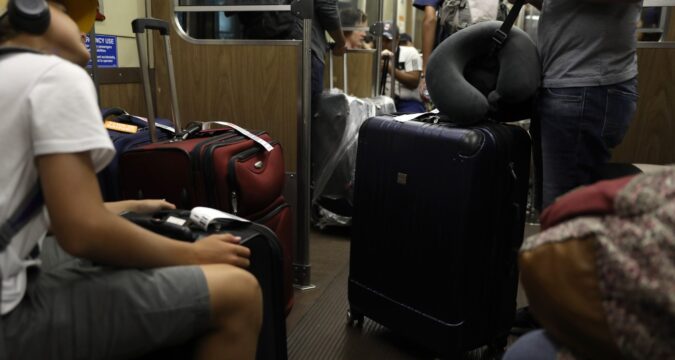
The CTA Blue Line, which links O’Hare to the heart of Chicago, technically works — but it does not work well. The ride is loud, slow, often crowded, sometimes uncomfortable and at times even unsafe-feeling. For travelers arriving late at night, carrying luggage or navigating harsh Midwestern weather, the experience can be discouraging. It is not the kind of arrival that prepares you for a city of bold architecture, world-class museums, lakefront paths and neighborhoods rich with culture.
At first glance, this may sound like a familiar transit complaint. But the issue runs deeper. Chicago’s infrastructure is not keeping pace with its growth, and the consequences extend well beyond individual inconvenience.
This gap is not felt by passengers alone. It also shapes the daily reality of managing O’Hare as a system. When the connection between the airport and the city is slow or unreliable, the effects surface in curbside congestion, roadway access, terminal circulation and passenger flow — areas that fall squarely within the operational environment of the Chicago Department of Aviation. In this sense, the quality of the airport-city transit link quietly influences how effectively aviation officials can manage growth, efficiency and long-term planning.
I’m a civil engineer, but examining cities through an engineering lens has long been more than a professional habit — it is a way of understanding how urban priorities are translated into everyday experience. Today, in most European cities, landing at an airport almost automatically means stepping onto a comfortable, reliable metro or rail connection into the city center. In the United States, however, this standard remains uneven, achieved consistently only in a handful of cities such as New York, Seattle and a few others. For a city such as Chicago — with its architectural legacy, cultural depth and steady flow of global visitors — this gap raises an obvious question: Shouldn’t a city of this stature have resolved this long ago?
Technically, the Blue Line is operated by the CTA. But its current condition is not the responsibility of a single agency. The Chicago Department of Transportation, the state of Illinois, regional transportation bodies and federal infrastructure priorities all shape the reality of this vital corridor. The airport-city connection is not merely a rail line; it reflects broader transportation vision, funding decisions and interagency coordination.
Travelers arrive at O’Hare International Airport on the CTA Blue Line, Dec. 22, 2022. (Brian Cassella/Chicago Tribune)
The Blue Line’s shortcomings cannot be reduced to institutional failure. Its performance is the outcome of the CTA’s operational capacity, CDOT’s urban mobility priorities, state-level infrastructure funding choices and the consistency of federal investment in public transit. In that sense, the challenge is less about trains and more about whether public actors at different levels can align around a shared, long-term vision.
That alignment matters — especially around O’Hare. The passenger experience does not begin or end at the terminal. How travelers reach the city shapes their perception of Chicago as a whole. The first hour in a city often determines whether a visitor feels welcomed or warned.
Chicago deserves better than a warning.
This is a city where you can spend the morning along Lake Michigan, the afternoon in a neighborhood cafe and the evening in a theater or jazz club. It is a city of ideas and ambition, of neighborhoods that still believe in public space. A reliable, comfortable and safe transit connection from O’Hare is not a luxury; it is a signal that the city takes mobility — and visitors — seriously.
A renewed Blue Line would do more than modernize a train:
It would strengthen Chicago’s global competitiveness.
It would reduce congestion and environmental impact.
It would expand equitable access to the city.
It would ease operational pressure around O’Hare, allowing public agencies to focus on long-term planning.
It would support tourism and local economic growth.
Chicago rightly celebrates O’Hare’s status as the nation’s busiest airport. But to sustain that success, the infrastructure connecting the airport to the city must rise to the same standard.
Modernizing the Blue Line is not simply about upgrading a transit line. It is about elevating the entire Chicago experience. The journey from O’Hare should feel like the opening paragraph of a great city — not a footnote explaining why so many visitors choose a taxi instead.
Yunus Emre Tozal is a civil engineer in Chicago and a master’s of art student at Catholic Theological Union.
Submit a letter, of no more than 400 words, to the editor here or email letters@chicagotribune.com.


