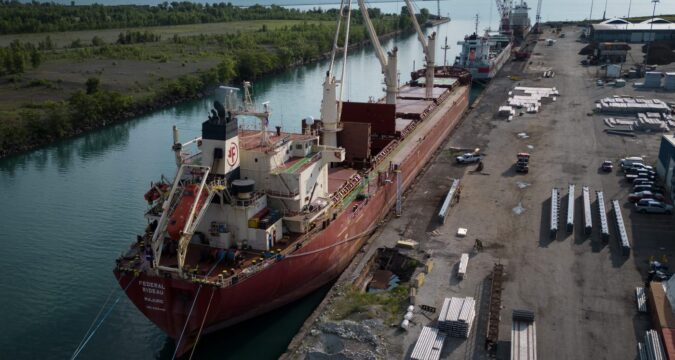
To prevent further spread of potentially catastrophic invasive species in the Great Lakes, the Canadian government is moving forward with tighter restrictions on all freighters. But standards finalized by the U.S. Environmental Protection Agency in 2024, meanwhile, apply only to a fraction of the lake-going vessels.
Environmentalists say the U.S. standards are flawed because existing lakers — or ships that stay within the Great Lakes — are exempted, and new lakers are rarely built.
“They suck all those zebra mussels up in them, along with the lake water from one location when they’re doing that uptake, and then they’re going to a new location, and they let them out,” said Wendy Bloom, a lawyer with the Environmental Law and Policy Center. “They’ve now created a new location infested with those species.”
While ballast discharge regulations have been in place since 2008 for ocean-going freighters, known as salties, few such rules exist for lakers.
In December, the law and policy center and three other environmental groups filed a petition in D.C.’s U.S. Circuit Court of Appeals calling on the EPA to include existing freighters in all of the new standards, arguing that lax regulations have contributed to the spread of invasive species nationwide.
“Why exempt ships when we know that there is technology that they can put on that will at least try to reduce the spread of invasive species,” said Marc Smith, the policy director for National Wildlife Federation, one of the groups filing the petition.
The same month, the attorneys general of Illinois, Michigan and Vermont also filed an amicus brief in support of the resolution.
“The Great Lakes are a critical resource to Illinois and surrounding states, which is why we need to defend the protections we have in place to avoid invasive species that create long-term environmental harm,” Illinois Attorney General Kwame Raoul said in a statement.
The Canadian government will require all Great Lakes vessels to install ballast water treatment systems by 2030, and some shipowners there have begun to install the technology.
In the United States, however, the EPA’s regulations only require lakers built in the future and ocean-going freighters to install treatment systems that will remove and kill foreign organisms in ballast water. The standards will take effect once the U.S. Coast Guard has finalized rules for implementation of the EPA standards, which may take up to two years.
According to the law and policy center, 90% of existing lakers were built before 2009.
Bloom called the EPA’s new ballast standards a “free pass.”
In a 2022 report by Great Lakes Now, the Lake Carriers’ Association, a trade group that represents U.S. shipping fleets on the Great Lakes, touted the first new freighter built in 35 years.
“The beauty of our environment is these are freshwater ships, and they last a long time. They don’t corrode like saltwater ships do and we maintain them,” said Jim Weakley, president of the Lake Carriers’ Association, in the report.
Quagga and zebra mussels shells, along with other shells and debris, clutter the dunes area at Montrose Beach on April 13, 2021, in Chicago. Both types of mussels are considered invasive species. (Erin Hooley/Chicago Tribune)
A representative with the Lake Carriers’ declined to comment.
The EPA’s final rule, however, said retrofitting lakers would pose sky-high costs and other technical challenges. An EPA spokesperson declined to comment on the final standards.
In a November report from Wisconsin Public Radio, Weakley also said current ballast water treatment systems are costly and ineffective. One 2017 estimate from the shipping industry found it could cost as much as $36 million per vessel to install.
Around 63 lakers operate exclusively on the Great Lakes today, according to the law and policy center. These ships, which range from 600 to 1,000 feet in length, transport bulk cargo, including iron ore, grain, coal and limestone. Lakers make 50 to 100 trips annually and handle about half of the billions of dollars’ worth of cargo that moves around the Great Lakes each year.
To balance their weight during loading and unloading of cargo, ships pump millions of gallons of water into their ballast tanks often at one port and then release it later at another port.
Freighters have enabled the spread of zebra and quagga mussels, the round goby, a small, invasive, bottom-dwelling fish, as well as harmful pathogens from algal blooms and viral diseases in fish through their ballast waters.
“The impacts of invasive species go beyond economics. They collapse food webs, harm fisheries and affect the quality of life for everyone who uses the Great Lakes,” Smith said.
Mussel crisis
In the late 1980s, zebra mussels, native to the Caspian and Black seas, arrived in Lake St. Clair brought in by an ocean-going freighter. Quagga mussels arrived soon after. Within a decade, the mollusks could be found in all the Great Lakes.
They have cost the region billions of dollars — from clogging industrial plant pipes to damaging boats and harming fisheries — according to the U.S. Fish and Wildlife Service.
National Oceanic and Atmospheric Administration scientists estimated there were about 300 trillion invasive mussels in Lake Michigan alone from a 2015 count.
Quagga and zebra mussels shells, along with other shells and debris, clutter the dunes area at Montrose Beach on April 13, 2021, in Chicago. Both types of mussels are considered invasive species. (Erin Hooley/Chicago Tribune)
Today, damages from invasive mussels in the Great Lakes cost over $500 million annually, the National Invasive Species Information Center found.
“These mussels build up huge masses, thousands and thousands of pounds of these things on water intake pipes. They can plug and damage infrastructure,” said Greg McClinchey, director of policy and legislative affairs of the Great Lakes Fishery Commission. “It costs huge amounts of money for the cities to keep our water structures working.”
Related Articles
An estimated 300 trillion invasive mussels blanket Lake Michigan. Eradication may be impossible, but small-scale removal efforts could be the answer.
In Lake Michigan’s first national sanctuary, nearly 100 possible shipwrecks could reveal tales of the superhighways of the Great Lakes
Scientists race to save Lake Michigan whitefish as invasive mussels, warming waters are wiping out population
According to Clear Seas, an independent, nonprofit marine shipping research center, 30% of the estimated 185 aquatic nonnative species in the Great Lakes were introduced by ballast water. Humans are another source.
Between 2006 and 2008, both the U.S. and Canada issued mandatory regulations requiring salties to exchange and flush their ballast water in the open ocean before entering the Great Lakes.
Since then, scientists have observed major changes. A Canadian study by Anthony Ricciardi, a biology professor at McGill University in Montreal, and Hugh MacIsaac, a professor at the University of Windsor, discovered that these measures have significantly reduced invasive species in the ecosystem.
After 2006, the rate of discovery of new nonnative species in the Great Lakes declined by 85%, the lowest level in the last two centuries, the study found.
“The overall rate of invasion for the Great Lakes has dropped precipitously,” Ricciardi said. However, he noted that the Great Lakes today remain vulnerable to other sources of invasion, such as these species spreading through canals or human trade and farming activities.
The other concern is existing invasive species in the Great Lakes spreading throughout the region on vessels, a threat that environmentalists are highlighting in their December petition.
The Illinois International Port District facility on the Calumet River at Lake Michigan on July 18, 2023, in Chicago. In the United States, the EPA’s regulations only require “lakers” built in the future and ocean-going freighters to install treatment systems that will remove and kill foreign organisms in ballast water. (E. Jason Wambsgans/Chicago Tribune)
After years of stalled efforts on the federal level, Congress in 2018 passed the Vessel Incidental Discharge Act, requiring the EPA to set performance standards for ballast water discharges around the country. Another six years later, the EPA issued its final standards, exempting existing lakers from ballast water treatment systems and overwriting stricter state regulations.
“We’re dealing with this issue of these aquatic species that are not indigenous to this area, being moved around and brought into the Great Lakes system, where they are also being moved around,” said Matthew TenEyck, director of the Lake Superior Research Institute at the University of Wisconsin-Superior.
Ballast water experiments
At the Lake Superior Research Institute in Superior, Wisconsin, TenEyck and his team experiment with a mix of technologies to attach to lakers to limit the spread of invasive species.
They have tried UV lights, ozone disinfection and filter methods. TenEyck said one system, which combines some of those elements, has entered testing trials, and is installed and collecting data on a group of lakers.
Although the team is still finalizing the technology, the design features a filter that removes most of the organisms and debris in the water that enters the ballast tank before UV light adds another layer of disinfection, TenEyck said.
Because many lakers were built in the 20th century, TenEyck said, one system likely will not fit all the molds.
“Our job is to collect the data and see the problems and the challenges shipping companies may experience,” said TenEyck, whose research is partially financed by the shipping industry. “We want the technology to work to protect the lakes, but we also don’t want to put the shipping companies out in any way, shape or form.”
Quagga and zebra mussels shells, along with other shells and debris, clutter the dunes area at Montrose Beach on April 13, 2021, in Chicago. (Erin Hooley/Chicago Tribune)
According to its website, the Lake Carriers’ Association supports measures to reduce the transfer of invasive species into the Great Lakes by salties.
But the association argues that its member vessels, which operate exclusively in the Great Lakes, should not be subject to treatment requirements to address species they did not introduce.
“Lakers welcome any measures to protect the Great Lakes without significant impact on vessel operation and trading patterns, but should not be held accountable for the spread of species, pathogens, or other waterborne pollutants that they did not bring to the Great Lakes,” the website says.
EPA regulators and the Lake Carriers’ Association also say the cost to retrofit lakers is too high, with the association estimating in the 2017 report that the entire process could total $639 million. But environmental groups argue these estimates are inflated.
“What I can tell you is that we were really disappointed in the EPA analysis of the viability of treatment systems, and that those costs have been dramatically overblown,” said Joel Brammeier, president and CEO of the Alliance for the Great Lakes, another group on the December petition.
A future goal
After decades of infighting and legal litigation, environmentalists say they want to see the EPA set a universal standard for all vessels in the U.S. Although the technology is still new and much of it still developing, Smith said, it’s urgent to set a clear future goal for the laker industry to adjust to and work toward.
“So why not set the standard and let technology catch up,” Smith said. “We just want all vessels regulated. We want the Great Lakes to be protected.”
As the legal challenge winds its way through the court of appeals, there may not be an immediate resolution to the case, Bloom said.
No other freshwater system on the planet has been invaded as frequently, experts say, and the future of the Great Lakes is at stake.
Jerry Wu is a freelancer.
https://www.chicagotribune.com/2026/02/01/great-lakes-freighters-ballast-invasive-specieskers/


