
It was four years ago in May that Darren Bailey declared Chicago a “crime-ridden, corrupt, dysfunctional hellhole” as he and five rivals made crime the centerpiece issue in their race to be the Republican nominee for governor.
Based on statements from the four current GOP candidates for governor, including Bailey, who is seeking a second chance, not much has changed.
To be sure, Bailey, the unsuccessful 2022 GOP challenger to Democratic Gov. JB Pritzker, says he is moderating his tone about the city. But he and primary opponents Ted Dabrowski, Rick Heidner and James Mendrick still maintain crime is a top issue of their campaigns — and have recently added their support of Republican President Donald Trump’s aggressive immigration enforcement to the mix.
Yet statistics show that since that 2022 election, violent crime is down in Chicago and across the nation. That’s something even Trump, whom the GOP candidates pledge fealty to, has proclaimed. Just a little more than a week ago, the president declared, “America is safer than it has been in over a century,” as the White House cited data of declining murder rates in the nation’s biggest municipalities.
Trump has taken credit for the falling crime rates, attributing them to his deployment of federal agents to Democratic-run cities, even though Chicago Police Department data show the city ended 2025 with declines in most major crime categories — including murders and shootings — drops that began before Trump started his second term.
Regardless, the result has been a paradoxical narrative in the Republican primary in which candidates for Illinois governor loyal to Trump are campaigning against a crime wave he says no longer exists.
Chicago has been the biggest focus of attention for the GOP candidates.
In statistics Mayor Brandon Johnson has cited as evidence of progress, Chicago recorded 416 killings in 2025 — the city’s lowest homicide total in more than a decade — while shootings, defined as incidents in which at least one person was killed or wounded, fell by about one-third compared with 2019, according to department data.
Still, the GOP candidates don’t buy it.
“I don’t think crime has gone down,” said Heidner, a real estate and onetime-embattled video gambling operator from Barrington Hills. “People aren’t safe. They’re not safe. They’re getting killed. They’re getting robbed. They’re getting raped.”
“Liars use numbers. Crime has not come down,” said Mendrick, the DuPage County sheriff, who contends the method of calculating crime statistics has changed and that “gangbangers don’t call the police on each other, so none of those are being reported.” He adds that “medical technology” is saving the lives of drug victims, reducing drug-related crime statistics.
Dabrowski, a conservative activist from Wilmette who has made a career offering his opinions based on data, said that “after so many years of so much crime, a lot of people don’t report crimes anymore. … Massive numbers of crimes aren’t reported anymore because the police (don’t) come.”
SAFE-T Act echoes
Crime and the fear of violent crime have long been used by politicians as an issue to try to motivate the electorate. And a recent Emerson College poll conducted for WGN-TV may explain the GOP candidates’ primary messaging.
The survey of 1,000 likely voters, conducted Jan. 3-5, found crime ranked fifth behind the economy, health care, threats to democracy and immigration as the most important issue to voters.
But among likely GOP primary voters, it ranked third behind only the economy and immigration.
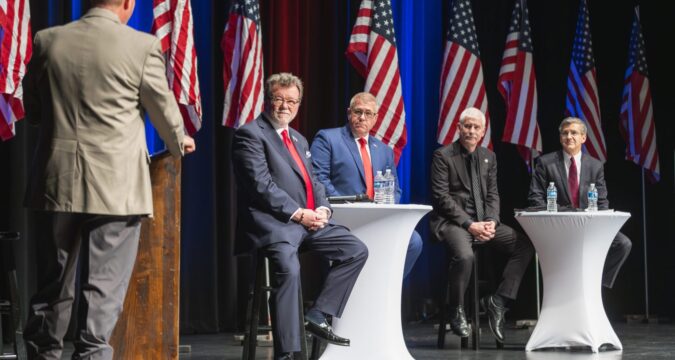
Rick Heidner, center, answers a question during a Republican Gubernatorial Candidate Forum hosted by the Tazewell County Republican Party in downstate Washington on Jan. 15, 2026. (Troy Stolt/for the Chicago Tribune)
In 2022, Republican governor candidates focused on the SAFE-T Act, the Safety, Accountability, Fairness and Equity-Today law, and its cashless bail provision known as the Pretrial Fairness Act — even before the law went into full effect on Sept. 18, 2023. Under the law, instead of holding people charged with crimes on cash bail amounts, judges weigh whether to detain someone pretrial based on whether they’re considered a flight risk or a danger to the public.
Bailey and other Republicans warned then that the law would end up exporting the violent crimes of Chicago to the suburbs and downstate.
During a 2022 speech in Peoria, Bailey contended “Chicago is living ‘The Purge,” a reference to a dystopian 2013 horror movie in which the government allows all crimes committed during a 12-hour period to be legal. Democratic leaders have turned “the West Loop into the Wild West” and “Chicago into the OK Corral,” the Republican said.
Now, with the SAFE-T Act in effect, the GOP candidates for governor are united in calling for its repeal, contending it has left citizens less safe and has decimated the morale of law enforcement.
“Crime is out of control. That’s because of the SAFE-T Act, which I vow to get rid of. Day one, SAFE-T Act is gone. Executive Order,” Mendrick told an audience at a Jan. 19 GOP candidate forum at an East Dundee gun shop — even though a governor has no power to overturn a state law with an executive order.
“I have a very simple answer for that,” Heidner said when asked by a reporter about the SAFE-T Act. “If you have money for bail or if you don’t have money for bail, I have a real easy way for you not to need bail. Don’t commit a crime.”
The GOP candidates point to high-profile individual cases where defendants have not been detained and go on to be accused of committing violent crimes, most notably a November incident aboard a Chicago Transit Authority Blue Line train in which a man with an extensive criminal background allegedly set a woman on fire in an apparently unprovoked attack while he was on electronic monitoring as a defendant in an aggravated battery case. The judge in the aggravated battery case had the option of holding the suspect, Lawrence Reed, in custody.
Ted Dabrowski answers a question during a candidate forum hosted by the Tazewell County Republican Party at Five Points in downstate Washington on Jan. 15, 2026. (Troy Stolt/for the Chicago Tribune)
Dabrowski, while supporting a repeal of the SAFE-T Act, acknowledged the Blue Line incident was an outlier. But he said there are still plenty of “very worrisome crimes” being committed in Illinois and that too many criminal suspects, like Reed, are not detained and instead are being released and able to commit more crimes.
“What I want to get to is not less crime. I want to get to safe city,” he said. “And I just think that more attention on prosecutors, more attention on the (sentences), making sure that they’re not letting repeated felons out all the time. That’s the big complaint.”
Potential changes unclear
Matthew McLoughlin, who has defended the elimination of cash bail as campaign coordinator for the Illinois Network for Pretrial Justice, said he believed the rhetoric of the GOP governor candidates seeking the law’s repeal “is being brought to the surface due to the Trump administration’s, you know, over the top, again, hyperbolic comments about what’s happening in Illinois that seem extremely detached from reality.”
In contrast to the governor candidates, he said, many Republicans more broadly are calling for changes to the Pretrial Fairness Act, giving judges more discretion to detain suspected criminals.
“There are many parts of the opposition that have recognized that they lost the debate about whether or not the money bond system was making our community safer,” McLoughlin said. “And they’re now talking about making changes because they know that they were wrong. And they know that they were making statements that were hyperbolic, meant to cause fear and were not based in fact.”
Despite favoring the SAFE-T Act when it was passed by the General Assembly, top Illinois Democrats, Pritzker and House Speaker Emanuel “Chris” Welch of Hillside, have expressed openness to proposed changes to the law. But as of now it’s unclear what those changes would entail.
Bailey, a wealthy downstate farmer, said that “it’s interesting” that Pritzker has suddenly become open to changing the law. But when asked why the GOP is zeroing in on the law when crime in places like Chicago has gone down, Bailey lamented how there are communities that are “struggling” to find people who want to become cops and for the “future for our children, our families and our businesses … it needs to stop dead in its tracks now.”
Darren Bailey, right, answers a question during a candidate forum hosted by the Tazewell County Republican Party at Five Points in downstate Washington on Jan. 15, 2026. (Troy Stolt/for the Chicago Tribune)
All four Republican candidates support ending Illinois’ “sanctuary state” status. And as all four seek a presidential endorsement, which helped Bailey win the 2022 primary, they also said they back Trump’s immigration enforcement efforts even as congressional Republicans express concerns over the actions of agents and the president himself has dialed back operations in Minneapolis after two U.S. citizens were shot and killed by federal agents in the last month.
Heidner, who backed Trump’s call to deploy the National Guard in Chicago over Pritzker’s objections — a move rejected by the U.S. Supreme Court — has gone so far as to say the president should invoke the Insurrection Act of 1807. The law would allow Trump to deploy the military and federalize the National Guard to suppress civil disorder.
Less than a week after the fatal shooting of Renee Good by a federal immigration agent in Minneapolis on Jan. 9, Heidner wrote on the social media platform “X,” “I support the First Amendment and the right to peacefully protest. However, the riots in Minnesota are unacceptable and this unlawful rebellion needs to end. I’m asking @realDonaldTrump to immediately invoke the INSURRECTION ACT and restore order in Minnesota!”
Despite explanations from the U.S. Department of Homeland Security that were widely at variance with video evidence of federal agents fatally shooting Alex Pretti on Jan. 24, and pending investigations into his death, Dabrowski quickly blamed Pretti, the “sanctuary” status of Minneapolis and comments by local and Illinois leaders critical of the enforcement actions as inciting violence.
“I find it interesting that the protesters on the streets of Chicago, along with Pritzker and Johnson, who otherwise oppose individual gun rights, have no problem with someone tracking federal officers in Minnesota for the purpose of impeding their enforcement operations while armed with a handgun,” Dabrowski said, though Pretti was legally carrying a firearm and there was no visual evidence of him brandishing it.
“The way to avert such tragedies with respect to federal law enforcement is to make your views known peacefully without crossing the line into illegally impeding their operations or resisting a lawful command when directed to stand down,” he said, though video and eyewitnesses have contradicted DHS’ contentions that Pretti was impeding agents’ operations.
James Mendrick answers a question during a candidate forum hosted by the Tazewell County Republican Party at Five Points in downstate Washington on Jan. 15, 2026. (Troy Stolt/for the Chicago Tribune)
Bailey said he believes issues such as federalizing military assets for immigration enforcement, as Trump attempted to do in Operation Midway Blitz in Chicago, were a result of actions by Pritzker and Johnson.
“It’s government’s role to protect the people. If a governor or a mayor refuse to protect the people, which JB Pritzker and Brandon Johnson are refusing to do, then it goes right up the line, so the president comes in and has the ability, I believe, to protect the people at whatever the cost is,” Bailey said.
Mendrick said he believed the state “is doxing” federal agents by following the TRUST Act, which prohibits state and local law enforcement from cooperating with federal authorities on civil immigration matters.
“It’s a flawed law. The only reason that law exists (is) so JB Pritzker can scream and yell about Donald Trump and say, ‘You’ve got to come through me. These are my people,’” Mendrick said.
In actuality, the TRUST Act was signed in August 2017 by Pritzker’s predecessor, one-term Republican Gov. Bruce Rauner.
https://www.chicagotribune.com/2026/01/31/illinois-republican-governor-primary-2026-crime/


