
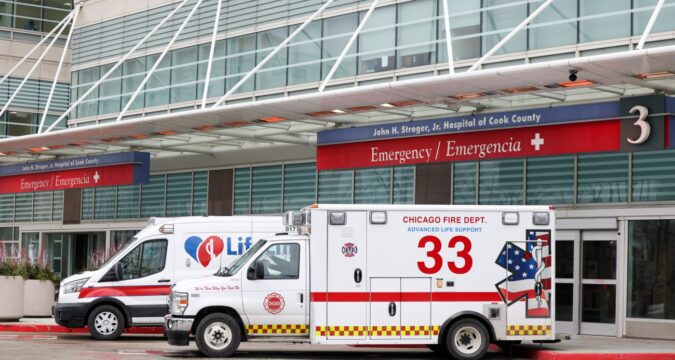
Across the country, people facing medical emergencies are increasingly opening the Uber app instead of calling 911. That choice isn’t about convenience. It reflects a health care system that leaves Americans weighing medical emergencies against the fear of a devastating medical bill.
That fear is not misplaced.
Last January, ABC affiliate WLS-Ch. 7 reported on a mother who brought her daughter to a local emergency department for abdominal pain and was told she needed to be transferred by ambulance to Silver Cross Hospital in New Lenox. Fearing something serious, such as appendicitis, the mother complied — only to be left with a $7,000 bill for an 11-mile ride.
As a volunteer in Silver Cross Hospital’s emergency department, I watched dozens of patients arrive by ambulance every shift with severe injuries and life-threatening illnesses. That TV report, set at the very same hospital, forced an uncomfortable realization: Patients I saw faced the same reality, even if I never knew it.
It happens more often than many may be aware. Each year, more than 3 million Americans are brought into the emergency room by ground ambulance, and roughly half of these rides end with a surprise medical bill.
The reason this keeps happening is not because Washington is ignorant of the problem. When Congress passed the bipartisan No Surprises Act in 2020, it proudly ended surprise medical bills for out-of-network emergency care and even included air ambulances. But ironically, four years after the law took effect in January 2022, patients who dial 911 can still be hit with surprise out-of-network bills for ground ambulances — a gap that reflects unfinished policy more than partisan disagreement.
Critics of reform argue that out-of-network billing is reasonable because patients “choose” their providers. That logic may apply to routine care, but in an emergency, patients do not have the option to pick which ambulance company responds. Instead, dispatch decisions are driven by proximity and availability, not insurance networks. While emergency medical services face significant financial and operational pressures, state reforms have shown that patient protections and system sustainability can go hand in hand.
In the year since that ABC story aired, Illinois lawmakers have begun to recognize this reality. Last summer, the state adopted new protections requiring insurers to treat out-of-network ground ambulances as in-network for cost-sharing purposes. In practice, this means patients pay only standard in-network copays and deductibles, even when the responding ambulance is out of network.
But Illinois lawmakers have acknowledged that insurance rules alone may not fully protect patients. A proposal introduced last summer and currently under consideration in the Illinois Senate would build on those reforms by treating surprise ground ambulance bills as a consumer protection issue, rather than a routine billing dispute, and by closing enforcement gaps that still leave patients exposed.
Even so, state-level fixes can go only so far. Today, whether families are protected largely depends on where they live. Recently, a mother in Nevada who called 911 when her 11-month-old son started seizing was later charged $1,600 for the ambulance. In Virginia, a man was hit with a nearly $5,000 bill for a 7-mile ride. Neither state has adopted billing protections for ground ambulances.
At the same time, adopted state protections often apply only to state-regulated insurance plans, leaving many patients with employer-sponsored coverage unprotected. Efforts to expand those protections are often politically fragile. That fragility was on display last month when New York Gov. Kathy Hochul vetoed two bipartisan measures aimed at lowering costs for emergency medical services, raising concerns about longer response times and higher transport costs.
Americans deserve one clear national standard.
Congress knows what to do. Under the original No Surprises Act, a federal advisory committee of physicians, EMS providers, insurers and consumer advocates was established to develop recommendations on billing practices for ground ambulance services. Its recommendation was unambiguous: Extend surprise-billing protections to ground ambulances.
This raises an obvious question. Why hasn’t Congress acted? What’s missing is not direction, but urgency.
Federal lawmakers have a clear opportunity to act. The recently introduced No Surprises Enforcement Act, which aims to strengthen enforcement of the original statute, demonstrates that bipartisan support for billing reform is still strong. But even widely supported reforms can stall without constituents’ sustained pressure on lawmakers to prioritize this fix.
At a time of deep political division, legislative action on this issue offers a rare chance for lawmakers from both parties to deliver tangible relief to patients. It’s time for Congress to finish the job.
At some point, each one of us may need an ambulance. In that moment, the only thing that should matter is getting help, not the cost of the ride.
Armin Pazooki is a medical student at the University of Chicago Pritzker School of Medicine and co-editor-in-chief of the Pritzker Health Policy Review.
Submit a letter, of no more than 400 words, to the editor here or email letters@chicagotribune.com.
https://www.chicagotribune.com/2026/01/27/opinion-no-surprises-act-ambulance-bills/


