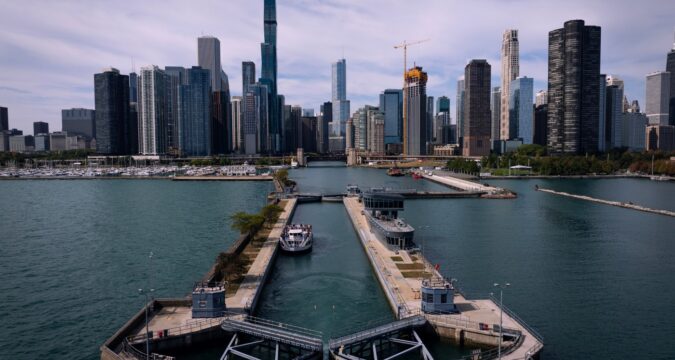
The Chicago Harbor Lock is expected to see its federal funding cut by more than 90% this year after an effort by Illinois lawmakers to secure more money for the busy stop lock and dam failed.
The Harbor Lock, the mechanism which boats use to travel between Lake Michigan and the Chicago River, is one of the busiest locks in the U.S. The 24/7 operation is run by the U.S. Army Corps of Engineers.
The Army Corps requested $3.85 million in funding for operation and maintenance of the lock this year. But in his own budget proposal, Trump allocated less than $300,000 for the lock, through which more than 900,000 passengers traveled in 2024.
Funding for the Harbor could have gotten bumped up above the president’s budget proposal during the Congressional appropriations process. An effort by Illinois Senators Dick Durbin and Tammy Duckworth to secure more money, however, went nowhere.
An appropriations “minibus” package, of which Army Corps funding is a part, passed the Senate without any amendments by an 82-15 vote Jan. 15. Durbin and Duckworth, both Democrats, were among those who voted to approve the measure. Trump signed the appropriations legislation on Friday.
The Army Corps said previously that though the cuts were “not ideal,” it would be able to cover operating costs this year by using leftover funds from 2025 and redirecting some money that it had planned to use for an electrical rehabilitation project.
However, the Army Corps said, funding cuts this year could threaten funding in future years because budget limits are based on a five-year average of prior funding levels.
Advocates for Chicago’s waterways said Monday they were disappointed and concerned that the effort to secure more funding for the lock had failed.
Colin Smalley, the president of Local 777 of the International Federation of Professional and Technical Engineers, which represents Army Corps workers in Chicago, said he saw the Harbor Lock cuts as “of a piece” of the Trump administration’s efforts to “politicize the civil service and our federal agencies.”
“The American public needs to know about this,” he said.
Mike McElroy, the president of the Chicago Harbor Safety Committee, said the news was “disheartening.” The harbor safety group, he said, would continue pushing lawmakers to see if there was a way to secure any additional funds.
It “just seems like Chicago’s getting the short end of the stick again,” McElroy said.
The Trump administration has repeatedly withheld or threatened to withhold federal funding from blue cities and states, including in Chicago. Last year, insiders told the Tribune it was not clear whether or not the Harbor Lock cuts specifically were politically targeted.
“Chicago [Harbor] Lock is one of the busiest locks in the country, and ideally, the funding available to the lock would match its prestige,” Durbin said in a statement.
“While the Chicago Harbor Lock will have the resources to maintain operations in FY26, I hope we can return full funding to the lock in the years to come,” he said.
The Army Corps did not immediately respond to a request for comment Monday. Neither did the White House.
A boater pushes off from the wall of Chicago Harbor Lock operated by the U.S. Army Corps of Engineers, connecting the Chicago River with Lake Michigan, Oct. 1, 2025. (E. Jason Wambsgans/Chicago Tribune)
Located just south of Navy Pier, the Harbor Lock functions like a water elevator to allow vessels to travel between the difference in elevations between the river and lake.
Illinois Democrats previously tussled with the Trump administration over its use of the harbor for a river cruise photo-op during Operation Midway Blitz.
In September, U.S. Customs and Border Protection officers docked their boats near the lock after taking a sail down the Chicago River whilst armed with rifles.
The outing prompted Durbin and Duckworth to send a scathing letter to the Department of Homeland Security, of which CBP is a part, writing that “the use of the Chicago Harbor and its infrastructure as a staging ground for armed Federal operations undermines public trust and risks politicizing Federal assets and agencies.”
https://www.chicagotribune.com/2026/01/26/chicago-harbor-lock-funding-cuts/


