
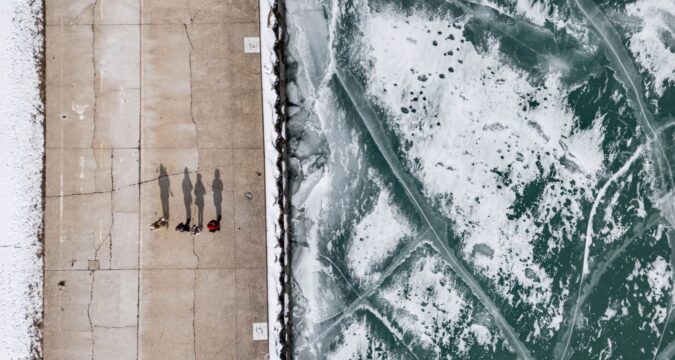
On a brisk January day with wind chills plunging to minus 25 degrees, Paul “Blade” Bloedorn stood out on nearly 2 feet of ice on Lake Michigan’s Little Bay de Noc.
Last weekend, more than 400 shacks speckled the frozen bay, Bloedorn recalled, as ice anglers flocked to the Upper Peninsula to take advantage of perfect ice conditions.
“It’s truly the best time to fish the Noc,” Bloedorn wrote in a blog post to his 10,000 Facebook followers. “Enjoy this ideal ice season to its fullest. It’s the best we’ve had in years.”
As owner of Blade’s Bait and Tackle, a popular fishing outfitter in Gladstone, Michigan, Bloedorn has become a trusted source on Lake Michigan’s daily ice conditions for the Upper Peninsula’s ice anglers — many of whom travel hours to fish the bay.
“Ice changes every day, and as we go south, it changes every minute,” Bloedorn said. “If I weren’t out there every day, I wouldn’t know what I’m talking about.”
This winter, Bloedorn and Great Lakes experts say lake conditions are shaping up well for ice fishing, a welcome shift for coastal communities that have endured recent winters with little ice.
Paul “Blade” Bloedorn uses a Jiffy Scout ice auger to measure ice thickness on Lake Michigan at Little Bay de Noc in Gladstone, Michigan, on Jan. 15, 2026. Bloedorn runs Blade’s Bait and Tackle shop and reports on ice conditions for 10,000 followers on Facebook. (Zbigniew Bzdak/for the Chicago Tribune)
Thicker ice is bringing some relief to Bloedorn and others whose livelihoods depend on a frigid winter, but more and more, they and the fish and microorganisms in the lakes are experiencing havoc wrought by deep fluctuations in conditions fueled by climate change.
“Mother Nature is stronger than all of us,” he said. “That’s what dictates our activity out on the bay: the elements and how ice grows.”
An icy winter ahead
A La Niña pattern is expected to persist through the remainder of winter, bringing colder conditions to the Midwest and relatively stable ice coverage across the Great Lakes, said National Oceanic and Atmospheric Administration meteorologist Joseph Phillips.
Ice coverage has been healthy so far this season, Phillips said. As of Friday, ice covered about 20% of Lake Michigan,15% of Lake Superior, 17% of Lake Ontario, 40% of Lake Huron and more than 79% of Lake Erie, according to data from NOAA’s Great Lakes Environmental Research Laboratory.
In Chicago, a layer of ice covered several harbors on Lake Michigan, and thin sheets of ice began appearing near the shoreline as an Arctic blast settled in, bringing bitter subzero temperatures to the city.
During a La Niña year, colder air tends to spill over the Great Lakes, Phillips explained. La Niña is a climate pattern marked by cooler-than-average temperatures in the Pacific Ocean that can influence weather worldwide, according to NOAA.
But winter conditions this season may be less predictable because the current La Niña pattern is relatively weak.
On the whole, weather experts forecast above-average ice coverage on the Great Lakes for the rest of the winter, a relief for business owners like Bloedorn.
Ice fisherman access Lake Michigan at Little Bay de Noc in Gladstone, Michigan, on Jan. 15, 2026. (Zbigniew Bzdak/for the Chicago Tribune)
Current lake conditions have been ideal, Bloedorn said, measuring upward of 22 inches of ice last weekend. His bait shop began its ice-fishing season in early December, 20 days earlier than usual, and Bloedorn expects the season will last through April.
“It doesn’t freeze like it used to,” he said. “But I’d say this ice is really good for how low (the lake) is, but that’s just because we’ve been cold earlier on than we’ve had previously.”
In the Upper Peninsula, the economy of many coastal towns depends on tourism from winter recreation, including ice fishing, ice climbing, snowmobiling and dogsledding.
As an ice angler in Little Bay for over 30 years, Bloedorn said he has witnessed a noticeable change in coverage.
“Whoever you want to point the finger at, climate change, we are changing,” Bloedorn said. “There is not a doubt in my mind that these are milder winter patterns in the last five years than we had 25 years ago.”
Climate Change: Great Lakes, High Stakes
Human-caused climate change has been driven largely by greenhouse gas emissions from burning fossil fuels, affecting Great Lakes temperatures and long-standing winter patterns.
In 2024, the Great Lakes hit a record low ice cover that devastated the winter outdoor industry in the Upper Peninsula, Bloedorn said.
The winter of 2023-24 was the warmest on record for the contiguous United States, according to NOAA. In the Midwest and much of the country, winter is the fastest-warming season, and this contributes to less lake ice.
Bloedorn estimated his shop lost a half-million dollars in revenue that he’s still trying to make up. The losses constituted over half of the profits the bait shop averages in a normal year, and Bloedorn said he still feels the financial strains caused by that nearly iceless season.
“It’s such a big portion of our livelihood that that one season took us backwards and will probably take five years to bail out,” he said. “Last year didn’t even bail us out from the year before. And even starting early, this year doesn’t bail you out. It’s hard to really get ahead after you get behind.”
Paul “Blade” Bloedorn prepares an ice shack trailer for his clients on Lake Michigan at Little Bay de Noc in Gladstone, Michigan, on Jan. 15, 2026. (Zbigniew Bzdak/for the Chicago Tribune)
When the Upper Bay of Lake Michigan ices over, it’s usually solid, Bloedorn said. But south of Little Bay is a different story.
“That ice has a potential to break off and float out, which is every ice angler’s nightmare,” Bloedorn said.
Increased uncertainty
Despite signs of average ice coverage this year, there has been a steady decrease in maximum ice coverage on the Great Lakes over the past 50 years, a trend caused by climate change, experts say. Maximum ice coverage is the point during the winter season when the Great Lakes have their greatest extent of surface area covered by ice. It typically occurs in late winter, around March, just before spring ice melt begins.
Since 1973, the Great Lakes have experienced a 5% decrease in annual maximum ice coverage every decade, said James Kessler, a physical research scientist with NOAA’s Great Lakes Environmental Research Laboratory.
As the Great Lakes experience more ice fluctuation from year to year, researchers are beginning to question how these changes occurring in shorter windows are affecting the lakes over time.
“Not only is the ice cover very highly variable, but that variability is increasing through time,” said Kessler.
The Great Lakes ecosystem depends on consistent winter ice. When ice is scarce, fish spawning can decline and microorganisms that live within ice lose critical habitat, Kessler said.
A fisherman casts a line into a hole in the ice in Diversey Harbor on Jan. 22, 2026, as frigid weather descends on Chicago. The Great Lakes ecosystem depends on consistent winter ice. (Brian Cassella/Chicago Tribune)
This can harm fish species, such as whitefish, that rely on stable ice to shield eggs from wave turbulence, according to the Great Lakes Commission’s State of the Great Lakes 2025 report.
Whitefish populations have declined dramatically over the past 15 years, in part due to warming lake temperatures. As waters warm and there is less protection from layers of ice, fragile whitefish eggs are exposed to direct sunlight, which may be increasing mortality rates. Experts warn the species may be at risk of disappearing altogether in the coming years.
Related Articles
Ice shapes economy, identity of Lake Superior’s coastal towns. But it’s disappearing.
75 on Tuesday, an ice-free lake, little snow: Climate change blunts winter in Chicago
A collapsing polar vortex brings Arctic blast to Chicago area. How long will it last?
A lack of ice also affects the food supply for young whitefish and lake trout, which feed on plankton after hatching. According to an Associated Press report, scientists caution that low-ice seasons can reduce oxygen levels in deeper, denser layers of lakes, causing plankton and other microorganisms to die — ultimately leading to further declines in whitefish and trout populations.
Shifts in water temperature, ice cover and lake levels can also create conditions that favor invasive species and fuel harmful algal blooms.
Bracing for the unpredictable
Researchers say variations in ice coverage may also affect water levels in the Great Lakes, though the dynamic between the two remains in question.
“Ice coverage and water levels have an interesting, sort of complex relationship,” Kessler said.
Water levels, like ice cover, have also experienced an increase in fluctuations in recent years, according to Megan Royal, the U.S. Army Corps of Engineers watershed hydrology chief.
In December, Great Lakes levels dropped below average for the first time in a decade. It may feel like a drastic change partially because the lakes are coming off a six-year period of extreme high water levels, Royal said.
From 2014 to 2020, Great Lakes water levels rose, hitting near-record-breaking levels in 2020.
Royal’s team is looking into the increasing speed of these water level changes over a period of years instead of decades.
“We went from about a decade of below-average conditions across the majority of the Great Lakes to a pretty quick swing up to record-breaking high water levels,” Royal said. “We don’t have a definitive answer, but it is something that we’re looking into, is the rate of change significant.”
On average, the Great Lakes typically experience lower lake levels in the winter and higher levels in the summer, Royal said, because of increased precipitation and melting snow.
Agencies like NOAA and the Army Corps track these conditions.
Paul “Blade” Bloedorn, left, signals to a family riding their ATV close to a spot with thin ice on Lake Michigan at Little Bay de Noc in Gladstone, Michigan, on Jan. 15, 2026. Bloedorn runs Blade’s Bait and Tackle shop and reports on ice conditions for 10,000 followers on Facebook. (Zbigniew Bzdak/for the Chicago Tribune)
Kessler said some researchers have suggested that more ice could lead to higher water levels since the water would be trapped by ice and unable to evaporate.
Another conclusion is that Great Lakes ice cover can change the timing of evaporation instead of the amount, which could mean water levels wouldn’t rise, Kessler said.
Overall, water and ice conditions are becoming more unpredictable, causing the Army Corps to focus on resiliency when it comes to protecting shorelines from erosion.
During the record-high lake levels of 2020, severe winter storms escalated shoreline erosion, causing temporary closures on Chicago’s Lakefront Trail and DuSable Lake Shore Drive and some permanent beach closures. In response, the Army Corps has had to plan for shoreline protections for the next time lake levels significantly rise.
“In terms of concerns, I think that if we’re within the range of recorded water levels, and we’re transitioning more quickly between highs and lows, it becomes something that requires adaptation and flexibility,” Royal said.
Those same qualities will be important for Bloedorn and other winter outdoor business owners.
He’s excited for this winter but worried about another shift, like the one in 2024, that could change his luck.
“Our business suffered, like everybody else throughout the Midwest that year, not having much ice, all the way from Minnesota through Wisconsin over to Michigan,” Bloedorn said. “That was really devastating for a lot of businesses up here over that period of time. So it comes down to survival of the fittest.”
https://www.chicagotribune.com/2026/01/25/great-lakes-ice-coverage-climate-change/


