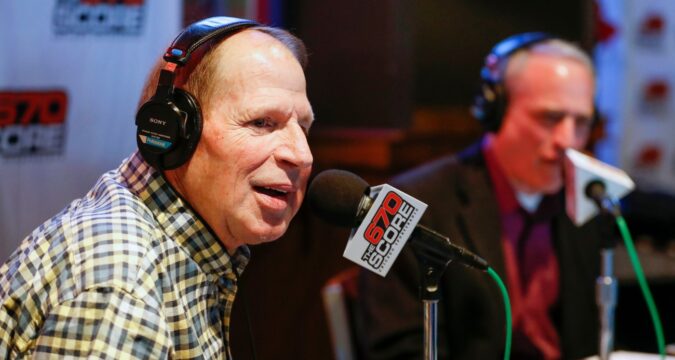
Terry Boers, a former Sun-Times columnist who 34 years ago was one of the founding talkers of Chicago’s first sports radio station WSCR-AM 670, died Friday afternoon. He was 75.
Boers publicly had dealt on and off with health issues over the years, including cancer treatments in the months before his retirement send-off from the Score on Jan. 5, 2017, three days after the station’s 25th anniversary.
Mitch Rosen, vice president of the Score, confirmed Boers’ death.
Paired first with Dan McNeil for 7½ years, then Dan Bernstein, Boers helped establish the station’s early identity as a clubhouse where boys could be boys.
That approach to broadcasting would have to evolve in response to changing community standards as what once was considered de rigueur and playful on sports talk radio might be deemed insensitive, or worse, today.
“We push it,” Boers told the Tribune in 2007. “We blur it. All of us go overboard. I plead absolutely guilty on many fronts, too numerous to mention.”
To his fans, that edginess was a sign of authenticity and part of his appeal. He was who he was — by turns outrageous and outraged, amused and bemused — and never lacked an opinion.
“Live microphone or not, he didn’t change,” former Tribune columnist Steve Rosenbloom, a colleague at WSCR, wrote after Boers’ retirement show. “That’s a hard thing to do. That’s an honest thing to do, and honesty is the highest compliment I can say about someone talking or writing sports.
“He was honest in his writing. He was honest on the air. He never lost his witty, embracing sense of humor. He never lost his capacity for raging against injustice.”
When Mike Ditka brought his call-in show from WGN-AM to the Score in 1992, WSCR bosses assigned Boers to serve as one of the station’s interlocutors. The program became a magnet for attention over the next few years.
Terry Boers, left, and Dan Bernstein talk during their show on WSCR-AM 670 on April 28, 2000. (Peter Barreras/For the Chicago Tribune)
Boers said the experience was “kind of like a suicide mission only less fun.”
The shows were appointment listening because one never knew who or what might set off with the irascible former Bears coach.
Among still-replayed sound bites ingrained in the collective consciousness of Chicago sports fans are Ditka challenging an obnoxious listener to a fight (“I’ll whip your ass!”) and accusing Boers of hypocrisy (“Who ya crappin’?”), which would inspire a signature Boers feature.
Boers credited Ditka’s association with the Score as critical to the station finding its footing in the market.
“I cannot be sure the station would have succeeded without him,” Boers wrote in his 2017 autobiography, “The Score of a Lifetime.” “Sure, I think it probably would have made it, but Ditka was the big name then. Plenty of people hung on his every word, even if some of them made absolutely no sense. Fans couldn’t get enough of his stories, of his tough-guy image and permanent blue collar.”
It wasn’t until Boers was eight months into his time with the Score that he quit his job writing features for the Sun-Times on the advice of future Tribune columnist Mike Downey, who went to Bloom Township High School in Chicago Heights with Boers and was a Los Angeles Times columnist at the time.
Seth Mason, vice president of the Score’s original parent, Diamond Broadcasting, set out to find out who was considered the funniest Chicago journalist in the press box as he prepared to launch the sports station modeled after New York’s WFAN-AM.
Boers was the name Mason heard most often, so he hired him.
Mason acknowledged a year after the station’s debut that Boers and McNeil often threaded their commentary with sexual innuendo that skirted the edge of being inappropriate.
“We ask them to use their heads and think before they talk,” Mason told the Tribune. “We ask them to stay as focused on sports as they can.”
If some listeners occasionally were taken aback by what Boers said, he could be taken aback by what some of them said as well.
“Some callers are right on,” Boers said in 2000. “And some guys are so far out there, you can’t bring them back in. You hope in your heart that’s not the voice of the real fan.”
Terry Boers, left, and Dan Bernstein interview a guest during their radio show on WSCR-AM 670 on May 16, 2005. (David Klobucar/Chicago Tribune)
Terry Boers was born Sept. 13, 1950, the only child of John Henry Boers, a mechanic for Chicago Heights’ Dixie Dairy, and Ruth Rubottom, a homemaker who loved the written word. They raised him in south suburban Steger.
His first job, at age 11, was washing milk trucks on Sundays for his father at $3 a pop. Boers would recall he routinely failed to meet his father’s exacting standards but the experience imbued him with a work ethic he embraced the rest of his life.
Each of his parents died at age 56, his mother in 1972 and his father two years later.
By the time he lost his father, Boers already had begun his newspaper career, first for the Lansing Sun-Journal and then the Chicago Heights Star. He graduated from Northern Illinois after two years at Prairie State Junior College.
Boers joined the Detroit Free Press in 1978 as a copy editor on the sports desk, earning hard-won writing assignments before leaving for the Sun-Times sports desk in 1980, again warned he was unlikely to write.
That changed in 1982 after Richard Justice, then of the Houston Chronicle, changed his mind about accepting a Sun-Times offer to cover the Bulls.
Justice instead took a baseball reporting job with the Washington Post. That left Sun-Times sports editor Marty Kaiser to scramble at the eleventh hour for someone to cover the struggling basketball franchise.
Boers got the job covering a 1982-83 team that would win just 28 games under coach Paul Westhead and only 27 the season after that for Kevin Loughery. The beat got markedly better with the 1984 addition of Michael Jordan, but Jordan’s rookie season was Boers’ last covering the beat.
In 1988, when the Sun-Times sports section was seeking a provocateur, Boers was the choice. Free to fully vent, he offered a hint of what was to come on WSCR.
When Central State University awarded boxer Mike Tyson an honorary degree in 1989, Boers wrote: “Tyson is probably the first man in history to receive a honorary college degree in human letters without knowing them all.”
Of CBS basketball analyst Hubie Brown, he said: “Just being around him for a few days makes me all the more sure that when Brown flies he has to buy two seats — one for him, one for his ego.”
Noting Jerry Reinsdorf’s White Sox had fired Tony La Russa as manager and Bulls fired Doug Collins as coach, Boers cracked: “If Reinsdorf had run his real estate business the same way he has run the Sox and Bulls, he wouldn’t be able to afford to open a lemonade stand.”
But Sun-Times management changed, and so did expectations. Boers was relegated to feature writing in 1990, but he enjoyed additional exposure Sundays on WGN-AM as a regular on “The Sportswriters” with Ben Bentley and the Tribune’s Bill Jauss.
Mason began courting Boers in 1991, ahead of WSCR’s debut on the second day of 1992 with call letters secured from a recently shuttered station in Scranton, Pa.
The Score, as it was branded, initially was on a different frequency and licensed only to broadcast during daytime hours.
That was a huge handicap for McNeil and Boers, who had to sign off in late afternoon in late fall and winter. But with McNeil and later Bernstein, Boers nevertheless established himself as a station tentpole.
Boers’ survivors include the former Carolyn Grace Imgruet, the high school sweetheart he married in February 1971, and their four sons.
Reflecting on what makes a good sports talk personality as he prepared to step down from daily radio, Boers said it’s being open to sharing yourself.
“The personal side of you, the human side of you is far more important than any other side,” Boers said. “I think people want to see you. They don’t want to see a guy talking sports and just an idiot yelling at people.
“How you feel, what you think about things, how passionate you are about stuff, it really does matter.”
Phil Rosenthal was a sports and business columnist for the Chicago Tribune from 2005-21.
https://www.chicagotribune.com/2026/01/23/terry-boers-score-sports-radio-dies/


