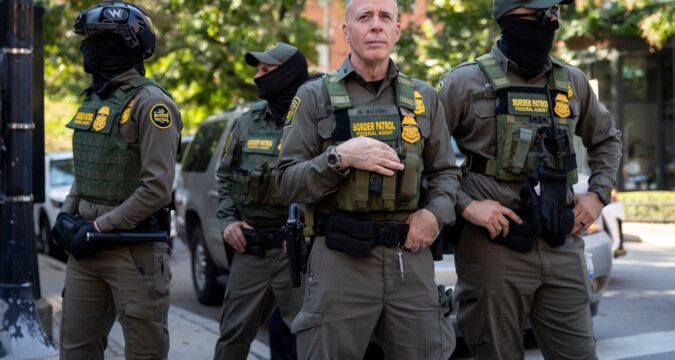
After less than a day of evidence, jurors will likely begin deliberating Thursday in the fast-moving trial of a man accused of putting a gang-related bounty on the head of Border Patrol Cmdr. Gregory Bovino.
Juan Espinoza Martínez, 37, a construction worker who has lived in Chicago for years but is not a U.S. citizen, is charged in an indictment with a single count of solicitation of murder for hire, which carries up to 10 years in prison.
Closing arguments in the case, which has made national headlines amid the continuing controversy over the Trump administration’s immigration crackdown, are set to begin at 9:15 a.m. before U.S. District Judge Joan Lefkow.
The jury of six men and six women, which was just empaneled on Tuesday, will likely be deliberating the case by lunchtime.
Espinoza Martínez’s trial is the first criminal case to stem from Operation Midway Blitz to go to trial and has garnered national headlines since it was first charged, with Trump administration officials holding it up as an example of the threats and violence faced by immigration officials during their deportation push.
Though limited in scope, the case is an important litmus test as immigration-enforcement operations continue to roil Chicago and other Democrat-led cities long targeted by President Donald Trump, including Minneapolis, where the killing of a U.S. citizen by an immigration agent earlier this month has sparked nationwide protests.
When the charges were first brought, authorities accused Espinoza Martínez of being a high-ranking member of the Latin Kings. But evidence of any gang membership never materialized, and much of the testimony about the Latin Kings wound up being toned down or stripped from the trial completely.
According to prosecutors, Espinoza Martínez sent Snapchat messages to an acquaintance from the construction business, Adrian Jiménez, calling for Bovino’s killing after an immigration agent shot a woman in Chicago’s Brighton Park neighborhood on Oct. 4.
Jiménez, who had worked as a government informant on and off for years, shared the messages with Homeland Security Investigations, including one that had a screenshot of a Chicago Tribune photo of Bovino with the words, “2k on information when you get him” and “10k if u take him down.”
In his opening statement to the jury Wednesday, Assistant U.S. Attorney Minje Shin said the case was not about someone charged with “expressing strong, even angry, views about immigration enforcement policy” or a hatred of Bovino.
“Make no mistake — the evidence in this case will show that what the defendant did was not a joke, not just mouthing off, not just him blowing off steam behind a keyboard, not political discourse. .. what the defendant did was a solicitation of murder,” Shin said.
Shin said Espinoza Martínez was “fixated” on Bovino, who was “the face of the threat” to arrest, detain and deport members of his community in the Little Village neighborhood, a threat that “hit close to home.”
Espinoza Martínez’s attorney, Jonathan Bedi, told jurors in his opening remarks that the case was “riddled” with reasonable doubt because “the government cannot point to anything that shows Juan’s intent.”
“When you cut through all of their words … all they have is their guesses and speculation,” Bedi said.
Bedi noted what he said were huge gaps in the prosecution’s case: no bags of money in the offing, no follow-up on any threats, no discussion of any plans, location scouting, escape route, surveillance, or communication saying, “Bovino’s here — now would be a good time to act.”
“Repeating neighborhood gossip is not a federal crime,” Bedi said.
Jiménez testified Wednesday he first met Espinoza Martínez about a year ago after he reached out to him on Snapchat, looking for construction work.
Jiménez testified he had conversations about immigration with Espinoza Martínez “more than a few times.” But when Shin attempted to ask what they talked about specifically, the defense repeatedly objected and the judge sustained it.
Jiménez testified he took Bovino-related photos of the Snapchat messages received from Espinoza Martínez on Oct. 2 and “almost immediately” contacted agents with HSI about them.
Shortly after his arrest on Oct. 6, Espinoza Martínez was led by three federal agents into a windowless interview room, still dressed in a green work T-shirt and carrying a small bottle of water.
In portions of the ensuing videotaped interview played for the jury on Wednesday, the agents pressed Espinoza Martínez repeatedly on how he thought his text messages looked, including references to the Latin Kings street gang backing the offer.
He said over and over he meant nothing by it, that they were nothing more than social media chatter, and that he had no intention of making any actual offer for Bovino’s killing.
“I’m really confused about this,” Espinoza Martínez said at one point. “I’m not nowhere around there. I work for a living every day. I’m a union worker. I work concrete, so I don’t know.”
After prosecutors rested, the defense called as its only witness Oscar Espinoza, the defendant’s younger brother who testified he’d already seen the language about a Bovino bounty on Facebook an hour or so before his brother sent it to him.
“I took it as a joke,” the brother testified.
jmeisner@chicagotribune.com
https://www.chicagotribune.com/2026/01/22/trial-bovino-bounty-expected-jury/


