
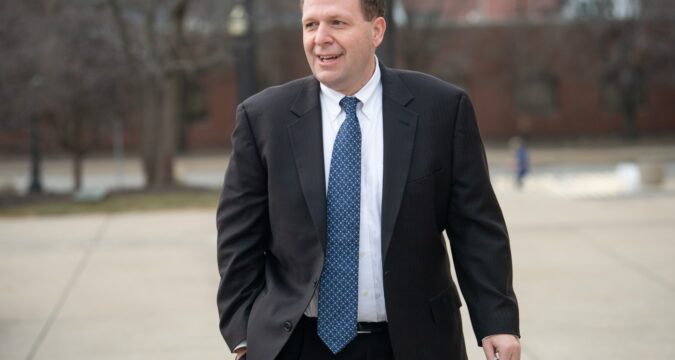
An Indiana House bill banning gratuities for public officials, which was drafted in response to the ongoing federal case against former Portage Mayor James Snyder, unanimously passed out of the House Courts and Criminal Code committee on Wednesday.
House Bill 1065 would make it a Class A misdemeanor for a person to offer a payment to a public servant as a reward for an official act taken by the public servant, or for a public servant to solicit or accept a payment as a reward for an official act performed by the public servant.
The bill, authored by State Rep. Hal Slager, R-Schererville, also increases the penalty to a Level 6 felony if the fair market value of the reward is at least $750.
The bill exempts a good or service that is subject to a reporting requirement or otherwise authored by an applicable rule or code of ethics. It further exempts plaques, trophies, framed photos, lawful political contributions and wages.
The committee amended the bill to include language from House Bill 1141, which would make the comingling of a political committee with personal funds up to $50,000 a class A misdemeanor.
Slager told the committee that multiple media outlets have asked him if the underlying bill stems from the case against Snyder.
“The answer is completely. Yes, it does,” Slager said. “What happened here was bribery and other charges were brought against the mayor regarding a piece of equipment that was contracted on behalf of the city and a payment received after the fact.”
On Nov. 17, 2016, Snyder was indicted on one count of defrauding the IRS and two counts of bribery, one involving towing contracts and the other involving garbage trucks,
A jury in U.S. District Court in Hammond found Snyder not guilty on the charge involving the towing contract, but convicted him twice on the garbage truck charge, a case that made its way to the U.S. Supreme Court, which deemed in June of 2024 that the $13,000 payment Snyder received over a garbage truck contract was a gratuity, not a bribe, because the payment came after the contract and not before. In the ruling, the court noted that Indiana didn’t have a law against gratuity, so the court ruled in Snyder’s favor, Slager said. The case was remanded to the lower courts.
A jury convicted Snyder on the IRS charge, which involved his personal business and not his duties as mayor at the time, and that conviction had remained unchallenged. Snyder is currently scheduled to be sentenced on March 10 at the U.S. District Courthouse in Hammond.
“That became obvious that we’ve now opened the door to making that legal,” Slager said. “I think it’s not in our best interest to allow public officials to receive payments of any kind for doing their official duty.”
State Rep. Matt Pierce, D-Bloomington, said he supports the bill because it will prevent public officials from accepting money after taking a vote or other official actions.
“We don’t want them taking gratuities after they’ve done a favor for someone,” Pierce said.
Pierce said the U.S. Supreme Court’s decision in Snyder’s case “was pretty bad.” Pierce said without a gratuity law — as long as he didn’t collude with anyone in advance — Pierce could leave a House session and stand in the hallway with a credit card machine and ask people to tip him if they support his work and votes.
“As long as I haven’t colluded and pledged ahead of time to vote a certain way in exchange for money, it’s not a bribe. It can just be a tip,” Pierce said. “I can’t imagine the public would be very comfortable with that kind of thing. But for the Supreme Court, they thought it was just okay.”
The bill passed out of committee 13-0. It will move forward for consideration by the House.


