
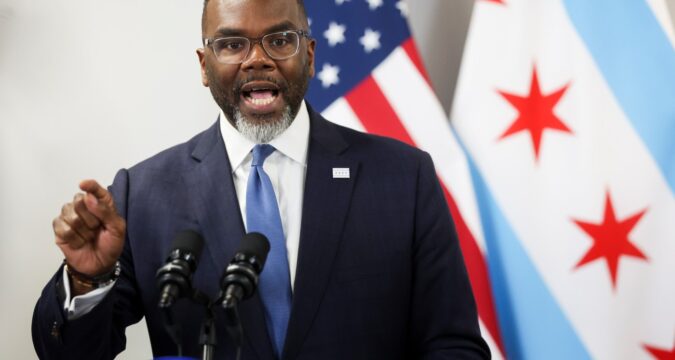
Mayor Brandon Johnson said Tuesday the city will not try to buy back Chicago’s parking meters after all, following days of speculation over whether he would attempt to find a way out of an infamous sale almost two decades ago.
Speaking to reporters at an unrelated event, the mayor confirmed he will forgo potentially purchasing the meters from the private company Chicago Parking Meters LLC.
Johnson said his team looked into making a bid for the citywide system, which the company took control of for $1.2 billion in a 75-year lease the City Council approved at Mayor Richard M. Daley’s behest in 2008, but determined the cost was “far too high.”
He said it would cost at least twice as much as that original lease price to buy the meters back, adding that the cash-strapped city would need to borrow to finance the purchase.
Chicagoans overwhelmingly hate the deal — which has seen the private investors already recoup their investment and then some with decades of control ahead of them and parking rates continuing to rise — and City Hall has been trying for years to figure out how to break it, to no avail.
“I want to put the rumors to bed. We are not pursuing a purchase of the city’s parking meters at this time,” Johnson said. “This purchase would have made a bad deal even worse. The price was too high and requires debt service payments that extend too far and impose too much risk. Chicagoans would most likely end up footing the bill yet again for this original decision to privatize our parking.”
The mayor said any potential buyback would require all parking revenues to go toward debt service for about the next four decades, which “would eliminate the flexibility to lower rates for residents or remove parking meters to make way for pedestrian ways and bike lanes.”
The council, in turn, would have to vote on hiking parking rates year after year, Johnson argued. He hinted that public transit expansion, automated vehicles and additional bike lane construction could also impact future parking habits, making any revenue projections on a meter purchase deal premature.
A spokesperson for Chicago Parking Meters did not immediately respond Tuesday. Johnson declined to share specifics on the negotiations beyond his remarks on the purchase price.
The company reported over $160 million in parking revenues in 2024, up from nearly $151 million in 2023, the two most recent years for which revenue data is available.
Top Johnson advisor Jason Lee shared little Tuesday morning, citing a non-disclosure agreement, but he broadly criticized the original parking meters sale. The contract was one sided and the money the deal raised for Chicago was quickly spent, he said.
“Things come across the desk and we do due diligence on things that are presented,” Lee said ahead of Johnson’s announcement. “You have a fiduciary responsibility to look at all possibilities.”
Facing the fallout from the 2008 recession, the city sold a 75-year lease of the city’s 36,000 parking meters to a private buyer led by Morgan Stanley, agreeing to also boost fees for the first time in 20 years. Though it was the first of its kind nationally, it was just one privatization effort under Daley, coming on top of the lease of the Skyway toll road, downtown parking garages, and the attempted, but failed privatization of Midway Airport.
The deal was set to net the city about $1.15 billion — with $150 million being dedicated to plugging the city’s deficit and $400 million being put into a long-term reserve.
Had the city kept the meters and raised rates to the same level it pledged in securing the deal, it was estimated back in 2009 the city would have still earned about $1.5 billion over time.
Between 2009 and 2024, the meters had brought in more than that, however — $1.97 billion in parking revenues alone, $1.87 billion in gross profits and net operating income of $1 billion, according to CPM audits. Meanwhile, the city ran through much of the initial payout to plug early budgets.
Mayor Rahm Emanuel revised the deal in 2013 to allow for free Sunday parking, different hours of operation and the ability for drivers to pay by phone. Efforts to unwind the lease have been unsuccessful. That included a 2009 lawsuit arguing the privatization deal went against the city’s right to create parking and traffic policy and tied future officials’ hands; and a 2021 class-action suit alleging CPM had a “monopoly” that was unfair to drivers.
The bad agreement of the past only made it more important for Johnson and his team to be judicious, Lee said. “It would be easy in a fit of exuberance to rush into another bad deal. So you have got to be very careful and scrutinous because there’s a lot of risk.”
The City Council would need to approve any parking meter sale, to the city or a new private owner, Lee said. Such a review could give Johnson and aldermen a chance to win more favorable terms from a buyer, even if the city does not buy the system itself.
Ald. Bill Conway, 34th, said Tuesday morning he first heard of a planned sale of the meters by its current owner from friends in private equity. The downtown alderman, a DePaul University finance professor himself, believed the latest debt sale by Johnson’s administration – unnecessarily large, in his view – may have been sized with a parking meter deal in mind.
Whether or not a new deal would have been a good idea would have depended on a number of factors, he said, speaking before Johnson’s backed away from the rumored purchase. Major changes in how Chicagoans use cars make the matter hard to predict, he added.
“The devil’s in the details,” he said.


