It will be a freezing cold Sunday night at Soldier Field, where the wind will be bitter and spectators warmed by libations and layers, and where, with any luck for those frigid, bundled masses, they will celebrate in unison as often as possible with their beloved anthem.
The song may well be louder that night, if the circumstances align. It may well be sung with more reverence. There may be more fervency upon its singing throughout the old stadium. And if it all happens the way the Bears and their supporters hope, the words may echo deep into the city:
BEEEAAAR DOOOWWWN, CHICAGO BEARS!
During home games, the music plays every time the Bears score. The familiar melody begins. The words erupt, with tens of thousands forming a kind of a giant church chorus defined not by denomination but devotion to a franchise that has long left its supporters questioning their faith.
Until now, that is. The Bears are in the midst of their best season in 15 years. It has been that long, since January 2011, that Soldier Field has hosted a playoff game this late into the NFL calendar. And so when an NFC Divisional playoff game begins against the Los Angeles Rams, kickoff timed perfectly for after dark, cold turning colder, a religious-like madness will grip Chicago.
Indeed, it will be time to Bear Down.
Jeremy Schmidt shows off his Bear Down fingernails while tailgating before the Chicago Bears face the Tennessee Titans in the season opener Sept. 8, 2024, at Soldier Field. (Brian Cassella/Chicago Tribune)
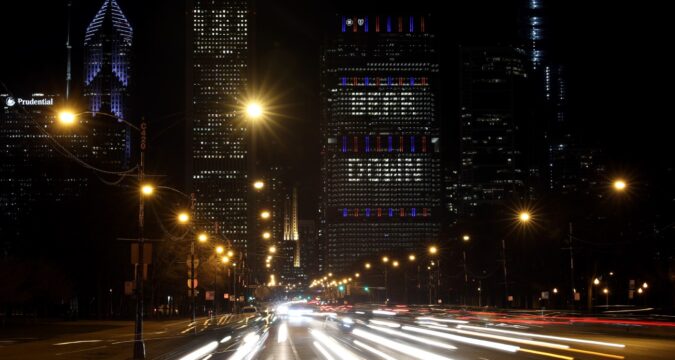
The words, stretched out into long, rhythmic notes at the beginning of the team’s fight song, have long been synonymous with the city. But it’s the playoffs now, and the Bears are a victory away from the NFC Championship game, and so “Bear Down” is even more ubiquitous than usual: on marquees at the front of city buses; in lights on the south-facing side of the Blue Cross Blue Shield tower downtown; on flags and in group texts and on shirts and everywhere, really.
Bear Down. Or, in song form: BEEEAAAR DOOOWWWN.
And all because, 85 years ago, a well-known composer accepted a challenge. A bet, of sorts.
Back then, Al Hoffman had made plenty of great music. He was in the midst of a career in which he had written. “worldwide smashes,” his great-nephew, Josh Max, told the Tribune. Some of Hoffman’s songs gained fame when the likes of Frank Sinatra, Perry Como and Tony Bennett, just to name a few, recorded them.
Hoffman, who died at 57 in 1960, often wrote his music with a colleague or two. And so in the early 1940s, one of his contemporaries offered a challenge. A kind of dare for Hoffman to prove himself: If he really was the songwriter he believed himself to be, it was time to write a solo hit.
Bears halfback George McAfee (5), running out of T Formation, scores a touchdown in the 73-0 win over Washington in 1940. (Chicago Tribune historical photo)
At the time, the Bears just so happened to be in the midst of dominance that allowed for cultural transcendence. A mythology was building. These were the Monsters of the Midway days, with George Halas as head coach and the 73-0 victory against Washington in the 1940 NFL championship game. And, after some thought, Hoffman had the subject of his attempt at a hit.
Who knows how easily the first two words came or how hard he labored.
Now they roll off the tongue, and will throughout Chicago on Sunday: Bear Down.
A boy from Minsk
Max, himself a musician and a performer, grew up hearing stories about his great uncle. About his music and talent for songwriting. About his appearance – how Hoffman was a “funny-looking guy, too,” with a crooked smile and a habit of writing songs while he smoked a carton of cigarettes.
Hoffman was born into a Jewish family in Minsk — now the capital of Belarus but then a part of Russia — in 1902. Six years later, amid oppression and political unrest, the family moved to America, Hoffman and his four siblings quickly needing to adapt to a new world. He developed a talent for words and music. A brother, David, became a stage and film actor.
When Al Hoffman wrote “Bear Down” he did so after returning from England, where he’d worked for years, and for unknown reasons he wrote it under the pseudonym of Jerry Downs. The song soon took off, like “bang, there you go,” Max said, and one of its most prominent early appearances came in October 1942, upon Halas’ departure to serve in World War II.
George Halas, owner-coach of the Chicago Bears, is presented a sword during halftime by Lt. Cmdr. Carl Olson, senior member of the Naval Aviation Cadet Selection Board, in October 1942. It was the Bears last game at Wrigley Field under Halas, who had been commissioned a lieutenant commander. (Chicago Tribune historical photo)
During halftime of a Bears-Eagles game at Wrigley Field, Halas, who was days away from assuming his role as a lieutenant commander in the Navy, received a ceremonial sword. A marching band serenaded him with “Anchors Aweigh” and “For He’s a Jolly Good Fellow,” and also with a new tune that was not yet two years old: “Bear Down, Chicago Bears.” With that, Halas was off to war.
Among the 1,500 songs that Hoffman wrote, or helped write, several endure. There’s “Mairzy Doats,” and “Takes Two to Tango,” and “Who Walks In When I Walk Out?” and “Papa Loves Mambo,” among a long list of others. But there’s a better than good chance that none of them will be sung in unison by about 62,000 people in a football stadium on Sunday night.
There’s a good chance that none of their lyrics have become as identifiable with a place either.
‘A nod to each other’
Brittney Payton cannot remember the first time she heard “Bear Down.” She was practically a newborn when the ‘85 Bears won the Super Bowl and became, arguably, Chicago’s most beloved team of all time. She was still a toddler when her dad, Walter, retired at the end of the 1987 season as the NFL’s all-time leading rusher.
She remembers the last time she heard the phrase, though, when she was out and about. It was just last weekend in Scottsdale, Arizona, where Brittney moved in the middle of the pandemic after about a decade working in Chicago television. Last Saturday, Brittney’s daughter had her first flag football game. (The name of her team is, you guessed it, the Bears.)
When the game ended, the kids requested a trip to Portillo’s. Brittney and her family walked in, she said, to a restaurant full of people in Bears gear. She was wearing hers, too, for her daughter’s game. Soon enough the greetings began — a steady stream of Bear Downs, with Phoenix-area locals likely not knowing they were bestowing them upon the daughter of the greatest Bear of them all.
In that moment, she said, she was “just another Bears fan.”
And all the exchanges of “Bear Down” was “like a nod to each other.”
“Kind of like Jeep drivers,” she said. “They always kind of salute each other when they’re driving by.”
Brittney Payton, from left, Connie Payton-Strotter and Jarrett Payton watch a video tribute to Walter Payton during halftime of the Bears vs Browns game at Soldier Field in Chicago on Nov. 1, 2009. (Scott Strazzante/Chicago Tribune)
When she was growing up in the 1990s, Chicago belonged to Michael Jordan and the Bulls. The Bears entered into a malaise in the post-Mike Ditka years, and though Brittney understood how much the city adored her father — she often attended Bulls games with him and her brother at the United Center — it wasn’t until she got older that she understood the meaning of Bear Down.
As a student at DePaul, living downtown, she often went to games at Soldier Field. She became “immersed,” she said, in the culture surrounding the team. She heard the fight song too many times to count. She better understood the symbolism of it all, and the large part her father and those 1980s Bears teams had in giving meaning to the song’s first two words.
“It’s like a rallying call,” she said. “It’s a sense of pride. It’s a sense of, just — a sense of team. Not just with the players, but with the fans, with the city. It means so much. And it’s a sense of like, “Let’s go, let’s go. Let’s get down. Let’s get to work, and let’s get to business and go out there and win.’”
Brittney was at Soldier Field for the Bears’ season-opener in early September, and watched a narrow Monday night loss against Minnesota. A blowout defeat six days later in Detroit might have rekindled a familiar feeling of disappointment and here-we-go-again among Bears supporters. But then came nine victories in 10 games, and a burgeoning resilience.
Then came more reason to play the song and say the words.
A Chicago Bears cheer team member waves a ‘Bear Down’ flag after a field goal in the third quarter of a preseason game against the Tennessee Titans at Soldier Field on Aug. 12, 2023, in Chicago. (John J. Kim/Chicago Tribune)
Bear Down became fashionable, again. Brittney plans to fly home for the game Sunday. To be there in person for the Bears’ first divisional playoff game in 15 years and “to see the electricity,” as she put it.
“And I just know that stadium is going to be abuzz. On fire,” she said. “It’s going to be amazing. And to hear that (song), and there’s going to be lots of Bear Downs going on on Sunday, that’s for sure.”
The song endures
Those words mean different things to different people, and signify pride for many. For Brittney Payton, Bear Down is a connection to family. For Bears fans and a great many Chicagoans, it’s a communal phrase that bonds; the NFL version of “Roll Tide”
When Max hears the words he thinks of his great uncle. He’s reminded of his family’s origin story.
“I feel proud to be a part of America,” he said. “In that, it’s atypical I guess these days — a guy with nothing, five kids coming from Belarus, because they’re getting chased out because of the pogrom, and two of them do really, really well, you know, like in show business. That’s a big deal.”
Al Hoffman wrote better songs. More artistic songs. He wrote more timeless lyrics than the line in “Bear Down” that goes: “We’ll never forget the way you thrilled the nation with your T-formation.” But did he write a more enduring song? The Bears’ version of the T-formation, after all, went out of style a long time ago. And yet the song lives on.
Chicago is a city in which sports and music have always been closely intertwined. It’s difficult to hear Alan Parsons’ “Sirius,” for instance, without thinking of the ’90s Bulls’ starting lineup introductions at home games. When the Cubs win, the sound of Steve Goodman’s 1984 song “Go, Cubs, Go” can be heard blaring throughout Wrigleyville.
“Bear Down, Chicago Bears,” meanwhile, remains the Granddaddy of Chicago sports anthems, one a marching band used to help send George Halas off to war more than 80 years ago, and one that will play on, again, at least for one more night on Sunday at Soldier Field. Max, who lives in Los Angeles and works music and stand-up gigs, wishes he could be there to hear it. To feel it.
To perform it, along with tens of thousands of others.
“Man, you know what?” he said at the thought of attending a Bears game. “If I could go there and be flown in there, and put up, I would sing, ‘Beeeaaaar Doooowwwwn, Chicago Bears!’”
And over the phone, he’d broken into a full-throated song.
https://www.chicagotribune.com/2026/01/18/bear-down-chicago-song-history/


