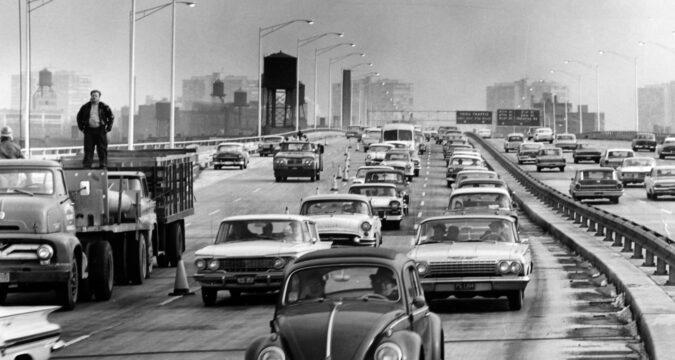
For people moving to Illinois, getting familiar with Chicago’s expressways — which are referred to by name instead of number — can be confusing.
Many of these names are easily recognizable, but others can be more obscure.
Here’s a look back at what expressways and major roads in and around the city were originally called, and when their names were changed.
William Edens Expressway (I-94, U.S. 41)
Charles Casey, Col. William Edens, William Erickson, Maj. George Quinlan and Dan Ryan wield scissors to cut a ribbon opening the new Edens Expressway in the snow at the Caldwell Avenue overpass on Dec. 20, 1951. (Louis Paus/Chicago Tribune)
Boundaries: West Park Avenue in Highland Park south to the Kennedy Expressway near Montrose.
Originally called: Skokie Highway/Edens Parkway or Super-Highway
When the new six-lane highway was dedicated at the North Caldwell Avenue/West Peterson Avenue overpass on Dec. 20, 1951, the namesake of “the first fully completed route in the county superhighway program” was in attendance. Col. William Edens — who celebrated his 88th birthday one month prior — was one of five men who attended the ribbon-cutting ceremony held during a snowstorm. A former banker, Edens is credited with taking Illinois out of the mud by promoting the state’s first highway bond issue in 1918, as president of the Illinois Highway Improvement Association.
Initially extending from the Lake-Cook county line to Foster and Cicero avenues in Chicago, the Edens replaced Skokie Road and Cicero Avenue as the main routes to Milwaukee.
John F. Kennedy Expressway (I-90, I-94, I-190)
Standing beside Mayor Richard J. Daley, left, President John F. Kennedy shakes hands with Fire Commissioner Robert Quinn upon arriving at O’Hare International Airport on April 28, 1961. The president and his party made a fast trip into Chicago by way of the Northwest Expressway, renamed a few years later for Kennedy after he was assassinated. (Luigi Mendicino/Chicago Tribune)
Boundaries: The Circle Interchange — where the Kennedy, Dan Ryan and Eisenhower expressways meet — northwest to O’Hare International Airport.
Originally called: Northwest Expressway
Tribune reporter Hal Foust had an early look in October 1960 at the completed 16-mile highway, which stretched from the Congress (now Dwight D. Eisenhower) Expressway to O’Hare International Airport.
Foust called it, “a superhighway so modern, so elaborate in special features that it makes Congress Expressway, under construction for 15 years, look outmoded. The Northwest improvement represents more than a decade of advancement in highway engineering.”
The Northwest Expressway cost more than a quarter billion dollars. It was expected to cut driving times from the Loop to O’Hare from an hour to 25 minutes (under the posted 45-mph speed limit) when it was dedicated Nov. 5, 1960.
City Council voted Nov. 29, 1963, to rename the expressway in honor of President John F. Kennedy — one week after he was assassinated.
Dwight D. Eisenhower Expressway (I-290, Illinois 110, Illinois 53)
President Dwight D. Eisenhower started a trip from Glenview to Evanston to give a speech before a crowd of thousands in Deering Meadow at Northwestern University in August 1954. (Chicago Tribune historical photo)
Boundaries: Named section of “the Ike” runs from the Circle Interchange to Illinois Highway 83 at the border of Addison and Elmhurst.
Originally called: Congress Expressway
Five miles — from Ashland Avenue to Laramie Avenue — of the $150 million superhighway project was opened to drivers Dec. 15, 1955. It marked a decade of construction and “a half century of dreaming — back to the 1907 plan for Chicago by the late Daniel H. Burnham,” Foust reported. (The full 15 miles was dedicated on Oct. 12, 1960.)
But the celebration was kept brief.
“I have heard talk about Congress Street for 30 years,” Cook County Board President Dan Ryan told the crowd. “That’s enough talk. Let’s drive it.”
On Jan. 10, 1964, seven miles of the expressway was unanimously renamed by City Council in honor of President Dwight D. Eisenhower. Eisenhower signed into law the first Federal-Aid Highway Act of 1956, which called for an interstate highway network to join cities across the country.
Daniel B. Ryan Expressway (I-90, I-94)
The ribbon-cutting scene as a three-mile section of the Dan Ryan Expressway was opened Dec. 12, 1961. Wielding scissors are Mayor Richard J. Daley, Dan Ryan III, Marcy Ryan, Gov. Otto Kerner, John J. Duffy, County Board President; William Mortimer, county highway Superintendent; and County Commissioner Seymour Simon. Mrs. Dan Ryan stands with her two grandchildren. (Jack Mulcahy/Chicago Tribune)
Boundaries: Circle Interchange south to where Interstate Highway 57 and the Bishop Ford split.
Originally called: South Expressway
Snow flurries, strong winds and a shivering crowd marked the Dec. 12, 1961, opening of the first three-mile section of the $300-million expressway.
The superhighway is named in honor of Dan Ryan Jr., who was Cook County Board of Commissioners president and member for more than 33 years. He died of a heart attack eight months before the expressway opened. Ryan’s wife, Ruby, served out his term on the board and was among the commissioners who voted Nov. 28, 1961, to approve the name change.
Robert Kingery Expressway (I-80, I-94, U.S. 6)
Robert Kingery, of Winnetka, was the secretary and general manager of the Chicago Regional Planning Association. Editors note: this historic print shows some hand painting. (Chicago Tribune archive)
Boundaries: Indiana state line west to Illinois Highway 394, Interstate Highway 294 and the Bishop Ford Freeway.
Originally called: Tri-State Expressway/Highway
The governors of Illinois and Indiana were on hand Dec. 13, 1951, to dedicate the superhighway that connected to the Calumet Expressway (now Bishop Louis Henry Ford Freeway). It was originally designed as a bypass around the city.
The route was renamed in 1953 for the late Robert Kingery, who as general manager of the Chicago Regional Planning Association promoted the route as early as 1926. Just prior to his death in November 1951, Kingery had also been appointed chairman of the newly created Chicago Regional Port District.
Jane Addams Memorial Tollway (I-39 toll, I-90 toll, U.S. 51 toll)
Jane Addams, circa 1914. (Library of Congress)
Boundaries: From the Interstate 90 intersection with I-294 to the Wisconsin border.
Originally called: Northwest Tollway
Barriers were lifted on 76 miles of Illinois tollways — including the Northwest Tollway — on Aug. 20, 1958. The initial cost per car was 2 cents (or about 22 cents in today’s dollars). Illinois Gov. William Stratton marked the occasion near Elgin by watching a historical pageant of ox-drawn wagons. It was a reminder that the Northwest Tollway followed a territorial route.
Vintage Chicago Tribune: Nobel Prize winners with Chicago connections
The Illinois Toll Highway Authority voted Sept. 7, 2007, to rename the Northwest Tollway in honor of Jane Addams. Even those who recognize her name think of Addams simply as the founder of Hull House in Chicago in 1889 and the caretaker of the urban poor. They might not be aware of her highly unpopular international crusade for peace during World War I, which earned her the Nobel Peace Prize in 1931.
The first stretch of Chicago-area interstate to be named for a woman, it takes motorists near Addams’ hometown of Cedarville, Illinois, and Rockford, where she studied at what is now Rockford College.
Adlai E. Stevenson II Expressway (I-55)
President Harry S. Truman, left, and Gov. Adlai Stevenson II at the Democratic National Convention on July 26, 1952, at the International Amphitheatre in Chicago. (Chicago Tribune historical photo)
Boundaries: Named section runs from Lake Shore Drive to County Line Road in Burr Ridge, the Cook County border with DuPage County.
Originally called: Southwest Expressway
Chicago’s third major expressway to open in four years was dedicated Oct. 24, 1964. As with the Kennedy and Dan Ryan expressways, the Southwest required financial cooperation from federal, state, county and city governments. The result: “A marvel in engineering,” said Rex Whitton, federal highway administrator.
There were so many politicians who wanted to speak at the event — which was held a month before the election — the ceremonies lasted all day.
“In essence it was a Democratic holiday, with officeholders stressing accomplishments under that party,” Tribune reporter Hal Foust wrote.
City Council approved the name change to the Stevenson Expressway Sept. 1, 1965 — less than two months after the former Illinois governor, presidential candidate and ambassador to the United Nations died of a heart attack in London.
Bishop Louis Henry Ford Freeway (I-94, Illinois 394)
Bishop Louis Henry Ford in front of his South Side church, St. Paul Church of God in Christ, at 4528 S. Wabash Ave. on April 11, 1990. (George Thompson/Chicago Tribune)
Boundaries: Dan Ryan Expressway south to the Kingery Expressway, where Illinois Highway 394 and I-294 meet.
Originally called: Calumet Expressway
The first segment opened in early 1950, but a bigger chunk was completed and opened with the Tri-State Expressway in late 1951.
State lawmakers renamed the Calumet on May 23, 1996, in honor of Bishop Henry Louis Ford. It is the only Chicago-area expressway that includes a person’s title. The longtime South Side clergyman led the 8.5-million member Church of God in Christ before his death in 1995.
Ronald Reagan Memorial Tollway (I-88 toll, Illinois 56 toll, Illinois 110)
Tampico, Illinois, shown Oct. 2, 1980, is the birthplace of Ronald Reagan. (Carl Hugare/Chicago Tribune)
Boundaries: Toll portion of Interstate Highway 88, which runs from I-294 west to Sterling in northwestern Illinois.
Originally called: East-West Tollway
The westward extension of the Congress Expressway at Mannheim Road to U.S. Highway 30 west of Aurora was opened Nov. 21, 1958.
“It is now possible to drive 35.5 miles of continuous expressway, tollway and freeway from Maywood’s 1st Avenue to west of Aurora,” Tribune reporter Foust wrote.
East-West Tollway was renamed June 14, 2004, in honor of the 40th president, Ronald Reagan at the request of then-Gov. Rod Blagojevich. Reagan was born in Tampico, Illinois, and the toll road passes just south of Reagan’s childhood home in Dixon. The name change came days after Reagan’s death.
Melvin Amstutz Expressway (Illinois 137)
Melvin Amstutz, the Lake County highway superintendent, circa 1950. Editors note: this historic print shows hand painting of the background. (Chicago Tribune archive)
Boundaries: A 1.3-mile strip from 24th Street to Buckley Road that replaced Sheridan Road at the south end of North Chicago; and Genesee Street in Waukegan to 2.8 miles past downtown north to Greenwood Avenue.
Originally called: Lakefront Expressway/Highway, Amstutz Highway
Melvin Amstutz was the longtime Lake County superintendent of highways who advocated for more and better highways to meet the demand of the area’s rising population.
In 1955, Amstutz proposed an abandoned Chicago North Shore Line and Milwaukee Railroad line be converted into a four-lane highway from Wilmette to Waukegan to relieve projected congestion on Sheridan and Green Bay roads. Eleven years later, Lake County bought a 13-mile chunk of property for $1 million (or $10 million in today’s dollars). Amstutz died in 1970, which prompted the Lake County Board of Commissioners to name the project in his honor.
To many, the expressway is known as the “road to nowhere.” Estimates to complete its 2.7-mile missing link between Waukegan and North Chicago could top more than $100 million.
But Hollywood embraces the stretch of pavement, which can be closed without causing any real disruption in traffic. The Amstutz has been featured anonymously in “The Blues Brothers” (1980); “Planes, Trains and Automobiles” with Steve Martin and John Candy (1987); “Ordinary People” with Mary Tyler Moore (1980); and in a scene from “Groundhog Day” that was filmed in March 1992. “The Fugitive” and “Southside with You” also used the road for filming.
Frank Borman Expressway (I-80/94)
Apollo 8 astronauts James Lovell, from left, command module pilot; William Anders, lunar module pilot; and Frank Borman, commander, stand in front of a mission simulator prior to a training exercise for their scheduled six-day lunar orbital mission at the Kennedy Space Center in Florida on Dec. 18, 1968. (AP)
Boundaries: From the Indiana state line to the intersection with the I-90 toll road.
Originally called: Tri-State Expressway
Astronaut Frank Borman, a Gary native, was feted locally after he commanded the Gemini 7 mission in 1966, and again in 1969 after the Apollo 8 mission — in which he, Jim Lovell and William Anders became the first people to orbit the moon.
A resolution was adopted in January 1969 to rename the part of the Tri-State Expressway that travels through Lake County, Indiana in honor of Borman.
Jane Byrne Interchange
Jane Byrne and supporters, along with her campaign manager Don Rose, in glasses on left, exult in her upset victory over Mayor Michael Bilandic on Feb. 27, 1979, in the Democratic mayoral primary in Chicago. (Anne Cusack/Chicago Tribune)
Boundaries: Where the Ryan, Kennedy and Eisenhower expressways meet.
Originally called: Circle Interchange
Chicago’s first female mayor, Jane Byrne was elected in 1979 and was mayor through 1983. She was appointed commissioner of consumer sales in 1969 by Mayor Richard J. Daley. She was later fired by Mayor Michael Bilandic in 1977, whom she later defeated in the mayoral primary.
The interchange was renamed for Byrne in 2014. A nine-year renovation was finished in late 2022.
Jean Baptiste Point DuSable Lake Shore Drive (U.S. 41)
A statue of Jean Baptiste Point DuSable, a Haitian-born trader dubbed the “founder of Chicago,” sits on Michigan Avenue at the Chicago River, Oct. 18, 2009. (Brian Cassella/Chicago Tribune)
Boundaries: From the intersection of Sheridan Road and Hollywood Avenue south along the lakefront to Ewing Avenue.
Originally called: Lake Shore Drive
Though not much is known about him, Jean Baptiste Point DuSable was the city’s first permanent non-native settler. He moved here in the late 1700s, married a Potawatomi woman named Kittihawa and had two children, Susanne and Jean. The family settled near the Chicago River, where DuSable built a home, and later, a trading post, with a mill, a bake house and a barn, among other small buildings.
On May 7, 1800, DuSable sold his properties in Chicago. Soon after, he moved to St. Charles, Mo., where he lived until he died in 1818.
In 1993, then-Ald. Toni Preckwinkle sponsored a proposal within a City Council committee to rename Lake Shore Drive for DuSable. It was defeated in an 8-2 vote. Aldermen revisited the idea in late 2020, and voted 33-15 on June 25, 2021, to rename it Jean Baptiste Point DuSable Lake Shore Drive.
Ida B. Wells Drive
Ida B. Wells in 1893 in Chicago. (Chicago Tribune archive)
Boundaries: From Grant Park west to the entrance to the Eisenhower Expressway
Originally called: Congress Parkway
Also known by her married name, Ida B. Wells-Barnett was an iconic investigative journalist who crusaded against the lynching of Black men, pushed for women’s right to vote and started numerous organizations that aimed to improve the economic and social status of African-Americans. She was born into slavery in Mississippi, but went on to be a schoolteacher and created the first kindergarten for Black children.
Wells-Barnett settled in Bronzeville in 1894 after her life was threatened, and she developed a reputation as a fearless activist and political strategist. She died in 1931.
Chicago City Council voted July 25, 2018, to rename Congress Parkway to Ida B. Wells Drive. Elected officials, dignitaries, activists and great-granddaughter Michelle Duster gathered at the Harold Washington Library to officially celebrate on Feb. 11, 2019.
Wells-Barnett’s image was unveiled on a quarter in February 2025 by the U.S. Mint.
Want more vintage Chicago?
Become a Tribune subscriber: It’s just $1 for a 1-year digital subscription.
Thanks for reading!
Subscribe to the free Vintage Chicago Tribune newsletter, join our Chicagoland history Facebook group, stay current with Today in Chicago History and follow us on Instagram for more from Chicago’s past.
Have an idea for Vintage Chicago Tribune? Share it with Kori Rumore at krumore@chicagotribune.com.
https://www.chicagotribune.com/2026/01/15/vintage-chicago-tribune-expressways-roads-names/


