
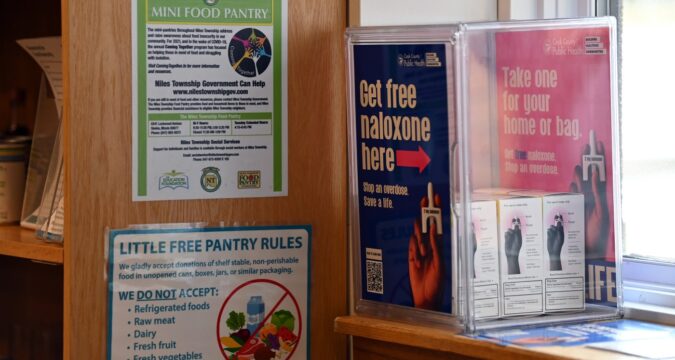
Even before a new state law went into effect Jan. 1 requiring public libraries to have opioid overdose-reversing medication on hand, several north suburban libraries had already stocked it and had for a while been prepared to administer it – echoing access benefits public officials extol.
Other local libraries, however, are just now starting to stock naloxone — the anti-opioid substance also known by the brand name Narcan — and sees it as an important new tool in their first aid kit.
The Illinois Local Library Act issued new provisions that took effect Jan. 1, that require libraries to keep a supply of opioid overdose reversal agents on hand and train staff to administer them in the event of a suspected overdose on their premises. Staff must also be able to identify and respond to an overdose.
State Rep. Anna Moeller, D-Elgin, had sponsored the bill calling for libraries statewide to offer and administer naloxone, believing that libraries – often popular community gathering places – can also be where someone could experience an overdose emergency.
Moeller said giving naloxone can be effective in helping someone survive an opioid overdose.
As of Jan. 1, 2026, Illinois public libraries are required to have on premises the anti-opioid medication naloxone, also known by the brand name Narcan. (Ismael M. Belkoura/Medill Illinois News Bureau)
Opioid-related deaths have dramatically declined in Cook County over the past few years, but remain a concerning cause of death. The Cook County medical examiner’s office reported that 683 people died of opioid-related overdose in 2025, with toxicology results pending in 180 cases that could affect that count.
In contrast, there were 1,026 deaths in Cook County due to opioid overdose in 2024, a count that was down about 44% versus the year before, according to the medical examiner’s office.
Library directors in Lincolnwood, Harwood Heights and Norridge told Pioneer Press their libraries had naloxone on hand way ahead of the state law taking effect, just as they have first aid kits and automated external defibrillators to treat sudden cardiac arrest.
For the Park Ridge, Niles-Maine and Morton Grove libraries, leaders said they had more than six months notice to prepare to comply with the new state law, and are ready and willing to provide the medication supplied free-of-charge to libraries by the Cook County Department of Public Health.
Since the library’s doors are open to everyone, area librarians collectively agree that it is important to be prepared.
Park Ridge
“It’s really part of the 21st Century first aid kit,” said Park Ridge Library Director Joanna Bertucci. “We see hundreds of people a day and we’re open 70 hours a week. If I have the opportunity to help someone in crisis, I want to have the tools and training to do my best to help them.
“If you have Band-Aids, ice packs and an AED, you should have Narcan,” Bertucci said. “There are only benefits to having it.”
Since September, the Park Ridge Public Library has stocked a total of three boxes each containing two doses of naloxone. A total of 25 staffers have been trained on how to identify an overdose and administer naloxone – in the form of a nasal spray – in case of an emergency.
Niles
The Niles-Maine Library District is not only adding the naloxone to its emergency first aid kits, it’s offering it up to anyone who enters the library’s doors.
“We do see the value in the resource,” said Executive Director Valerie Marshall.
She said on Sept. 25, library staff put a box of 12 doses of the anti-opioid medication in the front vestibule of the library, next to the food pantry, and saw the supply depleted eight weeks later.
“There is a need because people have taken supplies with them. We don’t ask questions; anyone is welcome to it. It seems like another service for us to provide to people,” said Marshall.
Library staff have since reordered and restocked, and have added four additional doses of naloxone to its two emergency first aid kits. Marshall said the initiative was not only to implement new policy to comply with the state law, but also followed a recent partnership with the social service agency Chicago House which had a table at the library and distributed naloxone in prior months.
When staff learned the Cook County Department of Public Health was providing naloxone, they decided to make it immediately available to patrons, Marshall explained. Meanwhile, Niles-Maine library staff identified as supervisors have been trained in administering the doses, she said, and an email link for additional online training was provided to all staff who were interested in the training.
Marshall said library staff have never witnessed potential overdoses in the library.
“In my personal opinion, us providing this service is another way to give information about public health and literacy about public health,” Marshall said. “A lot of people don’t know about the opioid crisis and that it may be within your community even if you don’t see it clearly. We’re providing help and information in a safe environment where people can access it.”
Morton Grove
Naloxone is new to the first aid kits at the Morton Grove Public Library, but a welcome addition for Executive Director Pam Leffler and her staff, she said. They received in-person training by the Cook County Department of Public Health and were also given supplemental online training resources.
Leffler said she will continue to require all 44 library staff members to be trained annually on administration of the anti-opioid substance.
“It’s certainly a lot simpler to administer Narcan than perform CPR, which made it easier for our staff and went a long way in easing concerns,” Leffler said. “We’re fortunate we haven’t had an issue with it but that doesn’t mean we wouldn’t. It’s better to have it and never need it than to need it and not have it.
“Given we’re open later and more accessible to a wide variety of people,” she said, “that in particular makes it even more important.”
Norridge and Harwood Heights
“It’s no hardship for us because we already have naloxone here,” Stacy Wittmann, library director of the Eisenhower Public Library District, said about complying with the new state law.
The library district serves residents in Norridge and Harwood Heights.
“We have actually been stocking a supply of naloxone at the library for a couple of years, just in case, as a precaution because we knew about the opioid crisis and we wanted to be prepared for any eventuality. Fortunately, we haven’t had to use it,” said Wittmann
She said library staff have been provided training and there have not been any confirmed cases of overdose incidents at the library. The Eisenhower library has eight boxes of naloxone, or a total of 16 doses, and just received a fresh supply last month.
Wittmann is planning more training for the entire staff in May.
“If someone sees a person in the library who is unresponsive, or suspect a drug overdose, they will call the person in charge and that person would access naloxone in the first aid area which is very easily accessible,” Wittmann explained. “They would ascertain the situation to see if the naloxone needs to be administered.”
She said the medication would be administered – as trained – and 911 called.
“I think it’s important to try to help if we can help because it’s a public building,” Wittmann said. “You have to meet people where they are, if there is a chance to save somebody’s life, why wouldn’t we do that?”
Lincolnwood
Susan Dove Lempke, library director of the Lincolnwood Public Library District, hosted a public program about opioids and how to use naloxone in August 2024 and decided then to have it available. She said library staff has never had to use the substance and never called police for an incident.
But, she said, they are ready, and shared training videos with staff to be aware of patrons who may be experiencing an overdose. Overdose behaviors identified include a person moving very slowly, speaking slowly, not speaking at all, not breathing or their lips and fingers becoming blue.
“I think most libraries are always happy to look out for the best for their patrons,” Lempke said. “It’s a building where people who are struggling tend to come; it’s warm and comfortable.”
Elizabeth Owens-Schiele is a freelancer.


