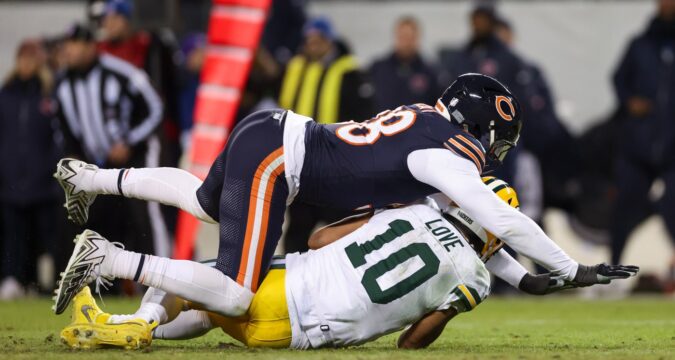
Chicago Bears’ Ben Johnson gave one last assessment of his team’s 31-27 win over the Green Bay Packers during his NFL playoff head coaching debut Saturday.
“Watching the tape, it’s just credit to them for being able to pull out a 21-3 deficit there at halftime, and the defense bowing up in the second half, only allowing six points, and then offense slowly chipping away and finding a way (during the) last three possessions to score touchdowns.”
The Bears scored 25 points in the fourth quarter to pull off their seventh comeback of the season — and the largest postseason rally (18 points) in franchise history.
As the Bears turn their focus to the Los Angeles Rams for Sunday’s divisional-round matchup at Soldier Field, they recognize the games will just get tougher.
“Where we’re at in the season, there’s going to be, after tonight’s game (between the Houston Texans and Pittsburgh Steelers) eight teams remaining, and all eight will be really well coached, they’re going to be really talented,” Johnson said. “It’s just the way it is in the playoffs. Once you get to Round 2, Round 3, there are no weak links.
“I’ve got nothing but respect for the opponent we’re going to play this upcoming week because they’re damn good. They’re No. 1 in offense in a number of categories. Their quarterback (Matthew Stafford) is playing at a really high level, an MVP-caliber level. And defensively, they create a lot of issues for you.
“So, this is going to take our best foot forward here to win this one this week.”
Here are five more things we learned from the Bears on Monday.
1. There’s reps and then there’s playoff reps.
Chicago Bears running back Kyle Monangai yells after getting a first down during the first quarter of an NFC wild-card game against the Green Bay Packers at Soldier Field on Jan. 10, 2026, in Chicago. (Armando L. Sanchez/Chicago Tribune)
Some of the Bears’ late-regular-season games may have felt like the playoffs, particularly those with last-minute comebacks, but much of the roster consists of postseason neophytes.
Second-year quarterback Caleb Williams made his playoff debut, as did the rookies, obviously, such as running back Kyle Monangai and tight end Colston Loveland.
But even an eighth-year veteran like wide receiver DJ Moore had never played a down of playoff ball before Saturday.
“First playoff game for a number of guys,” Johnson said. “So not only getting that experience, but also getting their first playoff win, I think that’s going to bode well for us going forward.
“This time of year, every point matters, every play matters, every blade of grass matters. And so we learned that throughout those 60 minutes there the other night.”
2. An early Bears play fooled the Packers later.
Green Bay Packers cornerback Carrington Valentine looks on as Chicago Bears wide receiver DJ Moore crosses the goal line to score a touchdown in the fourth quarter of an NFC wild-card game at Soldier Field in Chicago on Jan. 10, 2026. (Chris Sweda/Chicago Tribune)
On Chicago’s third offensive play of the game, tight end Cole Kmet and receivers DJ Moore and Luther Burden III lined up to the left in a bunch formation.
Williams threw a receiver screen to Burden, who picked up 12 yards and a first down as Moore bowled over Packers cornerback Trevon Diggs at the line to gain.
Then in the fourth quarter, with the Bears positioned at the Green Bay 25-yard line and 1:48 left, the Bears showed the Packers defense a similar look.
This time, it was tight end Colston Loveland bunched with Moore and Burden. Burden started slightly upfield and drifted back, like he was going to receive another screen pass, and Packers cornerback Carrington Valentine released the “blocker,” Moore.
By the time Valentine realized what was up, Moore was already headed toward the end zone and caught the game-winning touchdown.
Ben Johnson admitted the call was intentional.
“Sometimes the sequencing of plays early in the game does reveal itself later on in the game,” he said. “Yeah, that does happen.”
3. Caleb Williams’ iconic pass barely got the center’s attention.
Chicago Bears quarterback Caleb Williams celebrates after a Bears victory over the Green Bay Packers in an NFC wild-card game at Soldier Field in Chicago on Jan. 10, 2026. (Chris Sweda/Chicago Tribune)
The world watched in awe as Williams contorted his body — resembling Chicago Bulls legend Michael Jordan’s “Jumpman” logo — as he lofted a 27-yard completion to Rome Odunze on fourth-and-8 with 5:37 left in the fourth quarter.
Bears center Drew Dalman was otherwise occupied with blocking defensive tackle Karl Brooks. Dalman turned to look at Williams just as he released the ball.
“All that stuff is happening behind us, so you kind of see the ball and think, ‘That’s a pretty good throw,’” Dalman said. “But the fact that he’s jumping and getting hit, you see that after.
“There’s no one we trust more with the game on the line to make those plays. It’s awesome to have.”
4. Bears commiserate with injured teammates.
Chicago Bears linebacker T.J. Edwards is carted off the field during the second quarter of an NFC wild-card game against the Green Bay Packers at Soldier Field on Jan. 10, 2026, in Chicago. (Armando L. Sanchez/Chicago Tribune)
The loss of linebacker T.J. Edwards (broken left fibula) and left tackle Ozzy Trapilo (patellar tendon) to season-ending injuries Saturday still stung on Monday.
“We were really bummed to see Ozzy get hurt,” Dalman said. “A great guy, great teammate and player that showed up every day, is ready to go.”
Linebacker Tremaine Edmunds lost his main partner behind the front lines in Edwards, who had been in and out of the lineup all season with hamstring, hand and other injuries.
“He’s been fighting all year,” Edmunds said. “It’s just been one of those types of years where God’s got a bigger plan for him.”
Edwards missed the season opener against the Minnesota Vikings with a hamstring injury, and he aggravated it during the second half of the Bears’ road game against the Detroit Lions, subsequently missing the next two games.
Edwards later broke his hand in Week 9 against the Cincinnati Bengals, requiring surgery. He missed the next four games before returning to action for the Bears’ trip to Lambeau Field in Week 14.
“Obviously what happened to him earlier in the season, him battling to come back and obviously this happened to him,” Edmunds said. “I know there’s nobody else on the team, nobody else in the world who’d want to be out there with his guys more than him.
“We talk every day. That’s my brother. We came in together (as free agents on March 15, 2023) and just the bond and relationship we’ve built with one another, I feel that for him. … But I do know that a guy like that is going to bounce back from it.”
5. Can the Bears replicate the run defense?
Green Bay Packers wide receiver Romeo Doubs blocks Chicago Bears cornerback Jaylon Johnson as Johnson tries to tackle running back Josh Jacobs in the third quarter of an NFC wild-card game at Soldier Field in Chicago on Jan. 10, 2026. (Chris Sweda/Chicago Tribune)
The Bears turned up their pressure on Green Bay Packers quarterback Jordan Love during the second half of Saturday’s 31-27 win, but they also shut down the running game.
In the first half, Josh Jacobs toted the ball 12 times for 49 yards, a 4.1-yard average, with a couple of chunk runs from Chris Brooks and Jayden Reed.
But after the intermission, Chicago’s defense limited Jacobs to 6 yards on seven carries (0.9). In fact, Jacobs netted a yard on four rushing attempts in the fourth.
“We just did a good job executing. The guys up front dominated the line of scrimmage,” Edmunds said.
“That’s really just the message moving forward. We’ve got to win up front, us as linebackers got to do our thing as far as coming downhill and we’ve got to fill in the secondary. It’s all three levels.”
Sean McVay’s Los Angeles Rams rushing offense put up an average of 126.6 yards per game during the regular season, which ranked seventh. But they also finished with the league’s No. 1 total offense (394.6 yards per game).
“Obviously, big-time offense,” Edmunds said. “(Quarterback) Matthew Stafford’s playing big-time ball as he always does. … Weapons in the passing game. Running backs are real good. O-line’s good.
“They have a talented roster, so we’ve got to do a good job really looking at the field, seeing how they want to attack us and definitely make sure we execute at a high level.”
https://www.chicagotribune.com/2026/01/12/chicago-bears-what-we-learned-playoffs/


