
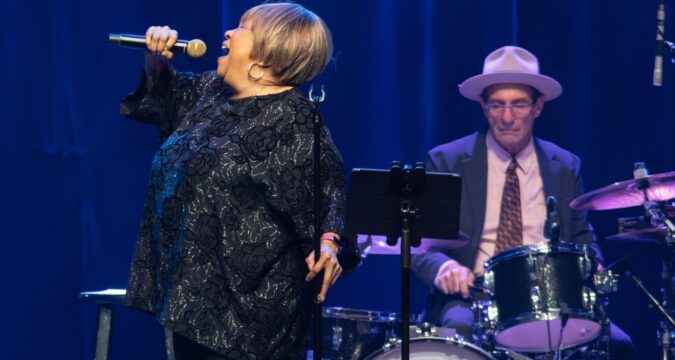
Mavis Staples leveraged more than 70 years of performance and activism to meet the moment Saturday at a sold-out Chicago Theatre.
Navigating a sociopolitical and cultural backdrop vastly different from the one that framed her jubilant 85th birthday celebration only 13 months ago at Auditorium Theatre, the local legend proved immune to losing hope or giving up in the face of developments that go against practically every concept she’s traditionally embraced in song and spirit.
Halfway into her 86th year, Staples led a vigorous charge against hate and oppression. Dressed in a black blouse and pants, and wearing a brilliant smile, the singer stood for the majority of the fearless 80-minute set. She sat for brief moments, and never for the entirety of a tune, her stance supporting the veracity of her repeated “I feel pretty good myself” claims. Staples was defiant, adamant, resilient, alert, cheerful, humorous. Nothing out of the ordinary for her, particularly in a live environment.
Yet amid current circumstances, her indefatigable enthusiasm and contagious optimism held greater meaning than at many of her prior shows this century. The four selections she chose to play from her new “Sad and Beautiful World” album underscored the stakes at hand. Ditto the fact that Staples left a few small openings for doubt and uncertainty — emotions that don’t often creep into her outlook.
Rather than downcast or defeatist, her acknowledgement of potential stumbling blocks came across as her way of admitting not every battle will result in victory, and that the struggle could be long and difficult. Truths she knows first-hand from journeying with her family in the Staple Singers in the contentious South during the civil rights era, and from her unwavering faith in a higher power.
She addressed both subjects during short between-song conversational breaks. The most endearing of which found her possibly mispronouncing Taylor Swift’s last name and initially misidentifying the title of the superstar’s 2014 hit “Shake It Off.” After realizing her error, Staples didn’t miss a beat. She admitted to having occasional “senior moments” and relying on her razor-sharp ensemble to help her when needed.
Guided by the stellar control of guitarist Rick Holmstrom, her five-piece band had her back at every turn. She didn’t require much assistance. Staples’ energy, passion and happiness filled the room with a warmth that evoked the presence of a favorite grandparent. Similarly, her radiant charisma, welcoming personality and cackling laughter served as reminders of what being truly alive looks and sounds like. She made it her mission to allow everyone in the building to share in that joy. And maybe, take it home with them for a while.
Per tradition, Staples recited several of her now-familiar statements to establish the mood and get people loose. As always, she meant everything she said. Staples paired vocal interjections — spontaneous commands uttered to spur on the group or crowd, emphatic assertions to redouble her own proclamations — with animated movements that helped connect her messages with the participatory traditions and compassionate tenets of the gospel church that formed the foundations of her career.
Slapping her knee. Rolling or clapping her hands. Extending her left arm as a salute. Patting Holmstrom on the shoulder as he extended a funky groove or laid into a slinky solo. Marching to a beat. Hugging back-up vocalist Kelly Hogan after serenading her with a few bars of “Happy Birthday.” Raising both arms in triumph. Staples’ physical gestures arrived as innate responses to the simmering rhythms and action-oriented lyrics. All the more appropriate for a national icon who took on the roles of instructor, preacher, healer, reporter, comforter, encourager, recruiter, disciple and, in circles that value vanity and greed, rebel and warrior.
Rich in throaty grit and raspy texture, Staples’ soulful deliveries demonstrated little evidence of limitations. Even if her ability to hold notes for extended periods has lessened, her propensity for reaching back, digging in and uncorking lines of considerable low-end depth suggested she remains as formidable a singer today as when her contemporary resurgence began in the mid-2000s.
Mavis Staples performs at the Chicago Theatre on Jan. 10, 2026. (Troy Stolt for the Chicago Tribune)
Relatedly, her phrasing, timing and dynamics revealed the nuanced techniques of a master — and expressive heft of a vocalist who sculpted each word to suit the situation. Staples avoided over-singing or using loudness for sensational effect. Never showy, albeit completely self-assured, she commanded attention whether growling bluesy declarations, humming wordless melodies or crooning soft assurances.
In several instances, Staples handed off verses to members of her band and swooped for the bridge and chorus, adding musical counterpoints and contrasts. She duetted with opener Nathaniel Rateliff on a minimalist rendition of “Friendship,” one of her late father’s final efforts. Entering from the rear flanks on a spunky cover of the Band’s “The Weight,” Staples explicitly volunteered for the task of bearing heavy loads. She aced the assignment throughout the evening.
The singer confronted climate change disasters, war-machine casualties and personal absences on the balladic “Human Mind.” Gunshots, police brutality and the death of innocents peppered a contemplative “Beautiful Strangers,” sung with a gentle grace that conjured a sweet lullaby even if the vulnerable narrative explored mortality. Despite a fog of sorrow hovering over both songs, Staples stayed resolved in her belief in the common good and humanity itself.
Mavis Staples performs at the Chicago Theatre on Jan. 10, 2026. (Troy Stolt for the Chicago Tribune)
Increasing the intensity, Staples leaned into the 1965 anthem “Freedom Highway” with a fervor that indicated she recognized its contemporary importance. Overt references to prejudice, inequality and confusion — along with the prescient line “The whole world is wonderin’ / What’s wrong with the United States” — echoed with unmistakable relevance.
For anyone seeking respite from life’s incessant storms, Staples offered relief and in-the-flesh evidence that lasting, unifying change can happen. Those principles fueled “I’ll Take You There,” deservingly given a romping treatment as the encore, and a bright, twangy reading of Eddie Hinton’s “Everybody Needs Love.”
Staples’ confidence in the transformative power of collectivity and positive thought peaked on an illuminating version of “Chicago.” Seen through her eyes, the Tom Waits tune emerged as part autobiographical tale, paean to her hometown and tribute to its spirit of resistance in the past year.
Having braved violent fearmongers and toxic cruelty before, and won, she’s come too far to turn back now. The forward momentum of her self-described “love train” won’t be stopped. Jump on board.
Bob Gendron is a freelance critic.
Setlist from the Chicago Theatre on Jan. 10:
“City in the Sky”
“I’m Just Another Soldier”
“Hand Writing on the Wall”
“Chicago” (Tom Waits cover)
“Beautiful Strangers”
“Freedom Highway”
“Respect Yourself”
“Human Mind”
“Friendship” (Pops Staples cover)
“The Weight” (The Band cover)
“Heavy Makes You Happy (Sha-Na-Boom Boom)”
“Everybody Needs Love” (Eddie Hinton cover)
Encore
“I’ll Take You There”


