MILWAUKEE — As usual, Marcia Lehman could not watch.
It had been that way for a long time, this habit of not watching her son’s races, Though it had become part superstition by now, it had always been more about coping. The truth is that she could not handle it. The anxiety. The nerves. The helplessness of being a spectator.
And so in the moments before Emery Lehman approached the starting line last weekend at the Pettit National Ice Center, Marcia made a familiar exit and walked outside. She began her go-to calming routine, pacing and smoking a cigarette or three. Anything to take her mind off the pressure and stakes, both of which felt much heavier than usual.
Emery Lehman, the Oak Park native and one of the fastest speedskaters in the world, was in that moment attempting to qualify for his fourth consecutive Olympics. Never mind that his place on Team USA was likely already secure, given his role on a formidable Team Pursuit squad that didn’t necessarily require he qualify individually.
To make the Olympics that way, though, by the appointment of a committee, felt like a consolation to him. It felt not quite as earned. And after dedicating much of the past 20 years to speedskating — after moving to Salt Lake City to train six years ago and after deciding that these Milan Cortina Winter Olympics would be his last, gold or bust — Lehman wanted to earn it.
He needed to earn it, in fact, after all he’d poured into the sport. Twelve years ago at the Sochi Games, then-17-year-old Lehman ascended from Oak Park, where he grew up, to become at the time the youngest person ever to make the U.S. Long Track Speedskating team. Everything back then was in front of him.
Emery Lehman skates on his way to winning the men’s 1500-meter competition on Jan. 4, 2026, during the U.S. Olympic Team Trials Long Track at the Pettit National Ice Center in Milwaukee. (Brian Cassella/Chicago Tribune)
Now, at 29, he entered the Olympic Trials last weekend in Milwaukee understanding the end was near.
He’d become what he long pursued when he was younger. He’d gone from chaser to chased, from young-and-up-and-coming to, as Lehman put it, “one of the older, grumpy guys on the team.” It wasn’t that long ago when he was looking up to Shani Davis, the Chicago native who won gold in 2006 and 2010, and to members of the U.S. team pursuit squad that won silver 16 years ago.
“I don’t know if I quite live up to their reputation to the younger guys now,” Lehman said, “but it definitely feels weird to be on the opposite end of that.”
‘It’s time’
In the months before trials, Lehman had been living in an odd kind of limbo typical for elite athletes in transition, in any sport. He found himself ready for the end, and for his final finish line. Yet now that it was in sight, it conjured all kinds of emotion. He spent most of the past four years, since winning bronze in team pursuit in Beijing in 2022, working toward an ending.
The ideal finish is obvious enough: a gold medal in team pursuit, reveling atop the podium with teammates Casey Dawson and Ethan Cepuran, a native of Glen Ellyn who Lehman watched grow up. The trio has been skating together for most of the past four years. They won gold last March at world championships in Norway and they all know the stakes approaching Milan.
“I don’t think it’s really something that needs to be said,” Lehman said. “Between the three of us, it’s something that’s just understood.”
His teammates in that event, though, may well have another chance after Milan. Dawson and Cepuran — “I’ve known Ethan since he was sitting on a bucket in the middle of the ice,” Lehman said, remembering when Cepuran was practically a newborn — are both 25.
Emery Lehman, right, celebrates with teammate Casey Dawson after winning the men’s 1500-meter competition and qualifying for the Olympics on Jan. 4, 2026, during the U.S. Olympic Team Trials Long Track at the Pettit National Ice Center in Milwaukee. (Brian Cassella/Chicago Tribune)
Their final competitive finish line, whenever and wherever it comes, is likely years away. For Lehman, it’s here. It’s known. And though speedskaters can remain competitive into their 30s, his decision to make these Olympics his final competition is not something he has second-guessed.
“I was like, ‘It’s time,’” he said. “And I still feel that way, like it’s time to move on. I’m ready for the next thing. But I think now that it’s real and it’s two months away, I’m like, ‘I’m gonna miss this,’ you know?”
Well, he isn’t going to miss all of it. Or perhaps even most of it.
Speedskating is among those niche Olympic sports that captures the country’s attention for a week or two every four years. It’s a sport, like many, the television cameras can’t accurately capture, and one best appreciated in person — the closer to the ice the better to understand the skill involved, just how fast the best skaters really are and how thin the margins between winning and losing.
Occasionally, transcendent national stars are born. Apolo Ohno, in short track. Bonnie Blair, in long track. Shani Davis, who excelled in both but won four Olympic medals in long track. But for every Davis or Dan Jansen, the Olympic gold medalist who in 2014 described Lehman “as the future of distance skating in the United States,” there are countless elite skaters who find themselves seconds or fractions of seconds from joining such company. The chase of greatness can be maddening.
Emery Lehman’s parents, David and Marcia, center, applaud other skaters on Jan. 4, 2026, during the U.S. Olympic Team Trials Long Track at the Pettit National Ice Center in Milwaukee. Marcia is too nervous to stay inside the arena during Emery’s races. (Brian Cassella/Chicago Tribune)
In the same breath in which he said he’d miss it all, Lehman detailed the toll.
“I’ve gotta say, like, 75% of the time things are tough,” he said. “Skating is not going well, races aren’t going well. You’re just like, ‘I want this to be over.’ … I just always go back to like, man, I spend a lot of time on the road. A lot of the time in training. And you’re just beating yourself up, and you’re not happy…
“I mean, I love training and I love skating, but it’s really difficult. There’s very few people that come out of practice every day and they’re full of confidence and like, ‘I did perfect today, I couldn’t have done any better,’ or, ‘I’m really happy with the time.’ You know, obviously, I go out there and try my hardest every time.
“But I’d say, yeah — well over half the time I’m unhappy with the results or the times or how I’m feeling, or whatever it is, and that’s tough. It’s tough to deal with every day.”
Home ice
Entering trials, Lehman had already begun preparations for his post-Olympics life. A new job awaited in Chicago. A new place in Logan Square. A descent back into normalcy, after the grueling insanity of those marathon training sessions in Utah, where he’d long become familiar with exhausting bike rides up mountains, legs burning in pursuit of one final Olympic dream.
The full realization of that dream required Lehman to qualify individually, and that’s why he felt as nervous as he did when he skated to the starting line of the 1,500 meters last Sunday. His mom by then was outside, cigarettes at the ready. It was impossible to know who was more nervous or more sick at the specter of the race not going well.
Emery Lehman warms up during the U.S. Olympic Team Trials Long Track at the Pettit National Ice Center in Milwaukee on Jan. 3, 2026. (Brian Cassella/Chicago Tribune)
It was “make or break,” as Emery put it later. The thought occurred to him that if it did not go well — if he stumbled or fell, or was just a fraction of a second slower than he knew he could be —it might be the last competitive 1,500-meter race of his life.
“It was a lot of pressure,” he said.
While his mom sought relief outside, Emery’s dad, David, settled in near the track, along with others in Emery’s cheering section. In some ways Emery had grown up here, inside the Pettit Center. He could still remember the first time he and his father came for a Friday night free skate.
Emery was 8- or 9-years-old, he said, when he and his dad glided around the Olympic-sized oval for the first time. They made it a competition to see how fast they could make it around, and “it was a big deal,” Emery said, when they completed it in a little less than a minute. In a way, that was the start of this 20-year journey, one that had taken him to Sochi in 2014, PyeongChang in 2018, Beijing four years ago and, at last, back to the Pettit last weekend. Home ice, in a way.
Twenty years after a 58-second lap brought him some boyhood joy and inspired a flicker of speedskating ambition, Lehman needed 24.2 seconds to round the oval during his first lap of the 1,500 at trials. A quiet murmur spread and grew louder throughout the packed bleachers surrounding the track while Lehman glided around and around again, anticipation building.
Emery Lehman waves after winning the men’s 1500-meter competition on Jan. 4, 2026, during the U.S. Olympic Team Trials Long Track at the Pettit National Ice Center in Milwaukee. (Brian Cassella/Chicago Tribune)
As he crossed the finish line, the spectators’ applause drowned out the satisfying sound of his skates flying atop the ice. His finish in 1:44.02 was more than a second and a half faster than the next-closest time, which belonged to Dawson. Lehman, usually stoic on the ice, let loose some rare emotion. He pumped his fists. He wore a smile of satisfaction. It all happened the way he’d hoped.
The time was his fastest ever in the 1,500 at sea level. His fastest ever at the Pettit Center.
“A good way to skate my final 1,500 meter here,” he said.
‘When it mattered most’
By the time Lehman was celebrating, his mom had reentered the building. Usually, Marcia first learns how Emery fared through text messages from David, and then she finds him in the stands or somewhere along the ice. This time, in the moments after Emery’s best 1,500 in Milwaukee, she knew how he’d done based on the reception she received walking back inside.
Everyone wanted to give her a hug. There were people she’d known for years at the Pettit Center. Parents of other skaters. Longtime friends. Shani Davis, who’d come out to watch the trials, was there, too, and among the first to wrap his arms around Marcia in celebration. If anyone could understand Emery’s journey, and the long pursuit of greatness, it was Davis.
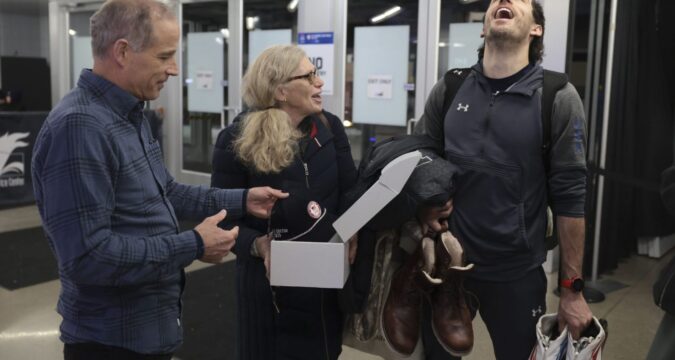
Marcia Lehman, center, and her husband David Lehman, right, celebrate with friends after their son, Emery Lehman, won the men’s 1500-meter competition on Jan. 4, 2026. (Brian Cassella/Chicago Tribune)
“I’ve known Emery since he was a little boy,” Davis said, and he could remember Lehman attending an event at the Pettit, where Davis competed and trained, in 2006 after Davis returned from the Turin Games with his medals. A young Emery had his picture taken with Davis, then a burgeoning star, a new American Olympic hero.
“And now, 20 years later, he has medals of his own,” Davis said of Lehman. “And now he’s going over to Italy, where it started for me, and he has a chance of winning gold medals for himself.
“So that’s really cool.”
Before the 1,500, Davis and Lehman shared a small moment. Davis said he “looked him in the eyes” and gave him a fist bump. There were no words, or need for them. As Davis recalled, it “seemed like he was really confident knowing that he was ready for the moment. And he went out there and he destroyed it.
“So I’m really proud of him for stepping up when it mattered most.”
Davis rose to the peak of the sport around the time when Lehman developed an interest in it. In his earliest days in speedskating, Lehman excelled in short track. Parents of other kids, Marcia Lehman said, “were really mad” because Emery kept winning. As Marcia recalled those days last week, she remembered another turning point.
It was when she and David brought Emery up for one of his first races at the Pettit. After it, they were back at a hotel talking with one of Emery’s first coaches, “and were having, like, a Scotch or something,” Marcia Lehman said.
“And he said to me, ‘Your son’s gonna make the Olympics.’ And I looked at him, and I go, ‘He’s 10.’ And he’s like, ‘I’ve been doing this a long time. You watch.’
“And he was right. And here we are.”
Becoming a champion
In his final Olympics, Lehman will carry the memory of the man, and coach, who was perhaps most responsible for his first. Lehman always had the raw talent. An ardent hockey player, and a huge fan of the Chicago Blackhawks as a kid, he always had the speed. Jeff Klaiber took those things and molded Lehman into an Olympian, at times pushing boundaries and pushing Lehman to the brink.
The two began working together when Lehman was 14. His mom had asked Klaiber, an Olympic speedskater who competed in the 1988 and 1992 Winter Games, to coach her son. Klaiber took measure of both mother and son. How serious were they? How good did Lehman want to be? Klaiber interviewed Marcia while he watched Emery skate.
He agreed to take on a teenager whose natural ability was undeniable, yet unrefined. Then the hard work began, like a sculptor chiseling a block of marble into a work of art.
“We definitely had a complicated relationship as the years went on,” Lehman said, “just because I think we spent so much time together and went through so much together.”
Speedskater Emery Lehman, second from right, and his coach Jeff Klaiber talk during training for the Sochi Olympics on Jan. 9, 2014, at the Pettit National Ice Center in Milwaukee. (Brian Cassella/Chicago Tribune)
Klaiber turned Lehman into a junior national champion and a world-class speedskater. His star rose quickly but Klaiber commanded a level of seriousness, of dedication, that could be exhausting. Especially for a teenager. And especially for a teenager such as Lehman, who continued to play hockey, and also made time for lacrosse and baseball while excelling in school.
As great as he was as a coach — as demanding and disciplined – Klaiber fought demons. When he died in 2023, at 61, his obituary detailed a rich and well-lived life, one full of hobbies and passions: stand-up comedy, radio DJing, painting and, above all, speedskating, which “was central to Jeff’s entire life.”
It also detailed how, in 2005, after a hip injury, Klaiber became addicted to painkillers and alcohol. The final summation of his life described how he fought with “incredible and valiant efforts.”
But “the last few years were particularly difficult,” his obit read. “He fell victim to a disease that is very much the same as contracting cancer. No shame. No stigma.”
Lehman could not remember the last time he spoke with his old coach. They stopped working together before the 2018 Olympics. The news of Klaiber’s death rocked the tight-knit community at the Pettit Center, where “people around the rink were distraught,” Lehman said, and trying to make sense of something that to many was incomprehensible.
As he has grown a little older, Lehman has come to appreciate what he couldn’t a decade ago. Klaiber pushed him in ways other coaches didn’t. There were moments they butted heads. Plenty of times when Lehman wanted to focus on his academic pursuits— he went on to earn a bachelor’s degree in civil engineering from Marquette University and a master’s degree in structural engineering from Johns Hopkins University — or other athletic endeavors.
Speedskater Emery Lehman, of Oak Park, goes through off-ice training exercises for the Sochi Olympics on Jan. 9, 2014, at the Pettit National Ice Center in Milwaukee. (Brian Cassella/Chicago Tribune)
He wanted to be well-rounded. Klaiber, meanwhile, wanted him to be the best speedskater he could be. They met somewhere in the middle, though closer to the side of the all-in devotion Klaiber commanded. The result was that a 17-year-old kid, still in high school at the time, represented his country on the world’s largest stage.
Lehman better understands it all now. He wishes Klaiber could know this version of him.
“He put a lot into the sport, and he only expected from me as much as he put into it,” he said. “And had we worked together now, I think we would get along splendidly.”
The finish line
The morning after he finished first in the 1,500 at trials, Lehman arrived at the Pettit Center for a team meeting. The rink was quiet, only a few skaters taking practice laps in front of empty bleachers. And in the serenity memories came back easily: the first time around the oval almost 20 years ago, with his Dad; those long sessions with Klaiber; the countless drives up from Oak Park.
There was still one more race later that day, in mass start, but the 1,500 was the last competitive race here that Lehman wanted to win. And he’d done it. Now his attention turned toward Milan and the pursuit of gold in team pursuit, a niche event in a niche sport, and one in which Lehman, Cepuran and Dawson know they must skate in precise harmony.
Ethan Cepuran, left, and Emery Lehman skate together in the men’s mass start event on Jan. 5, 2026, during the U.S. Olympic Team Trials Long Track at the Pettit National Ice Center in Milwaukee. (Brian Cassella/Chicago Tribune)
Lehman is the most experienced of the group, and the oldest, and the only one who is retiring after these Olympics. And so, for him, the stakes are higher.
“Me and Ethan have learned so much from him,” Dawson said of Lehman. “And also, I think Emery has learned a lot from us, as well, being the younger guns on the team.”
They form a compelling trio, and one that last November set a new world record (with a time of 3:32.49) at the World Cup in Utah. The group stands as good of a chance to win gold in Milan as any, though Italy and the Netherlands, along with Norway, France and China, also offer worthy competition. Cepuran, whose family has been close with Lehman and his family for a long time (Cepuran’s dad was among Lehman’s first coaches), has tried to avoid thoughts of the end.
It’s unavoidable, though, that Lehman’s journey is reaching its conclusion. Gold or bust.
“I’m not trying to think about that too much yet,” Cepuran said. “I have thought about it before, and it’s sad because he’s somebody that I’ve looked up to my whole career. And also because, you know, he’s the old guy on our team at the moment, and all of a sudden I’m going to be the old guy.
“But he’s been such a good teammate all these years that you just want to help see him through and reach his potential these last few weeks that he’s an elite athlete.”
Emery Lehman celebrates after winning the men’s 1500-meter competition on Jan. 4, 2026, during the U.S. Olympic Team Trials Long Track at the Pettit National Ice Center in Milwaukee. (Brian Cassella/Chicago Tribune)
For Lehman, so much of the past few years has been about fulfilling his potential. That’s why qualifying individually was as important as it was, even if he’d have made Team USA, anyway, as a specialist for team pursuit. It wasn’t that long ago, four years, when he was the age of his teammates in that event. And eight years ago he was as young as fellow Olympian Jordan Stolz, 21, is now.
Stolz is the undeniable star of American speedskating, a gold medal favorite whom NBC will undoubtedly highlight often next month in Milan. On the women’s side, it’s Erin Jackson. Lehman, once part of the future of his sport, has no illusions about it, or ego.
“Having Erin and Jordan on the team kind of overshadows us, with all the pressure, which I don’t mind,” he said. “I don’t mind because it’s all eyes on them, and team pursuit is kind of pushed down the line a little bit. So I think that helps, a little bit.
“But yeah, it’s something that we really want,” he said of winning gold. “I think it’s something that we know we can do, but I think it’s something that we know we can’t take for granted.”
After 12 years and three Olympics, few members of Team USA, in any sport, understand the stakes or the stage as well as Lehman. His parents will be in Milan and his mom likely won’t be able to bring herself to watch, again. During team pursuit, Lehman will take the ice with his teammates and he’ll know what they’re feeling, “because every time we go to the line,” he said, “we’re all kind of shaking in our boots a little bit.”
Then the starting gun will sound. The nerves will dissipate. And as much as Lehman is looking forward to the finish he’ll have one more chance to be a part of something that endures.
https://www.chicagotribune.com/2026/01/10/olympics-oak-park-speedskater-emery-lehman/


