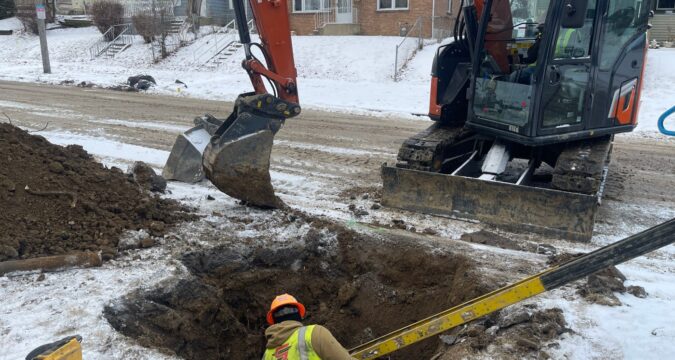
Waukegan is finding it increasingly challenging to find the mostly older houses with lead pipes in need of changing, as the city’s replacement program plans to double the number of homes with copper pipes in the near future.
When the city launched the pipe-replacement program three years ago, it began with an education effort simplifying the way residents can use technology to let the Water Department know the type of pipes in homes by taking a picture and sending it to the city online.
Along with using a computer or cellular telephone, representatives of Robinson Engineering, the contractor, began and continue to go door to door in neighborhoods likely to have lead pipes to gather the information enabling replacement. Cooperation has been underwhelming, officials say.
Diane Moeller, a project engineer with Robinson Engineering who is overseeing the Waukegan project, said educational efforts about the online endeavor yield approximately a 10% return. Door-to-door efforts are also falling short.
“People are afraid to open the door, though it has been more productive,” Moeller said. “This is a basic step to contact the homeowner to get into the home to allow the contractor to do the replacement.”
The city plans to finish replacing lead pipes with copper in 500 homes by April 30, and another 1,000 in the fiscal year starting May 1, to continue eliminating the possibility of water contamination throughout Waukegan.
For Mayor Sam Cunningham, the lead line replacement project is one of the most important things the city is doing for its residents. He said in an email that it potentially makes for a healthier community.
“Safe water is non-negotiable and that is why lead service line replacement is a top priority,” Cunningham said. “As we rebuild Waukegan, we are addressing lead line replacements with a citywide approach, ensuring no neighborhood is left behind.”
With funding for the project coming from the Illinois Environmental Protection Agency (IEPA), Moeller said Robinson Engineering applies for the grants each year. This year’s amount is $7 million, which allowed for doubling the current year’s total.
During the initial two years of the project, Antonio Dominguez, the city’s director of water utilities, said 1,000 lead pipes were replaced with copper. Since May 1, 350 lead pipes have been replaced, and 150 more are anticipated by April 30.
Dominguez said that in many of the older homes, lead pipes bring water from the water main under the street to the building. The portion of the pipe leading to the shutoff valve is city property, but the short amount of pipe from the valve to the water meter belongs to the homeowner.
Over the next 10 years, Dominguez said the city hopes to complete the project, estimating there are still 8,000 homes that will need the replacement after May 2027.
Going online to waukegansurvey.com and following the instructions enables residents to use a cellular telephone camera to take a picture of the water connection and send it to the city without anyone coming inside. This provides the necessary information, officials said.
Cunningham said in an effort to make the project as efficient as possible, plans will be made to coordinate infrastructure improvement projects with lead water line replacement.
“The replacements are being coordinated with road resurfacing projects to reduce costs and construction impacts, ensuring efficient and financially responsible investments that protect the health of our residents today and for generations to come,” he said.
David Motley, the city’s public relations director, said the city wants to complete the project while funding from the IEPA remains available. Dominguez said the cost to the homeowner would be between $10,000 and $15,000 if there is no longer money available from the state.
Moeller said residents’ resistance was more of a problem in the fall than it was earlier in 2025. Not only did Operation Midway Blitz make residents more apprehensive, but it also interfered with the work itself. Immigration enforcement agents had a strong presence in the area from early September to mid-November.
“They stopped work and took a utility locator,” Moeller said. “Any time we saw them, we shut down.”
Over the summer, Moeller said she went into neighborhoods, talked to people and explained the project. As they became more comfortable with her, people started to open their doors for the project.
“I’ll be doing more community-building,” Moeller said. “We’ll hold town halls and an open house. The aldermen are going to go door to door.”
https://www.chicagotribune.com/2026/01/09/waukegan-lead-pipe-replacement/


