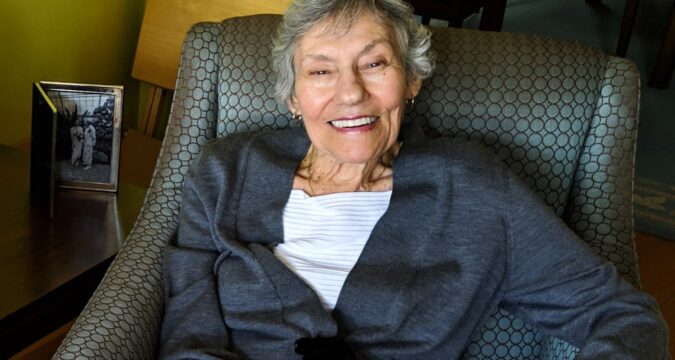
For more than a half-century, Nancy Cirillo taught English and was a scholar at the University of Illinois Chicago.
An expert on Caribbean studies and post-colonial literature, Cirillo loved teaching, mentoring and championing her students, colleagues said. She also devoted considerable scholarship to charting the impact on literature and music by the rise of fascism across Europe in the mid-20th century; her work also explored the economic effects of slavery.
“As a teacher, she was incredibly available and giving, and the classroom situation was always informative,” said Mani Pillai of Chicago, who took an honors literature class from Cirillo in 1978. “What I remember most was the breadth of knowledge that she had and that she shared with us. It was clear that she loved literature, and it was so clear that she was excited about sharing that; and more than that, she listened to us and valued every opinion and comment that (her students) had.”
Cirillo, 93, died of natural causes Dec. 2 while in hospice care at an assisted living facility in the Nashville, Tennessee, area near her daughter’s home, said her daughter, Dia. Cirillo previously had been a resident of the Lincoln Park, Lakeview and Avondale neighborhoods on Chicago’s North Side.
Born Nancy Rockmore in Amityville, New York, in 1932, Cirillo grew up in a Jewish family that lived in Massapequa, New York, and then moved to nearby Freeport. She graduated from Baldwin High School in Baldwin, New York.
Cirillo studied for two years at Alfred University in western New York before transferring to the University of Chicago, where she got an English literature degree in 1954. While at the U. of C., Cirillo became friends with classmate Eva Richter. After college, Cirillo and Richter both took teaching positions at the University of Nebraska, and the two later taught together for a short time at Rutgers University in New Jersey.
“What I remember is just the most overwhelming emotional generosity and warmth,” Richter said. “She treated everybody as though they were an individual. It was terribly important to her, and if anyone ever came to her with a problem, she tried to solve it in a very personal way. I also remember her dedication to her teaching and her commitment to the intellectual life and to the issues that she found really important — and paramount among them, obviously, were fascism and slavery.”
After teaching at the University of Nebraska, Cirillo began pursuing a doctoral degree in comparative language at New York University. Her dissertation examined how the rise of fascism in France, Germany and Italy showed up in literature and music. She got a Ph.D. in 1968.
Cirillo also taught at Hunter College in New York, and conducted some research in Europe, her daughter said. In 1964, the University of Illinois hired Cirillo as an English professor at its Navy Pier campus. She remained with the university as it opened its Near West Side campus in 1965, and she was awarded tenure in 1969.
While teaching at UIC, Cirillo focused her research on post-colonial studies, the literature of Caribbean independence from colonial nations, the institution of slavery and how slavery shaped Caribbean nations, the United Kingdom and the U.S.
She taught courses on Caribbean studies, the rise of fascism and 19th and 20th century Western European history and literature.
Cirillo also worked for a time as an administrator, overseeing undergraduate studies in UIC’s English department.
One major contribution that Cirillo made to UIC’s library was to work with a publisher in Jamaica to purchase the H.D. Carberry Collection of Caribbean Studies — about 1,000 works of literature, history and political theory, including the first published works from Nobel laureates Derek Walcott and V.S. Naipaul. Working with the special collections department, Cirillo curated a 2012 exhibit at UIC’s library called “Commerce in Human Souls: The Legacy of The Atlantic Slave Trade.”
Kellee Warren, a UIC associate professor and special collections librarian, came to know Cirillo while Warren was an undergraduate at UIC. She assisted Cirillo with the 2012 exhibit. Warren joined UIC’s library staff in 2016, and Cirillo became her colleague.
“She really respected you as a junior intellectual, no matter the age or the sort of academic level a student was at,” Warren said.
Herbert Nuwagaba, a structural engineer in Colorado who got a degree in engineering from the Massachusetts Institute of Technology, took a course on the Atlantic slave trade from Cirillo in 2015, shortly after he returned to the U.S. after having lived in Uganda for 11 years. He recalled Cirillo’s keen interest in his background and perspective, and her efforts to help him stay in school with financial support and employment on campus.
“She created a space where I was able to find my voice, and over time I was able to become more confident and engaged in the class,” he said. “But her generosity extended far beyond the classroom. That November, I was alone here in Chicago with no family here, and she invited me to her home to celebrate Thanksgiving with her and her friends. It was really an act of kindness because I was all alone.”
Cirillo was honored three times with the Silver Circle, a university teaching award, in 1974, 1999 and 2003.
At age 73, Cirillo retired from UIC in 2005 as an associate professor with emerita status. However, for another 13 years, she continued teaching an undergraduate class, Readings in Slavery, until finally ceasing teaching at age 86 in 2018.
During retirement, Cirillo enjoyed reading, keeping up with colleagues and spending time with her daughter and granddaughter, her daughter said.
A marriage to Carl Cirillo ended in divorce. In addition to her daughter, Cirillo is survived by a granddaughter and three nieces.
A remembrance event will be held in the spring.
Goldsborough is a freelance reporter.
https://www.chicagotribune.com/2026/01/07/nancy-cirillo-uic-obituary/


