It was in the morning, probably second or third period, recalled Nelson Granadillo, when he was told federal agents were outside his building. The principal of Simmons Middle School on Aurora’s East Side had been in a meeting with a teacher when he got the news.
“I didn’t believe it,” Granadillo told The Beacon-News of that day in early November.
He recalls walking to the front door and seeing a few vans, with people in vests, who appeared to be in the process of making an arrest. A parent of one of his students — who had been coming to the building for a meeting, he explained — ran to the door, and the school let her in.
This is Granadillo’s second year in East Aurora School District and his first year as principal of Simmons. Before this, he’d spent years working in School District U-46.
“It’s one of those things in life that you say, ‘It would never happen to me,’” Granadillo recalled of the situation he found himself in. “We had protocols from the district for (these) situations. … We’re always getting ready, I’m prepared for the worst. But I (thought) it would never happen to us.”
The school activated a hold-in-place, Granadillo explained, keeping students from leaving the classroom. District leadership was called, some of whom showed up to the school shortly after. According to district officials, two people who had been in the car with the parent who ran inside were detained.
Bob Halverson arrived a little later. The district’s superintendent and a few other district leaders got a call about a situation going on at Simmons and came to the school.
“The son came out of the classroom to greet his mom in the hallway, and he literally collapsed out of, just, you know, exhaustion and just everything he was dealing with,” Halverson recalled of the day. According to Halverson, the child’s father had recently been detained by federal agents.
Halverson and another district leader ultimately drove the mother, the student, his younger sister and their cousin home, picking up McDonald’s for them along the way.
“That was the thing for me that kind of solidified that we needed to do more at that point in time,” Halverson said. “That day was the one that kind of stuck out for me.”
The incident at Simmons on Nov. 5 garnered attention on social media, with talk and video about it swirling around Facebook.
The U.S. Department of Homeland Security did not return The Beacon-News’ request for comment about the incident at Simmons.
The alleged federal immigration action occurred about two months into President Donald Trump’s administration’s immigration crackdown in Chicago, dubbed Operation Midway Blitz. Thousands were detained across Chicago and its suburbs — most of whom had no known criminal record — and fear and uncertainty have permeated work, school, Halloween celebrations and more.
And, as this incident in Aurora — and others like it across the broader Chicago area — arose over the past few months, an unusual semester at East Aurora School District 131 has prompted the district to examine its procedures and adapt to unexpected circumstances, particularly as the question of what’s next for Chicago in the Trump administration’s federal immigration crackdown remains unclear.
In East Aurora, an incident at an elementary school almost two weeks earlier on Saturday, Oct. 25, had prompted some concern within the district. Two protestors were detained outside Allen Elementary after being confronted by federal agents, prompting the district’s school board to pass a measure banning federal immigration enforcement actions from occurring on its property just a few days later.
But preparation within the district had been going on much longer, Halverson has said.
At a school board meeting in November, he described how the district had been anticipating the immigration crackdown reaching its schools. East Aurora had been reviewing its visitor procedures, ensuring students had updated emergency contacts and sharing “Know Your Rights” resources with the school community.
“It has been trying times for our community for sure,” Halverson said at that meeting. “And we’re there to support our students, support our parents.”
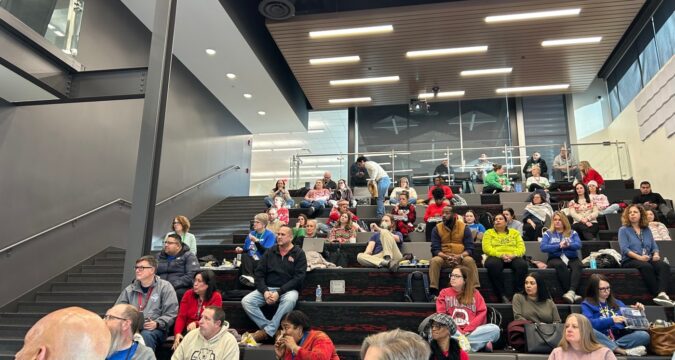
Just before winter break began, district administrators and building representatives gathered for a training session about handling federal immigration enforcement activity.
“This isn’t political,” Halverson said at the training, “but our kids have a right to come to school and be safe every day.”
Citing continued uncertainty about federal immigration enforcement ramping up in the area once again, Halverson said he was “thankful” that the district “had the foresight to continue moving forward with this process.”
“If we would have pressed pause and said, ‘Hey we’re hearing that they’re not going to come back (until) March,’ we wouldn’t be prepared,” Halverson said.
At the meeting, staff from the Chicago Teachers Union presented some of the information they’ve learned from enforcement activity at schools in Chicago.
CTU staff member Vinay Espinosa-Ravi, for example, described what kind of information to document at the scene of a potential detention, warned against interfering with immigration enforcement actions and discouraged posting documented information on social media but rather reporting the activity to the Illinois Coalition for Immigrant and Refugee Rights or the proper district authorities.
CTU organizer Linda Perales went over the details of a valid judicial warrant and what federal agents’ badges and vehicles tend to look like.
Associate Superintendent of Leadership and Learning Jonathan Simpson said East Aurora’s district administrators have assisted with daily dismissal in light of the incidents on district property. After the Simmons incident, they shifted to being present at drop-off in the morning, Halverson said.
Other staff have the opportunity to help with providing “safe routes,” Halverson said, though he emphasized that doing so isn’t mandatory. Going forward, the district plans for staff volunteers to serve as the points of contact at their respective buildings if another situation at a school should occur.
“We’ve already seen a lot of our staff doing these things naturally to help out when those crises have come,” Halverson said.
The district’s adaptation to the circumstances has been gradual, according to Becky Roireau, the East Aurora Council AFT Local 604 teachers union president.
“With each event, we just got a little bit better at responding, taking feedback, and responding and developing a plan,” she told The Beacon-News in December.
The idea for the training in December, she said, was so that leadership from the district’s schools could take the information and share it with the employees at their respective buildings.
“Whatever level it ramps up to, what we wanted to be is spend(ing) any time in this lull preparing, so we’re not just being reactive,” Roireau said.
Attendance is another issue the district plans to address, according to Halverson and Simpson. Weekly attendance has been trending several percentage points lower than last year even though attendance rates had started considerably higher at the start of the semester.
“I think we were setting a really good standard for our staff and our students where we were trying to really get after that sense of belonging, so I think that initial jump was due to some of that,” Halverson told The Beacon-News. “And then, it literally, if you look at it (the district’s dip in attendance), that timeline lines up right when the ICE enforcement … got really strong.”
Simpson added that attendance dropped last year too, when President Trump took office.
For the middle and high school students, Simpson said the district is finding that some older siblings are staying home to help watch their younger siblings these days.
“Taking on some more of, kind of, adult responsibilities,” he said. “And that’s pulling them out of school, too. So how can we connect them with resources that we have? Because we do know that we want the kids in school, and it’s the safest place for them to be as well.”
Starting in January, Halverson said leadership at each school will be going forward with training their staff on the information presented at the December training and on the protocols the district has in place. The plan is for each school to form a group of staff volunteers who will help out should there be reports of federal immigration activity at their building.
East Aurora School District Superintendent Bob Halverson speaks at a training session with district leaders on Dec. 19, 2025, about recent federal immigration enforcement action in Chicago and its suburbs. (Molly Morrow/The Beacon-News)
And part of what the district will do to respond is what it always does: teach its students, and try to protect them.
After the November incident at Simmons, Granadillo, the school’s principal, said the school had “pretty much a normal day … when it comes to teaching and learning.”
“All the stress and everything was happening in the main office,” he said.
The incident brought up the question, however, about how much to tell students about a situation like this. One classroom had a view of the incident, Granadillo said.
The next day, he recalled, the school worked to fix some blinds on its windows that were malfunctioning.
“Just protecting the students … from what’s happening outside,” Granadillo said of his approach when it comes to activating protocols and overseeing his school. “Just making sure that they don’t know what’s happening.”
mmorrow@chicagotribune.com
https://www.chicagotribune.com/2026/01/06/east-aurora-district-131-federal-immigration-response/


