
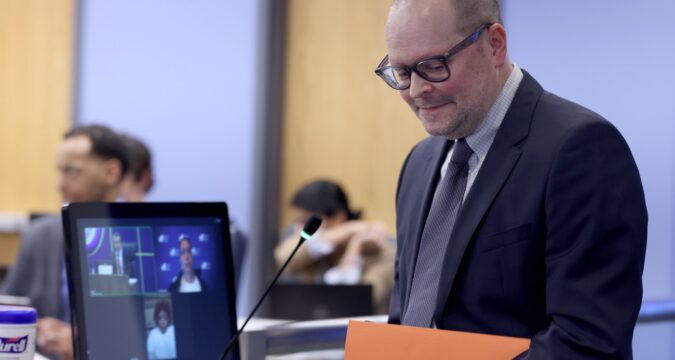
The Chicago Board of Education voted Monday to slightly increase its property tax levy, a move expected to yield an additional $20 million to $25 million for the school district.
Due to a months-long delay in county property tax data, Chicago Public Schools had initially set its tax request below the legal limit. Monday’s vote captured the remaining allowable revenue, bringing the levy — the total amount of requested tax money — to $4.12 billion.
“There’s very few levers that we can pull … to raise revenues,” acting Chief Financial Officer Wally Stock told the board at a special meeting. “It isn’t going to alleviate all the pressure that we have going forward, but $25 million is no small amount of money.”
Because Cook County tax data was delayed until September, about four months past its usual release, the district had to rely on estimates when it passed its $10.25 billion budget this summer. The delay was due to technical issues with the county’s new data system.
Cook County property tax bills were also sent out late, forcing CPS to take out $1.6 billion in short-term loans to cover overdue revenue, according to Stock. That borrowing has cost the district $33 million in interest, or about $220,000 per day.
Stock noted the extra $25 million from the levy hike could help offset those interest costs. “We know there’s pressure on the budget, with a lot of things that come up during the course of the year,” he said.
Because tax raises compound over time, foregoing the increase would have cost CPS hundreds of millions in future revenue. The impact on the average household is relatively small: The increase on a $250,000 home is estimated at about $8, according to Stock.
CPS is facing significant financial challenges, including billions in long-term debt. The district ended its 2025 fiscal year with -$339 million in net cash, which was $485 million less than the year prior.
“You may ask yourself, ‘Well, how do you exist in a negative cash position?’” Stock said. “Well, we do that by borrowing.”
The district closed a $734 million shortfall in August, in part through refinancing debt and the layoffs of central office staff, custodial workers and crossing guards. Some school services also faced cuts.
“Adjusting the tax levy will help CPS navigate its budget challenges while continuing to support its students and educational programs,” a CPS spokesperson said in a statement.
Despite the district’s financial position, five elected board members voted against the levy increase, arguing that the hike is a temporary fix that disproportionately impacts working families. This year, the median property bill for residents rose 16.7%, with many South and West Side neighborhoods seeing the biggest jumps.
“The families I represent … across the Southwest Side are already at a breaking point,” said board member Angel Gutierrez, district 8A. “For them, another tax increase is not a budget line, it’s the difference between stability and displacement.”
The district’s ability to raise property taxes is governed by the Property Tax Extension Limitation Law, or PTELL. To protect residents, the annual increase is capped at the lower of either 5% or the rate of inflation, this year calculated at 2.9%. CPS still makes up the largest portion of Chicagoans’ property tax bills.
“This district putting more financial pressure on our families to foot this bill is simply irresponsible,” said elected board member Ellen Rosenfeld, district 4B. “This levy will not solve our underlying structural issues.”
But others pushed back. “We have to do all we can for our students, now more than ever, with federal dollars questionable, with state funding not being sufficient,” said Ebony DeBerry, district 2A. “It’s undeniable that we must do all we can in this moment.”
Sources told the Tribune last week that the resolution was supposed to be up for vote at the board’s monthly meeting, but it was abruptly pulled a few days prior.
School board President Sean Harden told the Tribune the decision was related to “outstanding questions” from board members. But the maneuver also came amid City Council’s high-stakes budget battle — and Mayor Brandon Johnson’s push to cast himself as a defender against rising taxes. Harden was hand-picked by Johnson to lead the school board.
“The board made a deliberative effort to understand the impact this would have on the average homeowner versus the impact of foregoing our ability to bring in revenue to meet students’ needs,” Harden said in a statement Monday.
https://www.chicagotribune.com/2025/12/29/cps-board-hikes-property-tax-levy/


