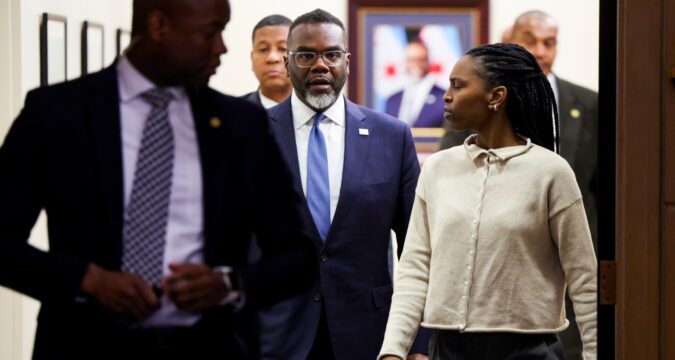
Chicago’s mayors have been the subject of Tribune editorials for pretty much this newspaper’s entire 178-year history. But few of the city’s chief executives have made as many appearances on the editorial pages in a single year as has Mayor Brandon Johnson, whose 2025 was filled with conflict, ending with a grand December debacle at the City Council over the city’s budget.
As part of our annual year in review, here’s a revealing look back at 2025 editorials featuring Johnson.
In a statement Tuesday, Johnson said he wanted to balance “concerns related to minor consumption” with supporting “entrepreneurs and municipalities” and that he was in favor of regulation of some sort. Eventually. Translated, Johnson’s neutral-sounding language really amounted to something along these lines: I’ve got the city of Chicago’s budget to manage, and shutting off one of the few areas of higher taxation available to me takes precedence over all else. Including the health and safety of children. In 2023, five students at Uplift Community High School in Uptown were hospitalized after ingesting gummies from a neighborhood smoke shop. Well over a dozen states have banned delta-8 THC. What are you waiting for, Mr. Mayor? A teenager to die?
The prospect of the former CTU organizer taking the side of striking teachers even as he holds the office of mayor of Chicago isn’t unimaginable. Given what we’ve seen from him to date — multiple appointed school boards trying at Johnson’s behest (and failing) to force Chicago Public Schools CEO Pedro Martinez to cave to the union, the hiring of a high-priced, taxpayer-funded law firm to try (and fail) to force Martinez out of his job immediately and advocacy for hundreds of millions in new junk-rated CPS debt at nosebleed interest rates — it’s the logical next step.
Johnson’s best defense won’t be to take the bait, or ignore the questions, or yak away on his usual themes of Black liberation theology. Rather, he’d be better advised to remind the panel that Chicagoans of all political stripes take pride in our long history of welcoming and championing law-abiding immigrants. And in our creating the kinds of opportunities that have allowed them to make great successes of themselves.
He could quote that Republican favorite, Mark Twain: “It is hopeless for the occasional visitor to try to keep up with Chicago—she outgrows his prophecies faster than he can make them. She is always a novelty; for she is never the Chicago you saw when you passed through the last time.” Our immigrants have been part of that, he could say. Or he could bring up major league baseball’s William Hulbert: “I’d rather be a lamppost in Chicago than a millionaire in any other city.” Or even the actor Michael Douglas: “Hollywood is hype, New York is talk, Chicago is work.”
Hey, Mr. and Ms. Bond Investor, this mayor and council — you know, the ones asking you to invest in the future of Chicago — aren’t willing to pay a nickel during the remainder of their terms to cover any part of what the city will owe you over the next 30 years. But surely some future mayor and aldermen will step up. Worry not.
This isn’t to predict that the mayor’s finance team won’t ultimately find takers for this wheelbarrow full of debt. Most everything that’s for sale can be offloaded at some price.
But we expect investors will demand higher interest rates than Johnson administration officials now anticipate. As it stands, this repayment structure will end up costing taxpayers $2 billion for an $830 million loan.
March 6. The editorial board thinks Johnson did well at the sanctuary cities hearing in Washington.
Mayor Brandon Johnson answers questions before the House Oversight Committee on March 5, 2025, during a hearing on Capitol Hill about sanctuary cities and immigration policy. (Brian Cassella/Chicago Tribune)
Johnson’s primary job as the Republicans on the House Oversight and Government Reform Committee attacked him (and fellow Democratic Mayors Eric Adams of New York, Mike Johnston of Denver and Michelle Wu of Boston) was to keep his cool. First, do no harm. In that we believe Chicago’s mayor succeeded, and for that we are glad.
It took self-discipline not to rise to the bait when performative GOP Rep. Nancy Mace of South Carolina barked at Johnson, “This is why you have a 6% approval rating — because you suck at answering questions,” or when Republican Rep. Brandon Gill of Texas asked Johnson about recent revelations regarding gifts he’d accepted as mayor and declared, “This raises serious ethical concerns.”
Even though President Trump undoubtedly remains as deeply unpopular in Chicago as he was in his first term, that doesn’t mean voters suddenly will change their minds about the shambolic management of this city. There certainly remain progressives in Chicago who back Johnson’s leftist aims. And there’s also a sizable minority in Chicago who are Trump supporters, which some forget. In between is the vast center-left and center-right that currently isn’t represented by either. Aldermen (and state lawmakers) increasingly are figuring that out.
How about you, Mr. Mayor?
Mayor Brandon Johnson speaks with chief of staff Cristina Pacione-Zayas in an elevator between meetings with lawmakers April 30, 2025, at the Illinois Capitol building in Springfield. (Brian Cassella/Chicago Tribune)
Forming a working group of representatives from all the affected constituencies is a reasonable strategy for building consensus. But it won’t work without far more assurance from the mayor than we got on Monday that this effort isn’t all about forcing residents and businesses to pay more without rethinking the services the city provides and how it provides them.
Equally as important, the working group’s membership must include people who aren’t part of Johnson’s usual circle — particularly when it comes to the business community. Johnson routinely turns to two or three businesspeople who’ve been supporters when he claims Chicago’s “business community” writ large backs some mayoral initiative.
The truth, of course, is that the business community in Chicago generally believes the administration’s policies are stifling growth in the city. Many to whom we speak simply are counting the days until the next mayoral election and seeking to muddle through until then. In addition to ensuring this group includes Johnson skeptics (outright critics would be even better), the mayor must be clearer about what options are on the table.
May 7: Mayor Johnson wants it both ways when it comes to migrant busing.
Not long ago, when busloads of migrants were arriving in Chicago from Texas, Mayor Brandon Johnson denounced the move as “evil.”
Fast forward to 2025, and Johnson is now touting population growth as a sign of his administration’s success — growth made possible by the very migrant arrivals he once condemned.
It can’t be both, Mayor Johnson. Was the mass busing of migrants from Texas an unconscionable humanitarian disaster, as you once claimed — or a population boost worth celebrating? It can’t be both. This kind of rhetorical whiplash doesn’t sit right. We remember how forcefully Johnson denounced the busing in 2023. And we remember it so well because we wrote several times that we agreed with him.
A shopper exits the Jewel-Osco supermarket at 550 N. State St. in Chicago on June 3, 2025. Mayor Brandon Johnson had been pushing aldermen to add a city grocery tax in Chicago. (Terrence Antonio James/Chicago Tribune)
Mayor Brandon Johnson has positioned himself as a champion of working families and the poor. But his messaging is getting complicated as it collides with the city’s difficult fiscal reality. “You all know my position. The ultra-rich continue to get away with not having to put more skin in the game,” he said at a Tuesday news conference.
But at the same time, Johnson is pushing for a grocery tax that will disproportionately hurt families at the checkout line as they try to put food on the table. His administration is taking an obfuscational messaging approach to explain its position. Johnson insists this isn’t a new tax — it’s merely a local continuation of a state tax being phased out. But for struggling families, the semantics won’t matter. Higher grocery prices are higher grocery prices.
July 31. Mayor Johnson offers multiple ideas for scaring businesses out of Chicago.
As a matter of public policy, the city ought to be in the business of encouraging the private sector to employ more people, not giving businesses more reasons to reduce their head count.
In 2025, the issue is starker than it was more than a decade ago. With the rise in artificial intelligence, companies nationwide already are laying off workers who are performing functions corporate leaders believe AI can do instead. If Johnson truly wants to jump-start AI-induced white-collar employment losses in Chicago, there are few more effective ways than bringing back the head tax.
Mayor Brandon Johnson greets Randi Weingarten, president of the American Federation of Teachers, at an event Oct. 9, 2025, at Funston Elementary School in Logan Square. (Brian Cassella/Chicago Tribune)
We’re all for Johnson being candid. Might as well be honest. But it hardly gives us hope that Johnson might moderate his socialist views in favor of the pro-growth agenda Chicago so badly needs to raise its hopes or merely to broaden his perspective as mayor. This matters now, of course, because the mayor’s self-definition isn’t about the past — it’s a declaration of how Chicago is being run today: not by consensus, but by a single, ideologically driven machine.
We hope for better.
Johnson administration lawyers seem to have contributed to making Chicago’s streets a little safer in the future. “We know that Glock switches have been used in the vast majority of mass shootings in our city,” Johnson said in a release. “They have taken far too many lives and caused tremendous pain and suffering in our communities.”
We’ve criticized this mayor on many occasions, but credit is due here. It’s difficult to make much overall progress when seizing illegal Glocks with switches, as Chicago police have been doing in concert with the U.S. Bureau of Alcohol, Tobacco, Firearms and Explosives, when new ones can so easily take their place.
Submit a letter, of no more than 400 words, to the editor here or email letters@chicagotribune.com.
https://www.chicagotribune.com/2025/12/27/2025-year-review-mayor-brandon-johnson-editorial/


