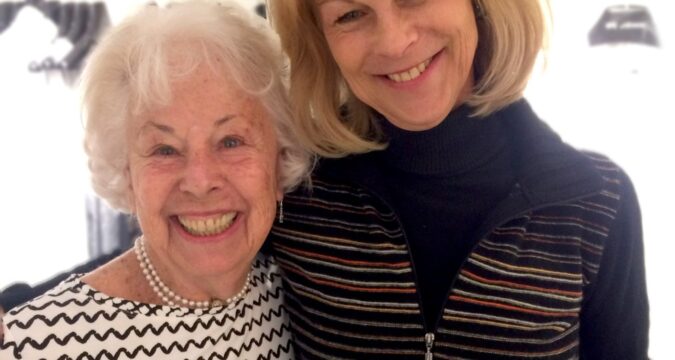
Married for more than a decade to a man who defined and shaped the sexual landscape of this nation, Millie Hefner Gunn led a rewarding and active life, raising two children and remaining curious and active until her death on Dec. 13. She died at The Clare, the Near North Side senior living facility, where she had moved in 2021. She was 99 years old.
“My mom was my biggest cheerleader and inspiration, and a joy to be with,” said her daughter Christie Hefner, a strategic advisor and board member of several companies and non-profit organizations. “She was smart and funny and full of life until the very end.”
Born Mildred Williams in Chicago on March 10, 1926, she was one of five daughters of Henry Williams, a streetcar conductor, and Mary, a housewife. She first met Hugh Hefner when both were students at Steinmetz High School on the Northwest Side.
The teenagers kept in touch while Hefner served two years in the U.S. Army and later graduated from the University of Illinois with a degree in psychology, while she attended the same school, getting a teaching degree.
They started dating after college and married on June 15, 1949. “We both had serious doubts before getting married,” Hefner told a reporter decades later. “But I had no other game plan except to get married and, somehow, live happily ever after.”
They lived for a time with Hefner’s parents, then moved to Hyde Park, furnishing their apartment stylishly with a Henry Miller dining room set and Eames furniture.
While she taught school and worked various other jobs and her husband was making $60 a week writing copy in the promotion department of Esquire magazine, the couple started a family. Soon came a daughter, Christie, in 1952 and a son, David, arriving three years later.
“But very soon I started becoming afraid that I was turning into my parents,” Hefner told a reporter years later. “I started to see that happening to my peers. People who were so much fun in high school were going dull.”
He began to fashion a men’s magazine on the kitchen table. He took out loans and borrowed from friends and relatives and started a magazine in 1953 he called Playboy. The first issue, featuring Marilyn Monroe on its cover and, less clothed, inside, was a success, selling more than 50,000 copies. Within a few years its circulation was in the millions and it had become a cultural phenomenon.
The couple divorced in 1959. She got custody of the two children and moved to a North Side high-rise. She dated and married Ed Gunn, a partner in her divorce attorney’s firm, took the name Millie Hefner Gunn and moved to Wilmette, where she became active in local politics, played duplicate bridge, competitive golf and bowled in a league. She and Hefner fostered a close relationship with their children.
There is no question that her early support and encouragement helped fuel Hefner’s ambitions, and it was notable that she chose to define herself away from the glare of fame, never trying to capitalize on a connection to a world famous ex-husband.
Hefner remarried in 1989 to Kimberley Conrad, then to third wife Crystal Harris in 2012.
“Obviously he wasn’t a hands-on father,” says Christie Hefner, who would attend New Trier High School and Brandeis University and would become president and CEO of Playboy Enterprises. “But he was a good father. I had my 16th birthday party at the mansion. There was never a period of time when I didn’t see him.”
Divorced from Gunn after 11 years, Millie and Hefner crafted what would remain a deep friendship. She would meet and eventually marry Pierre Rohrbach, a Swiss emigre, hair stylist and salon owner on the North Shore, and, says Christie, “the love of her life.”
The couple would be together for nearly 50 years, traveling extensively. There were golf trips to Scotland and Thailand, safaris in Kenya, and sailing around the Greek Islands. Closer to home, they were avid opera goers and frequent guests at cultural and political events.
“She had always wanted to return to the working world,” said Christie. “But Ed Gunn didn’t approve. Pierre was all for it, but like many of the women of her generation, my mother was smart, well educated, had been a school teacher, but didn’t have a marketable resume.”
Shortly after Christie began as an executive with Playboy Enterprises in the 1980s, her mother was hired to oversee a new retail concept combining fashion and music, called Playtique. That wasn’t successful, but Millie began to work in the firm’s human resources department, running such programs as tuition reimbursement, relocations, blood drives, and employee get-togethers.
She worked into her 70s, finally retiring but then completing the Great Books program at the University of Chicago, and, full circle, tutoring kindergarteners in North Chicago.
Pierre’s deteriorating health necessitated a move from their Northfield townhouse into The Clare in 2021. “They were able to see one another every day until Pierre’s death (in 2023). She stayed alert, continued to read the New York Times and worried about the state of the nation,” said Christie, who lives nearby and was a frequent visitor. “She continued to root for the Bears and the White Sox and went to games during her last months.”
In addition to her daughter, she is survived by son David; sister Elizabeth Wilson and many nieces, nephews and their children. A memorial service is being planned for the new year.
rkogan@chicagotribune.com
https://www.chicagotribune.com/2025/12/19/millie-hefner-gunn-obituary/


