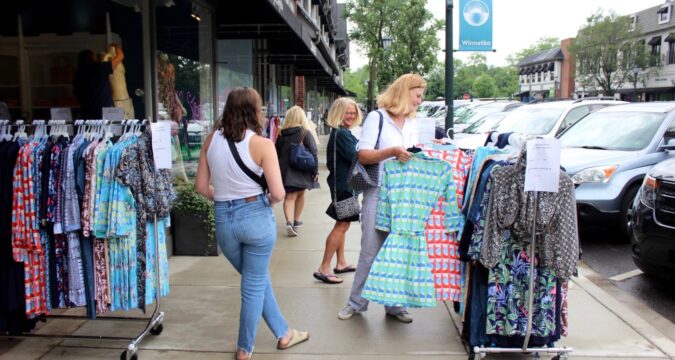
People who shop in Glencoe and Winnetka will pay new local taxes next year as both communities move to diversify their revenue sources.
The village boards in both communities recently approved a 1% home rule sales tax, adding to other tax changes enacted earlier this year.
In Glencoe, trustees approved the new tax in November, roughly a year after voters adopted a home rule form of government. Home rule status allows Illinois municipalities greater authority to enact local legislation, including certain taxes.
Deputy Village Manager Nikki Larson said the sales tax is expected to generate approximately $500,000 annually. It will apply to general merchandise sold in the village but will not cover high-priced items such as cars and boats, which are restricted by state law.
Larson said the revenue will be used for infrastructure improvements, including roads, sidewalks and sewer mains.
Glencoe Village President Howard Roin said village officials signaled before the November 2024 home rule referendum that they intended to seek additional revenue sources that would not fall solely on residents.
“If you are a Glencoe resident and you shop in Glencoe, you will pay it,” Roin said. “But if you are a Northbrook or Highland Park resident, you will also pay it.”
In Winnetka, which has operated as a home rule community since 2005, the village council approved its own 1% home rule sales tax on Dec. 2.
Chief Financial Officer Tim Sloth said in an email the tax is expected to generate about $1.5 million annually.
“The funds will provide a dedicated funding stream in the Business District Revitalization Fund,” Sloth said, adding that the money will support projects in the village’s three downtown business districts.
Terry Dason, president and CEO of the Winnetka-Northfield-Glencoe Chamber of Commerce, said she has heard concerns from some local businesses but supports the new tax.
“All of these villages are struggling,” Dason said, citing the lack of major industry. “Most of their money comes from property tax dollars. They don’t want to keep charging people more on their homes.”
The home rule sales tax will go into effect on July 1, 2026 in both communities, officials said.
In addition to the sales tax, Glencoe approved a new food and beverage tax in November that will apply to prepared food and alcohol sold at restaurants, grocery stores and liquor stores. At the same time, the village is repealing its place-for-eating tax, which applied only to restaurant food sales.
Larson said the food and beverage tax, which will go into effect on New Year’s Day, is expected to generate approximately $375,000 over a 12-month period.
Not all businesses support the change. Binny’s Beverage Depot Vice President Brad Stein said the tax will make the company’s Glencoe location less competitive.
“Cook County already has a very high liquor tax,” Stein said. “When you compare the cost of goods in Glencoe to Highland Park or Wheeling, Glencoe is more expensive.”
Earlier this year, both Glencoe and Winnetka also enacted a 1% local grocery sales tax, replacing the state’s grocery tax after it expired. Previously, the state collected the revenue and distributed it back to municipalities. Shoppers will see the same grocery tax rate on Dec. 31, when the state grocery tax ends, and Jan. 1, when the local grocery tax starts.
https://www.chicagotribune.com/2025/12/18/winnetka-glencoe-add-sales-taxes-to-fund-roads-downtowns/


