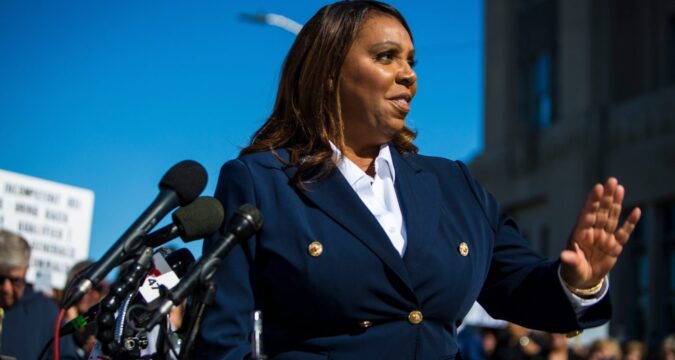
Proponents of democracy should be cheering a recent grand jury refusal to reindict New York Attorney General Letitia James — the second grand jury in recent days to do so — after a federal judge dismissed an earlier case against her. Perhaps this and other embarrassing setbacks for Trump administration attempts at “lawfare,” combined with the role Joe Biden-era lawfare played in fueling the president’s political comeback, will convince both parties to abandon what James called “the weaponization of our justice system.” Optimistic observers, in fact, might even imagine these events will convince the two parties to abandon lawfare altogether.
Despite these recent developments, though, there are two big reasons to worry. First, cases are still proceeding against other Donald Trump antagonists, headlined by former national security adviser John Bolton. Secondly, and even more problematic: Since at least the presidency of Franklin Roosevelt, something like lawfare has been disturbingly common. This lamentable reality is evident in Watergate, the Iran-Contra affair and the impeachment of Bill Clinton.
The Watergate scandal was not exactly lawfare as we discuss it today, because it involved actual crimes. Still, critics who denounced Nixon’s “dirty tricks” typically ignored similar activities under his predecessors. During the administrations of Roosevelt, John Kennedy and Lyndon Johnson, officials weaponized government agencies such as the IRS, FBI, CIA, Department of the Treasury or Department of Justice to bug, wiretap, surveil, harass or otherwise intimidate administration critics, including business groups, journalists and civil rights leaders. Among those targeted at some point during those years were the African American press, the Los Angeles Chamber of Commerce, the Congress of Racial Equality, Students for a Democratic Society, the “sugar lobby,” Malcolm X, reporters from Newsweek and The New York Times, and the Rev. Martin Luther King Jr.
Plus Richard Nixon.
That’s right: Nixon himself was targeted for the sorts of abuses that later led to his ouster. He was bugged and his taxes audited, the DOJ tried to conjure up criminal charges against him, and his mail was intercepted and read. This triggered no serious investigations, no Watergate-style scandals. Nixon might understandably have concluded the opportunity to harass political opponents was a perk that came with the presidency. Most alarming, in some of the cases mentioned above, the abuses were technically legal because the people who should have been policing them had authorized them or carried them out.
The chief difference, then, between Nixon and those aforementioned predecessors was that he faced investigations they did not and was caught trying to obstruct them. In this way, Nixon’s antagonists were unfair, yet they reaped a tremendous political payoff. Less than two years after Nixon’s landslide reelection, he became the only U.S. president to resign. Three months later, Democrats gained a whopping 48 House seats, plus five in the Senate, in the 1974 congressional elections. And in 1976, largely because of Nixon’s long shadow, Democrats claimed their only presidential election victory between 1964 and 1992.
Similarly, the Iran-Contra scandal damaged Ronald Reagan politically. It did not drive him from office, but it reduced him, in the words of one sympathetic historian, to a “caretaker president” for the remainder of his term. The scandal arose from a scheme to fund so-called Contra guerrillas trying to overthrow Nicaragua’s communist-led government while Congress prohibited U.S. aid to the Contras. After failed efforts at diplomacy with the Nicaraguan government, at the end of 1981, Reagan decided to support the Contras. During 1982, Congress imposed restrictions on that aid, then in 1984, it banned Contra aid for fiscal year 1985. Congress subsequently reversed course in 1985, voting to resume aid, then removing all restrictions in 1986, before the scandal broke.
In denouncing Reagan, critics talked and acted as though that vote for the fiscal year 1985 was the only congressional action on Contra aid that counted. And this criminalization of policy differences not only damaged Reagan; the resulting scandal’s impact lingered into 1992, when an independent counsel’s highly politicized indictments, on the eve of George H.W. Bush’s bid for reelection, helped defeat Reagan’s former vice president.
But while lawfare worked for its practitioners against Nixon and Reagan, it boomeranged on Clinton’s antagonists. During his presidency, the U.S. House approved articles of impeachment that charged him with perjury and obstruction of justice over his response to a lawsuit alleging sexual harassment. His defenders dismissed Clinton’s problems as “just sex,” as though his adultery was the issue and not the perjury and obstruction of justice. The implication, that perjury could be overlooked in sexual harassment cases, undermined sexual harassment law with consequences that only became clear after the #MeToo movement emerged, but in the short term, it worked for Clinton: The Senate acquitted him, and in 1998, his party lost no Senate seats and actually gained five in the House, an almost unheard-of success for the party of a second-term incumbent in midterm elections.
Lawfare, then, is undemocratic and can backfire, but it sometimes pays big political dividends. Hopefully, its recent failures, for both parties, will convince politicians, and the American people, to demand it be tossed on the scrap heap — immediately and forever.
John Soares teaches history at the University of Notre Dame. This essay reflects his opinion and not that of Notre Dame or any part of it.
Submit a letter, of no more than 400 words, to the editor here or email letters@chicagotribune.com.


