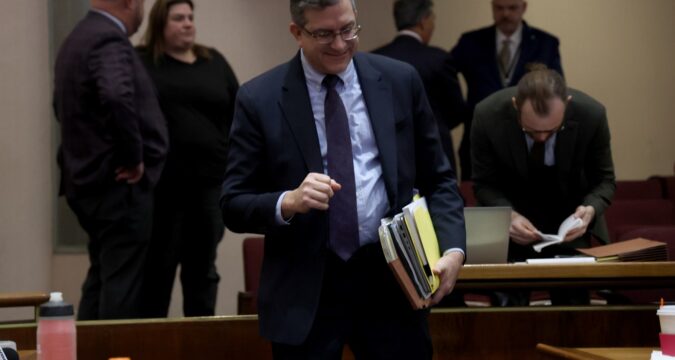
Tuesday’s marathon City Council Finance Committee session, as mind-numbing as it could get at points, was a remarkable moment in the history of Chicago government.
We saw a City Council, in the face of a mayoral administration relentlessly driven by ideology, for the first time wrest control of Chicago’s budget in the name of pragmatic solutions to a crisis. The committee’s 22-13 approval of the alternative revenue package forged by Aldermen Scott Waguespack, 32nd, and Nicole Lee, 11th, and shepherded by panel chair Ald. Pat Dowell, 3rd, was a critical step in signaling to the broader world that Chicago recognizes it exists in a competitive landscape and isn’t a progressive bubble unto itself.
A majority of the council has made it abundantly clear to Mayor Brandon Johnson that his proposal to revive the city’s corporate head tax — a monthly tax on each worker employed in Chicago by large private-sector firms — is a non-starter. But with a year-end budget deadline looming, the opposition bloc looked to garner more support by making concessions to the mayor. They scrapped a proposed increase to the city’s monthly trash-collection fee of $9.50, and they allowed for a $6 million increase in summer jobs for teens, a top priority for Johnson.
We’ll state upfront that the document the committee produced and approved isn’t perfect.
Chicago’s garbage fee, for example, is far lower than nearly all peer cities and doesn’t come close to covering the cost of the service; we believe a reasonable increase is more than warranted. As it stands, Chicagoans who live in multifamily housing must pay for private garbage collection and are subsidizing through their property taxes or rents their fellow Chicagoans who live in single-family homes or two- or three-flats.
For those, including the mayor, who derided the trash-fee increase as an attack on working people, we would remind them that lots of poor and working residents of this city live in apartments and condos. And they are effectively paying twice over for trash services thanks to the refusal to allow for any fee increase — an argument Cate Plys so effectively made earlier this month in our pages.
We also have misgivings about opening the door to video wagering in bars, a major expansion of legal gambling that would affect lower- and middle-income Chicagoans far more than the tourists and conventioneers who are the primary target of the Bally’s casino now under construction at the former Chicago Tribune Freedom Center. The aldermanic opposition bloc projects $7 million in net revenue from video terminals in bars in 2026, but far more than that in later years.
We think it makes more sense to modestly increase a highly subsidized garbage fee than it does to expand gambling so aggressively into the neighborhoods. But politics are what they are, and the demagoguery on the trash fee unfortunately has been effective.
It also was disappointing to see the Finance Committee approve the lion’s share of the record $2.8 billion in new bonding authority the Johnson administration requested. The panel cut $1 billion from $2 billion the mayor’s financial team wanted for money-saving refinancing. But it approved $449 million to cover $166 million in back pay owed to firefighters under a labor contract finalized earlier this year as well as more than $280 million for current and future legal settlements — mainly for past police misconduct.
And the panel endorsed another $1.3 billion for future capital projects despite the fact that the city has $2.4 billion in unused bond authority for infrastructure from past issuances. Ald. Bill Conway, 34th, vice chair of the Finance Committee, tried to eliminate that $1.3 billion from the ordinance, but he was overruled by his fellow committee members.
Chief Financial Officer Jill Jaworski said that needed projects would be delayed if the council didn’t vote on the new capital plan. But here’s the thing: The city’s credit rating is teetering; it may well be downgraded once this budget is finalized, especially with the council now appearing set on debt-financing operational costs — a major fiscal no-no for credit rating agencies. Now is the time to err on the side of caution, not behave as if Chicago is in a business-as-usual situation vis-a-vis the bond markets.
We’re sure to have more to say on debt and the bond markets as the city looks to tap investors again early next year.
Despite our misgivings, we believe the opposition alders, who have performed remarkably well in hashing together an alternative in the face of a mulish and unhelpful administration, deserve support from the full council as this budget makes its way through the process in the next few days. As Ald. Lee pointed out to the Finance Committee, the tax and fee increases in the alternative budget are overwhelmingly being levied on businesses rather than individuals — and that’s without passage of the toxic head tax. Businesses are shouldering 84% of that load while residents are absorbing 16%.
For the sake of the city, the mayor ought to make this easier for all involved and declare he will not veto this plan if it ends up being the will of the council majority, which it appears it will be.
After all, it’s not just his future electoral prospects that are at stake in this moment. Chicago’s budgetary circus slowly but surely is drawing unwanted notice around the country. Editorial boards in cities far away are pointing to our example as a cautionary tale. We are rapidly becoming the poster child for how not to govern a city.
Credit analysts, of course, also are lurking. “The level of brinksmanship we are seeing in Chicago is uncharacteristic of many other rated local governments,” Michael Rinaldi of Fitch Ratings told Bloomberg News. In the cold-eyed world of municipal finance, cities don’t want to be “uncharacteristic” in that sort of way.
Let’s exit this road to fiscal and economic oblivion, and get to work making Chicago a safe place in which to invest again.
Submit a letter, of no more than 400 words, to the editor here or email letters@chicagotribune.com.


