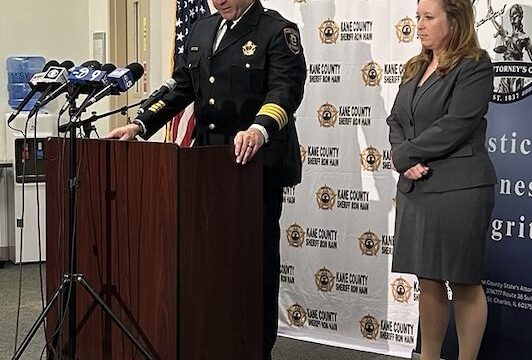
A new state law limiting federal immigration enforcement around courthouses and other sensitive locations is to be enforced via civil lawsuits, not local law enforcement, according to the Kane County State’s Attorney’s Office and Kane County Sheriff’s Office.
The county offices, in a news release on Monday, also noted that police cannot intervene to stop federal immigration enforcement-related arrests, and discouraged residents from calling 9-1-1 in these situations so officers “can focus on other public safety duties.”
Last week, Illinois Gov. JB Pritzker signed into law a ban on federal agents making certain arrests near courthouses and easing a path for individuals to sue federal officers if they believe their rights were violated during civil immigration arrests, following months of resistance to the Trump administration’s enforcement crackdown in Chicago and the suburbs.
The law could increase damages under the lawsuit provision in cases where the defendant wore a mask, used crowd control equipment such as tear gas, did not identify themselves as a law enforcement officer, used a vehicle without an Illinois license plate or did not turn on a necessary body camera. The state legislation also codifies a zone around courthouses where people involved in court proceedings are exempt from civil arrests.
The state law also asks hospitals, day care centers and higher education institutions to put in place policies about how they would respond to the presence of federal immigration agents.
Kane County State’s Attorney Jamie Mosser and Kane County Sheriff Ron Hain, in the news release, emphasized that the new state law finalized last week can only be enforced through civil lawsuits filed by individuals, not by local law enforcement. Police can’t intervene and stop federal immigration enforcement-related arrests, and they requested residents not call 9-1-1 in those situations.
The county officials also reiterated that local law enforcement is not allowed to participate in civil immigration enforcement actions. The Illinois Trust Act, which was signed into law in 2017, generally prohibits state and local law enforcement from getting involved in deportation efforts with U.S. Immigration and Customs Enforcement or other federal policing agencies handling immigration matters.
Local law enforcement officers are not able to detain someone based solely on immigration status, a federal administrative warrant or ICE detainer request, the sheriff and state’s attorney noted, nor can they provide immigration agents access to individuals in custody, allow federal agents to use their facilities or databases or help with or coordinate arrests.
Before the state legislation was passed, Kane County last month enacted legislation of its own aimed at limiting federal immigration enforcement. The measure sought to prohibit federal agents from using county property — parking lots, vacant lots and garages — for staging, processing or as an operational base for civil immigration enforcement.
Under the new state law, local officers can still investigate and enforce criminal laws within their jurisdiction, the news release from the state’s attorney and sheriff noted, and may carry out their responsibilities even when federal immigration actions are happening nearby.
And, though they cannot be involved in matters of civil law when it comes to immigration enforcement, the sheriff and state’s attorney emphasized that local law enforcement can assist federal authorities when presented with a federal criminal warrant.
mmorrow@chicagotribune.com


