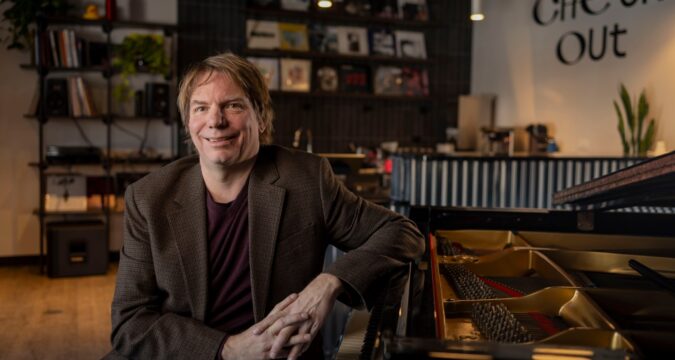
The day the CheckOut — a cozy music venue housed in a former 7-Eleven — opened to the public, one would expect founder and proprietor Seth Boustead to be working through nerves, or frantically setting up the space.
Instead, he spent much of that morning and early afternoon down the street, playing piano for a neighborhood block party. Why? Simple, he says: “They asked.”
Boustead takes the CheckOut’s identity as a neighborhood fixture seriously. When the venue opened in September, there was little doubt that Chicago’s close-knit contemporary classical music community would frequent the space. For three decades, Boustead has been both participant and booster in that community, as a composer, host of the radio program-turned-podcast Relevant Tones, and executive director of the nonprofit Access Contemporary Music (ACM), which operates The CheckOut and three neighborhood music schools.
But that demographic alone can’t buoy the CheckOut in a punishing economic landscape for live music, and especially for independent venues. Instead, Boustead has been consciously positioning the venue as an anchor in an otherwise sleepy, noncommercial stretch of Lakeview.
“‘Community’ is such an interesting word, because it can be this massively broad term, like ‘the LGBTQ community,’ ‘Black community,’ or ‘the Gen X community.’ Or, it can be the community of people who live on Warner Avenue, right next to the CheckOut,” he says.
So far, that’s paid off. Boustead has been “overwhelmed” by interest in the venue, with publicly announced bookings stretching well into April. Promisingly, its audiences only occasionally overlap with the core classical-music crowd in the city, as I observed in these pages and at subsequent concerts. The CheckOut has even become an unexpected haven for the city’s cabaret scene, after the sudden closure of Wicker Park venue Davenport’s earlier this year.
“It’s a close-knit community, and it’s absolutely adjacent to classical in so many ways,” Boustead says.
That approachable ethos fuels the Thirsty Ears Festival, which celebrated a milestone 10th edition in August. Also organized by ACM, the Ravenswood tradition applies the street fair format to classical music. Food and beer vendors sling their wares yards away from musicians who could be playing everything from Brahms to Boulez to, well, Boustead. Kids romp and yelp at a family-friendly station nearby.
“I have a real fascination with bringing classical music to new people and watching them go through the opposite of the stages of grief, because most people have this real resistance to it,” Boustead says. “Thirsty Ears really taught me a lot about how to communicate to people who know nothing about classical and to not make any assumptions at all.”
In other words, he wants to reach listeners who were once like him. Boustead, 54, has always worked odd jobs to make ends meet: holding down a paper route, working at McDonalds, delivering sandwiches from a sub shop, unloading merch for WTTW’s old gift shop. He first learned about classical music through a marching band arrangement of Dvořák’s “New World” Symphony at his Missouri high school. He’d started, quit, then resumed piano as a child. But lessons were a lift.
“My mom could not afford it, but she made it happen,” he says. “That’s a lesson I learned from her: The walls you think are blocking you, if you push them, they’re not as solid as you think.”
An apathetic but bright student, he muddled through high school before finding his footing as the only white kid in the music department of Lincoln University, a historically Black university in Jefferson City, Missouri. He eventually transferred to the University of Missouri, declaring a piano performance major.
That is, until he met a student in the composition department. At the time, Boustead was flummoxed. Weren’t all the composers dead?
“He’s looking at me, like, ‘No, man, there’s 30 of us in this department,’” Boustead recounts.
He switched his major, but he didn’t stick around Mizzou much longer. A dazzling weekend trip to Chicago in 1995 convinced him to drop out of school and try his hand as an improvising pianist in the city’s improv comedy scene, with just a semester left of school and almost no money to his name. Boustead has lived here ever since, founding ACM five years later and incorporating it in 2004.
Today, Boustead splits his time between Ravenswood and New York City, where his compositions are still frequently performed. Thirty years on, the thrill of hearing music performed for the first time — whether his own or someone else’s — hasn’t abated.
“It doesn’t matter if it’s John Adams or a composer that barely gets played at all. We’re all chasing that high, every time,” he says.
Hannah Edgar is a freelance critic.
https://www.chicagotribune.com/2025/12/16/chicagoan-year-classical-music-boustead/


