Not a single author in this short appreciation started writing yesterday. Not a single one just fell off the proverbial turnip truck. Daniel Kraus has written almost 30 books in the past couple of decades, a handful with famous collaborators (including Guillermo del Toro and George Romero). Cynthia Pelayo wrote 10 books. Nick Medina wrote three books. Grady Hendrix wrote 15. Christina Henry wrote 14. Rachel Harrison wrote seven. Stephen Graham Jones wrote 31, not including comic books and collaborations.
They share almost nothing in common, except:
No. 1, they are contemporary horror writers — some of the best, and best-selling.
And No. 2, they’ve been championed by Becky Spratford, a Chicago librarian who’s spent her career tirelessly nudging horror literature into the American mainstream. For a long time, unless your name was Stephen King, a writer in this once-damnable niche understood that whatever support they had came from a small audience. Crossovers were rare. Sci-fi — sometimes even fantasy — had won the gene-respectability sweepstakes.
“Now that the spotlight is on horror? Now that readers and booksellers seem aware of how much quality is there? I think of Becky as one of the key reasons,” said Jones, whose recent historical-vampire novel, “The Buffalo Hunter Hunter,” has been on countless lists of the best books of 2025. “She was supporting horror before we had a spotlight, in important ways. She’s out there talking to libraries, approaching readers, saying smart things, so readers can see how much she believes this (genre) is not some weird corner of the world, only for weird people, but a rich place for everyone.”
“To me, Becky is the spark plug, lynchpin, head coach and fairy godmother of horror,” said Kraus, whose latest novel, “Angel Down,” made the New York Times’ top 10 of 2025. The Evanston author’s “Whalefall” is also getting a movie adaptation next year. “Becky’s a hustler in the best of ways, doing the ground work, meeting with the writing groups, being the kind of tastemaker everyone can respect, never claiming the glory.”
Her title is deceptively modest.
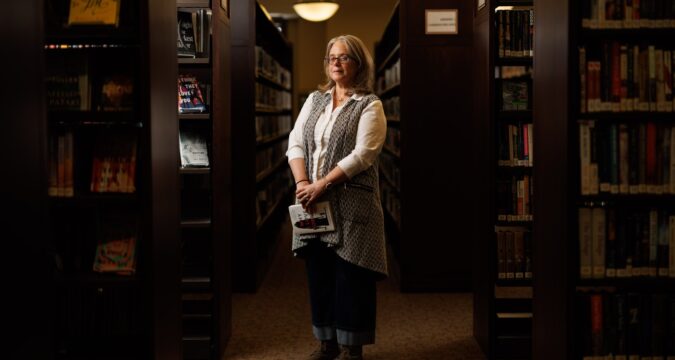
Spratford is a reader’s advisory librarian, which means she matches library patrons with the perfect book. It also means she travels the world training librarians on how to serve their readers, revealing a universe of publishing just beyond best-seller lists, espousing small presses, unknown authors and entire sections of the library that readers might assume aren’t for them. About 20 years ago, Spratford, who is now 50, lives in La Grange and worked at the Berwyn Public Library for decades, focused her attention on horror lit.
She grew scarily committed.
She wrote three textbooks on horror. She began reviewing horror novels for various publications, so many that she now has a horror column in Library Journal (a very influential resource when libraries are purchasing new books). In 2016, with Hendrix and novelist JG Faherty, she co-created the annual Summer Scares reading program, which has since been adopted by dozens of libraries, including the Chicago and New York City public library systems. She now sits on the advisory board for the Shirley Jackson Awards, serves as secretary for the Horror Writers Association and has been a jury chair with the Bram Stoker Awards (horror lit’s leading award) for the past 10 years.
A couple of months ago, having cashed in decades of good will within the horror-lit community, she assembled “Why I Love Horror” for Simon & Schuster, an entertaining compilation of new essays by a who’s who of major contemporary horror writers (that also acts as a kind of clandestine guidebook to any newcomer tiptoeing into the genre).
She became a one-woman word-of-mouth campaign.
“I’ve always been drawn to the odd, the slightly askew,” she said. “I grew up in New Jersey, and as a child, my favorite author was Shel Silverstein, but also, being a kid in the 1980s, I didn’t think there was a lot for girls in Stephen King. I found what I was looking for in ‘Flowers in the Attic,’ and on that one small occult shelf in Waldenbooks, and I couldn’t believe how much I loved Shirley Jackson after reading ‘The Lottery.’
“As I got older, I was astonished how much quality there was (in horror lit), but I also couldn’t believe how much everyone was missing by dismissing it out of hand. That’s when I knew I wanted to make a job of it, showing people how much they were missing.
“Plus, my face is unassuming — it doesn’t suggest goth girl.”
Harrison said Spratford uses her everyday appearance and enthusiasm in devilishly clever ways. “She comes at you with this very Shirley Jackson-esque set-up — meaning, she could be your neighbor, or your local librarian. It’s important to have someone like that on the front lines saying ‘This genre is not one thing — it’s not what you think it is.’”
When authors and booksellers and librarians talk about the explosive popularity of horror literature in the past decade, when they mention the fresh voices in the genre and the renaissance of quality that’s happening, when they note the dedicated horror section that Barnes & Noble created, Spratford’s name is often mentioned.
Poking around the scary, horrible, disgusting, excellent cauldron of new horror lit
Pelayo, a lifelong resident of Hermosa whose novels blend Chicago history with Latina influences and local legend, doesn’t like to think of Spratford as a tastemaker. “That suggests gatekeeper to me, and there are plenty of people in this genre doing that, rehashing the same four or five names, usually their friends. Becky is not one of them. She champions diversity like hell, across the board. When she is dealing with libraries, she is always including horror authors from diverse backgrounds — who are some of the best horror writers right now. This can be a very hard game to break into, but because of Becky, people know I exist.”
Ask Spratford why horror literature is in a golden age and she sounds restless, hesitating to repeat the old refrain that anxious times create an anxious culture and that’s why horror is doing so well. That’s part of it, she said, just not remotely all of it.
“Yes, the world is a dumpster fire and people are turning to horror, but let’s not forget here is a genre that is now full of new voices, from all backgrounds, Black, Indigenous, Latino, LGBTQ, and that’s worked to make this incredibly vital reading. I want to take my place in all of it very seriously. But I’m not a tastemaker, I’m more of a gate opener.”
cborrelli@chicagotribune.com


