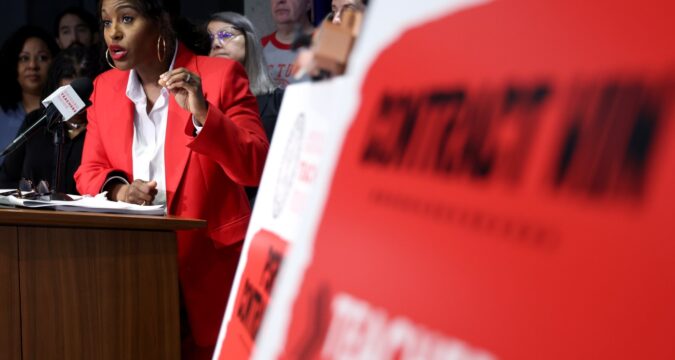
The Chicago Teachers Union is now a political machine — focused not on education or collective bargaining but on expanding its control over city government, taxpayer dollars and the broader labor movement.
The CTU has evolved into an existential threat to Chicago’s fiscal health — and to the city’s other public sector unions.
It is time for organized labor — teachers, police, firefighters, trades and city service workers — to recognize that the CTU’s dominance is not solidarity.
The CTU has turned on fellow public employee unions and attacks even its closest union allies. The teachers union is currently in conflict with Service Employees International Union Local 73 over its demands that CTU-represented classroom assistants take over SEIU-represented aide positions. In plain terms, CTU seeks to raid SEIU membership rolls — capturing new dues and expanding its reach — at another union’s expense. This is not solidarity; it’s empire building.
No organization has displayed less solidarity with other workers than the CTU. During the pandemic, its leadership backed one of the longest big-city school closures in the country, while first responders, sanitation workers and health care staff continued reporting to work. While other unions fight for safe streets, CTU leaders have repeatedly framed budget debates as a choice between schools and policing — even though Chicago Public Schools’ annual spending now exceeds that of the Chicago Police Department by roughly five times.
An ever increasing share of city resources are going to schools. Since the CTU’s CORE Caucus took power in 2010, CPS has ballooned into the city’s largest and fastest growing financial liability. Repeated CTU contract wins have sent spending soaring. CPS’ own budget data shows that between 2010 and 2025, its total budget has climbed from $6.9 billion to $9.9 billion. Property tax revenue for schools has more than doubled, while state aid has increased.
The city continues to channel ever larger subsidies into CPS, effectively making the school district a quasi-subsidiary of City Hall. What began under Mayor Rahm Emanuel as pension funding financial assistance has grown into an annual billion-dollar transfer — a mix of dedicated pension levies, tax increment financing surpluses, capital subsidies, fee waivers and subsidized CTA fares for students. Under Mayor Brandon Johnson this diversion of resources has accelerated dramatically.
CTU interests are prioritized at the expense of other unions. Johnson’s 2026 budget proposal includes approximately $552 million projected for CPS in the 2026 budget. These are funds that the school system should use to cover school district expenses, relieving the city of funds that could help it balance its own budget. City departments have shed roughly 2,100 public safety positions in recent years, even as CPS has added 9,000 full-time positions since 2019, despite losing enrollment. The district has over 11,000 more nonteaching employees than police officers in Chicago.
CTU contracts since 2019 will have increased average teacher salaries by almost 50% by the end of the current contract agreement, with nonteaching salary growth also outpacing inflation, according to CPS labor cost projections. The result is a top-heavy structure while classroom outcomes and enrollment continue to decline.
The CTU is making the city less affordable for city workers and their families. The fallout extends beyond teachers. The average private school education from kindergarten through 12th grade for a single child costs more than $175,000, placing a heavy burden on middle-class and low-income families that lack quality public school options. Meanwhile, CTU leaders have fought to dismantle even the limited choices available, such as public charter and magnet schools.
Charters — capped in number and enrollment — receive less per pupil than traditional CPS schools and face expanding mandates that limit innovation. And the Invest in Kids tax credit scholarship program, which once offered low-income access to private education, was eliminated under CTU political pressure.
This inequity hits hardest among other city workers — SEIU; American Federation of State, County and Municipal Employees; and CTA union members — whose paychecks lag far behind those of CTU teacher members. Many can’t access selective magnet schools as easily as teachers can. It’s no surprise that about 40% of Chicago teachers send their own children to private schools.
The CTU’s unchecked political power undermines the very labor movement it claims to represent. Residency-bound workers — including teachers themselves — face higher taxes to fund a school system they no longer trust to educate their children.
Organized labor once built Chicago’s middle class on shared sacrifice and mutual respect. The CTU has traded both for political dominance. For Chicago’s other public employee unions, the question is no longer rhetorical: How long will they tolerate one faction commandeering city resources and dictating its politics? Chicago’s fiscal solvency and the future of organized labor itself hang in the balance.
Paul Vallas is an adviser for the Illinois Policy Institute. He ran against Brandon Johnson for Chicago mayor in 2023 and was previously budget director for the city and CEO of Chicago Public Schools.
Submit a letter, of no more than 400 words, to the editor here or email letters@chicagotribune.com.
https://www.chicagotribune.com/2025/12/15/opinion-chicago-teachers-union-political-power/


