Palos Park police Sgt. Ross Chibe said he recently discovered when listening to a podcast that experts are using lidar technology to discover lost cities in the Amazon Rain Forest, the same technology that is now coming to the Palos Park Police Department, but to enforce safe driving.
The department received a grant from the Illinois Department of Transportation, along with several other grants, to purchase a lidar device, which uses a laser to specifically measure the speed of individual vehicles.
Chibe said speeding is an issue in Palos Park, so although the Police Department already has a similar device in use, he said the lidar units will be specifically accurate.
“That’s kind of one of the biggest issues that we face in our town,” Chibe said. “There’s a lot of roads in our town that are just very open, and there’s a lot of forest preserves, so people go fast.”
Chibe also said the technology, purchased for $1,859 with support from $1,750 in grant funding, are important because the Police Department is small and limited in resources.
The grant program supporting the technology, the Sustained Traffic Enforcement Program, aims to address traffic violations, specifically the “fatal four” issues — speeding, occupancy protection, distracted driving and impaired driving — that Chibe said are leading causes of death or serious injury in car crashes.
He said lidar was chosen over other speed enforcement technology because they could be more effective and precise than the radar units already in the squad cars.
He said a traditional radar sends out a signal wave to try and detect objects moving forward. Once the radar wave hits the cars driving forward, it bounces back and measures the time it takes for those waves to bounce back.
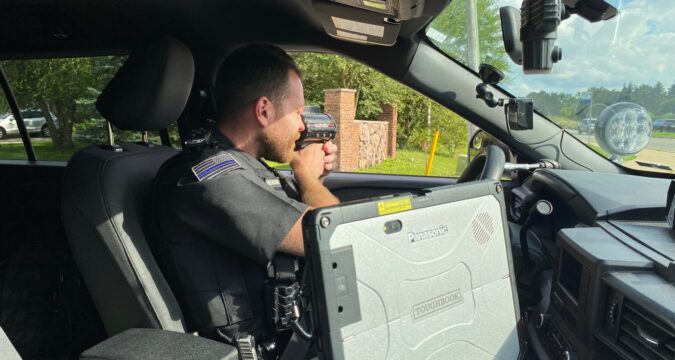
A lidar unit uses a singular point instead of a wave and has a small aiming device that can point to a singular car, which makes it more accurate and overall a better piece of technology, he said.
Palos Park police Officer Cohen Piechocinski uses a lidar unit during the Arrive Alive on Route 45 traffic safety initiative in summer 2024. (Palos Park Police Department)
The technology is also used in a variety of scientific fields, specifically for surveying and mapping geospatial data.
According to the National Oceanic and Atmospheric Administration website, the instrument is able to be mounted on vehicles in the air, on the ground or on the water and collect important data in many different environments and for many different purposes.
Chibe said several departments use the technology, such as Orland Park, and said it first became popular about five years ago. But it has advanced and some devices used by police can take video, he said.
The STEP grant program also included funding for Palos police to compensate more officers to work details addressing traffic violations, which most recently focused on seat belts.
The officers were paid overtime for their extra hours conducting seat belt checks on the roadways in October, which he said was helpful.
“Our officers do a great job doing traffic enforcement during their normal shifts, but sometimes they get busy with calls and it’s just one of those things, it’s just really really beneficial to have extra officers out,” Chibe said.
Chibe said this initiative showed a lot of people are not using their seat belt, a pattern he saw in his own time conducting seat belt checks.
He said one day they had seven to eight seat belt violations in under an hour at just one intersection.
“It’s a shame,” Chibe said.
He said officers would pull people over and have an educational moment where they tell them why its important to wear a seat belt.
Chibe said the department has participated in the STEP grant in the past, but last year was the first year it become involved again.
He said the department participated in the program’s mini grant initiative in 2024. He said this program consisted of traffic enforcement periods throughout the week that would focus on different topics, such as speed enforcement in July, distracted driving in April or DUI enforcement around the time of the Super Bowl.
The department elected this year to participate in the full program, which means officers will participate in all of the enforcement periods and also qualify for technology grants, Chibe said.
Chibe said the department aims to slow people down to the posted speed limit, have people wear seat belts or put their kids in car seats when it’s necessary, stop people from texting when they’re driving and find impaired motorists and get them off the road.
“If we continue doing these things, I mean, that’s going to really make a big difference with the number of crashes and how severe they are, and that’s basically the goal of all of this,” Chibe said.
Chibe said he expects the department to receive the new technology by January 2026 and said once it arrives, it will be used immediately, as all officers are already trained to use the technology when they’re hired.
awright@chicagotribune.com
https://www.chicagotribune.com/2025/12/15/palos-park-updated-laser-technology-speeding/


