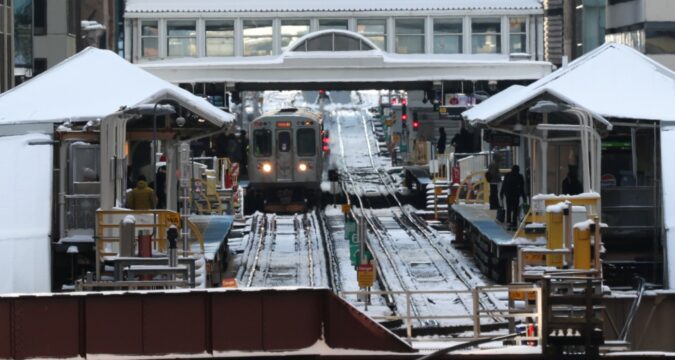
The Tribune Editorial Board really misses the mark with its State/Lake CTA station editorial (“A snazzy new State Street station. But, seriously, $444M and 3 more years?” Dec. 8). Between mixed comparisons and a seeming lack of awareness, the points the board should’ve made fall by the wayside.
Cost is a major issue, as the board correctly points out, regardless of where the money is coming from. Instead of looking at similar, recent projects such as the Washington/Wabash station, the board compares a full station rebuild to adding an elevator?
Washington/Wabash cost $74.8 million and took 29 months to construct. The proposed 36 months for State/Lake isn’t much longer, considering its size and scope, while the $444 million is almost six times the budget for a station that serves the same elevated lines.
Why didn’t the editorial board probe where that money is going? Washington/Wabash built a mezzanine over Wabash, creating a dark cavern for the roadway and limiting vehicle height while not replacing the now 130-year-old track superstructure. Will State/Lake remove the beams in the middle of Lake? Will there be a direct elevator connection between the elevated station and the subway’s mezzanine? Both of those would be quite costly, adding to the astronomical amount.
Instead, the editorial board uses Quincy as an analog. State/Lake is the CTA’s fifth-busiest station, thus necessitating a complete rebuild, not a mere elevator addition leading to the current narrow and unsafe platforms.
The board also doesn’t look at CTA projects that took even longer. Instead of acknowledging that these downtown transit projects are complicated, the board creates some conspiracy about the withholding of construction costs until the fiscal cliff was resolved.
Transit projects, especially entirely rebuilding a station in a dense downtown core, are costly and lengthy. History proves this. They have nothing to do with the Kennedy Expressway construction, an Illinois Department of Transportation project, or whatever weak links the editorial board tries to create. Besides saying the CTA should hire someone who will shave a year off the project, it has no actual suggestions.
This station is adjacent to two hotels, preventing 24/7 construction. All the board wants to do is complain and, frankly, without reason.
History and now this response show the editorial board is wrong in its piece.
— Brian Kaempen, Chicago
Investigate the project
It took only 16 months during wartime to build the Pentagon and only 33 months to erect the Sears Tower. Why then is it projected to take three years to demolish and build a new elevated station at State and Lake streets? Was the contract issued as time and materials?
It appears that there should be an investigation and explanation as to the estimated time.
— Stephen Morris, Chicago
Insiders’ involvement?
I read the editorial about the cost of the new State/Lake station. The Tribune needs to do more. Assign reporters with financial/business acumen to analyze the contracts to break down the costs of this project. How much for design and engineering? How much for materials and labor? Who are the contractors? Are they bleeding the taxpayers with help from political insiders?
How did the cost go from $180 million in 2021 to $444 million now before any work has been done? This happens every time there is a large government construction project. Think the Kennedy Expressway rebuild and the O’Hare International Airport terminal project.
Say what you will about Donald Trump (and the editorial board certainly will), but when he puts up a building with his own money, you can bet that it will be done on time and on budget.
— Juliet S. Goldsher, Lincolnwood
An example of waste
Did I read this correctly? The cost to rebuild the State/Lake elevated station is $444 million? Half a billion dollars to rebuild one train stop? I can’t believe that there are not more affordable options.
I thought the CTA was broke. Just another example of government waste!
— Tom Murray, Barrington
Bus priority projects
On Dec 1, the CTA hosted a community involvement event for feedback on its new Bus Priority Corridor Study. The event was informative and interactive. With falling ridership and public distrust, are this study and this plan going to be enough?
Chicagoans have been begging for more improvements to the CTA. A struggling bus network — with traffic causing slower speeds and reduced reliability — needs improvement. The buses play a huge, undervalued part in the network and deserve projects that will improve their service.
With the General Assembly recently passing SB2111 with new transit funding, there is momentum here. It is wise to start with five crucial corridors in approaching the community. This is not only a good way to soft-launch a project, but also a necessity after the top-down planning of the Ashland Avenue bus rapid transit, which was killed by community pushback.
The proposed corridors for improvement are: Fullerton Avenue, 55th Street, Cottage Grove Avenue, Western Avenue and Pulaski Road. Western already has support, with a 2024 letter from aldermen demanding improvement. Dedicated center running bus lanes and priority signaling would dramatically improve speed and reliability and give everyone living near the corridor access to true north-south rapid transit.
So what’s the tradeoff? On some streets, a reduction in parking, a travel lane or left turns entirely. The wider the street section, the more can be included, but yes, bus priority projects take up car spaces, which undoubtedly would raise community concern. The hope is that by garnering community support and addressing concerns, a project can prove its worth.
These five corridors are just a start hopefully to a full implementation of bus priority. With the new transit bill and funding, it may be time to holistically reexamine our future. Leadership at the CTA agrees: “CTA is launching its first-ever comprehensive, long-term strategic planning effort.” There is community support for a better future, captured in a grassroots petition, Chicago 2100, a grand plan for the city’s transit network.
With community support and a successful completion of these corridors, CTA could prove the worthiness of bus priority. Furthermore, it could inspire residents to fight for a better connected network. That starts with these five corridors but shouldn’t stop there.
The priority corridor study won’t fix the CTA’s problems, but it signals a brighter future ahead.
— Dan Gentile, Chicago
Accessibility issues
Regarding the editorial “Chill out aldermen, the delivery robots are cute” (Dec. 11): I just think it’s funny how people may use “accessibility” as an argument against the delivery robots. Meanwhile, the city doesn’t clear sidewalks along the parks or on the bridges over the highway, making the city essentially inaccessible for months for people in wheelchairs or with mobility issues.
The robots are the least of the city’s accessibility issues.
— Kyle Breedlove, Chicago
Replacing humans
The editorial on robot delivery devices misses a major reason not to be in favor of such devices roaming the streets of Chicago. They are taking jobs away from humans who would be earning money to pass along to the city during their daily lives.
Robots do not go to grocery stores, the barbershop, gas stations, restaurants or clothing stores. They do not buy movie tickets or theater tickets. They do not buy eyeglasses; they do not go to the dentist; they just do not contribute to the economy, except via the companies that employ them.
— Michael Hersh, Chicago
Note to readers: We’d like to know your hopes for the new year. Please send us a letter, of no more than 400 words, to letters@chicagotribune.com by Sunday, Dec. 28. Include your full name and city/town.
Submit a letter, of no more than 400 words, to the editor here or email letters@chicagotribune.com.
https://www.chicagotribune.com/2025/12/15/letters-121525-state-lake-project-cta/


