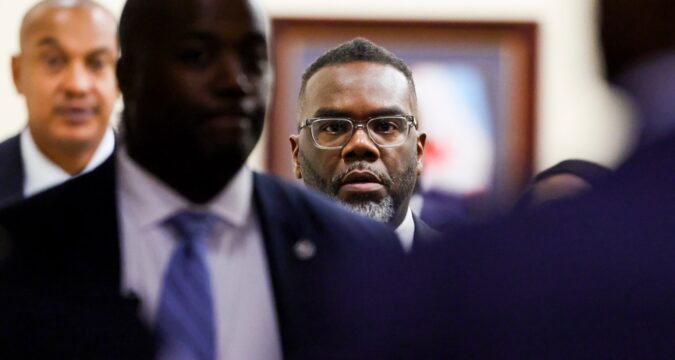
Mayor Brandon Johnson and the majority of the Chicago City Council are deadlocked over next year’s municipal budget, an impasse that could halt all city services if they can’t find common ground on tax increases by year’s end.
Chicago residents aren’t deadlocked, though, over who’s to blame if city government actually shuts down — it’s Johnson, hands down. In a citywide poll we just conducted, three quarters of representative respondents say they’ll hold the mayor responsible if he vetoes the council’s alternative budget, versus a quarter who’ll pin it on the council.
The opposition is widespread. Across all age groups and among both men and women, most Chicago adults in our poll hold the mayor accountable for this breakdown, with the share rising to supermajorities of 4 out of 5 residents among those 35 and older.
A plurality of 43% of residents says they’ll also turn against aldermen who side with Johnson in a budget vote, while just 15% say they’ll rally for his allies. (The rest say this vote won’t affect their preferences one way or another.)
However it ends, this budget battle seems likely to hamper Johnson in a reelection bid. Though he won handily in 2023, his nonstop efforts to raise taxes are a turnoff. Half of Chicago adults now have unfavorable opinions of the mayor — twice the number who see him favorably. This net favorability gap leaves him with minimal political capital to negotiate a budget resolution or rally public support for difficult choices.
Johnson brought this rebellion on himself. To help close a massive $1.15 billion deficit, he proposed reimposing an employee head tax. The tax was repealed in 2014 under Mayor Rahm Emanuel, who called it a job killer. Rebranding it a “community safety surcharge,” Johnson initially asked the City Council in October to enact an annual $252 per employee tax on corporations with 100 or more city employees, which he said would net $100 million annually.
Facing public opposition from 26 of the 50 members of the City Council, he began backpedaling by limiting the tax to those employing 200 or more and, earlier this week, reducing it further to only “corporate behemoths” with headcounts of 500 and up. At the same time, though, he raised the annual rate to $396.
Neither modification changed the minds of aldermen in the majority bloc. Instead, they drafted their own budget, which avoids any head tax by increasing the fee for household garbage collection by nearly 70% and raising taxes on ride-shares and liquor. Johnson has vowed he’ll veto any budget that swaps “regressive taxes” such as those for his head tax.
It’s unclear how this duel will end. The majority would need to grow to 34 members to override a veto. Conversely, Johnson would need to peel away at least two aldermen from an opposition majority that is now up to 27 members.
Our polling doesn’t reveal any easy workarounds. The city could avoid these taxes by borrowing more. But 56% of residents oppose that. Another option, which neither the mayor nor the council majority endorses, would be to cut spending by reducing benefits to municipal employees. In our poll, 40% reject that idea, while 37% favor workforce sacrifices. (The other 23% say they don’t know.)
If Johnson and the City Council can’t find an acceptable compromise, Chicago will enter 2026 without a budget, something that’s never happened. With no legal authorization to spend any more money and employees getting no pay, city government could be forced to cease operations overnight.
Though Johnson may look weak by compromising with the council majority on the head tax, it’s what the Chicago residents have told us they want: a local government that takes a commonsense approach to taxing and spending, and not one that gives employers or employees yet another reason to leave the city behind
Will Johnson is the Chicago-based CEO of Outward Intelligence, an artificial intelligence-powered quantitative research company, and former CEO of The Harris Poll.
Submit a letter, of no more than 400 words, to the editor here or email letters@chicagotribune.com.
https://www.chicagotribune.com/2025/12/12/opinion-chicago-budget-mayor-brandon-johnson/


