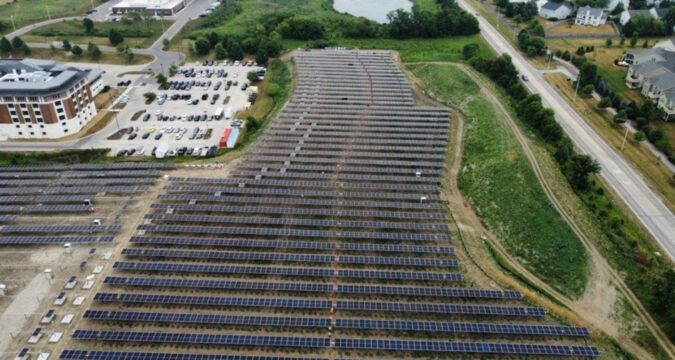
A long-unused property in Geneva may get a new life as a solar field, as Kane County considers what to make of the site of its old jail.
While the proposal is still in its early stages, some county staff and officials are looking at whether a county-owned property off of Fabyan Parkway could be turned into a solar field, sold for development purposes or a combination of both.
“This opportunity came to our attention that the land that’s lying fallow at the old jail, like a ghost town, could possibly be producing clean, green energy and revenue and tax revenue for the county,” Kane County Board member Mavis Bates said at a Committee of the Whole meeting on Wednesday, at which the board considered the site’s past and future.
Jodie Wollnik, director of the county’s Environmental and Water Resources Department, explained that there has been some discussion of how the property could generate revenue and potentially help alleviate the county’s revenue concerns.
The land in question is around 32 acres of county-owned property in Geneva off of Fabyan Parkway. It was last used as the site of a jail in 2014, according to Wollnik, who presented the proposed plans at Wednesday’s meeting.
The jail complex on Fabyan was built in the 1970s. But, in 2006, after years of discussion about the jail’s future, the county board approved plans for a new facility in the Judicial Center complex in St. Charles, which was completed in 2008.
But what to do with the Fabyan property has been a question almost two decades in the making.
The jail complex was eventually demolished, Wollnik explained, but the property continued to be used for some county purposes. Repurposing the land has been under consideration in the county over the years — with ideas like a resort hotel and a new government center in the mix — but none of the ideas ultimately came to fruition.
In October, Wollnik said on Wednesday, the county released a request for proposals to determine whether a community solar project might be feasible. It got back several proposed projects that indicated it may be a viable way for the county to use the land.
Community solar is a sort of solar project or purchasing program in which customers subscribe to, or sometimes own, a portion of the energy generated by a collection of solar panels, according to the U.S. Department of Energy. Those customers then receive a credit on their electric bill for the power generated by their share of the community solar system.
This proposed solar field wouldn’t be the first solar project the county has taken on in recent years. In 2023, Kane County began operating a solar field near the county’s Judicial Center — where the new jail site is. At the time, county officials touted it as a money-saving initiative.
At Wednesday’s meeting, the board considered several possibilities and their financial implications: the proposed solar field, whether to sell some or all of the land and whether to keep a portion vacant for future use.
Kate Coxworth of real estate company JLL offered information on the potential value of the property, indicating that the county’s best option for selling would likely be for an industrial user.
Board member Michelle Gumz asked about that recommendation, and Coxworth indicated it was based on the market in the surrounding area.
“Industrial development has continued to be a very big push from finance companies, and we expect that to continue,” Coxworth said at the meeting.
Board member Jon Gripe asked about the difference in future tax generation from the different kinds of development that could occur on the property — industrial, residential or commercial.
“Just seems to me that it’s not just what we get today, it’s what we get five years from now, 10 years from now, 20 years from now,” Gripe said.
Wollnik said residential, industrial or commercial development for Geneva on the property would generate around $30,000 per year in tax revenue, whereas community solar would generate only about $3,000 annually.
As for the possibility of using some or all of the land for a solar field, Arnie Schramel of Progressive Energy discussed some of the options for the property.
The site of the potential solar field would be around 11 to 22 acres of the total property — the portion of the property behind the front portion along Fabyan, which was set to be left for other uses, Schramel noted. A solar field could generate annual lease payments to the county of $3,500 to $9,500 per acre.
“The big winners on community solar are the landowners and the community solar subscribers,” he said.
In light of those considerations, Wollnik presented four potential options for the land.
First, the county could sell the whole property, for a total estimated value of the land at around $2.9 million to $4 million, according to Wollnik’s presentation. But that would mean no revenue from lease payments to the county, and no savings to electricity bills.
Alternatively, per Wollnik’s presentation, the county could sell the front portion of the land along Fabyan, and build a solar field on the 22 acres behind it, for a total estimated value of around $3.5 to $4 million for the property, factoring in the lease payments’ present day value, according to Wollnik.
The county could also sell the front portion, use a portion for solar and leave a third portion vacant for future county use, for a total estimated value of around $2.1 million to $2.6 million. Or it could use the back portion for solar and keep the portion along Fabyan vacant, for an estimated value of a little under $2.3 million
Those figures do not include the future electricity bill savings, which could be in the range of around $20,000 to just under $38,000 per year, per the presentation.
“Really, there’s not a huge, huge difference in selling the property versus doing part of the property in solar, and then leaving part of the property as vacant land,” Wollnik said. “The maximum value, probably, you’re going to get is doing the solar and then selling a portion of the property.”
But she emphasized that the revenue from the solar options would be stretched over the course of years.
Board member Clifford Surges asked if there was consensus among the board that this property is “in play and that we have an urgency to do something with this.”
“We’re floating a balloon here,” Bates said in response. “This land has laid fallow for … years, and we would like to make good use of it.”
A few board members expressed some concerns.
“I’m still up at 30,000, 40,000 feet about what to do with this place, and I think some of us are, you know … down at 100 feet,” Gripe said.
Bates, however, reiterated her support for the idea.
“It would make money for the county with the leasing, it would make money, savings for anybody who signs up for this community solar as a subscriber receives a 10% discount,” Bates said. “And, to me, one of the biggest benefits is it keeps the land in the family, in our family. It keeps the land for future use by (the) Kane County Board.”
Gumz said they should consider the proposal as an option, as well as look into other possibilities.
“I think we have started a great conversation,” she said.
And board member Vern Tepe applauded the solar project at the Judicial Center, citing the money it is saving the county annually. He expressed support for a mixed-use concept with solar and leasing out the front portion of the property.
“We’ve got land back there that’s doing nothing and we have (had) no plans on it for quite some time,” Tepe said of the property. “Let’s put some money back in the coffers. Lord, we can use the income.”
Wednesday’s Committee of the Whole meeting was a discussion, so the county board did not take any action on what to do with the property. Bates said the county leadership involved in the proposal will take the board members’ feedback to the Energy and Environmental Committee to consider next steps.
mmorrow@chicagotribune.com
https://www.chicagotribune.com/2025/12/12/kane-county-solar-field-former-jail-site/


