Fear remains among community members despite no immigration enforcement arrests in Lake County since the U.S. Department of Homeland Security (DHS) closed its command center on Nov. 14 at Naval Station Great Lakes.
Abigail is a Lake County resident whose last name is withheld because of fear of deportation. She is a dreamer who has a work permit through Deferred Action for Childhood Arrivals (DACA). She said she is now a bit more likely to leave her home for more than going to work.
“I can breathe now,” she said. “Thanksgiving was great, being with family. I can go to the store, but I avoid big events in the community. I try to stay home.”
Another Lake County woman who asked her name be withheld out of fear of deportation said through an interpreter that fear began mounting long before Operation Midway Blitz began on Sept. 5. She started to warn people during President Donald Trump’s election campaign last year.
“I read Project 2025,” she said. “It was very alarming to me. I warned people I know who could vote.
“I rely on friends to go to the store for my basic needs,” she added, explaining her reluctance to leave home.
Members of Lake County’s immigrant and Latino communities remain cautious after experiencing 70 days of DHS’s Operation Midway Blitz, when 76 people were detained by federal immigration enforcement agents.
Dulce Ortiz, the executive director of Mano a Mano Family Resource Center and a Waukegan Township trustee, said no arrests were reported to the organization’s rapid response team since DHS left the Navy base.
There are still a significant number of agents in the Chicago area, and on Saturday, federal immigration agents made an arrest and reportedly deployed tear gas and pepper spray on a crowd during a related confrontation in Elgin.
“They’re still afraid, no doubt about it,” Ortiz said. “People are trying to go about their daily lives as best they can. We’re still having groceries delivered by our volunteers. People are still reluctant to leave their homes.”
During the intense activity of Operation Midway Blitz, a majority of Lake County federal apprehensions were in the northeast portion of the county, with more than half in Waukegan.
With Christmas approaching, Ortiz said immigrants in festive moods are hard to find. Family members were separated from one another. Some were deported, and others remain in detention. There is worry that more will happen.
“It will be very somber,” she said. “A lot of families have had loved ones kidnapped. There is a lot of stress. It’s hard to celebrate and have fun when you don’t know if you’ll see a loved one ever again.”
While there were no sightings of U.S. Immigration and Customs Enforcement (ICE) agents or U.S. Border Patrol officers since DHS closed up shop in North Chicago, Ortiz said she sees drones flying in the area nearly every day.
Ortiz said the drones are smaller than a single-engine airplane but much larger than the ones used by the city of Waukegan. A Beach Park resident said he has regularly seen similar drones near his home.
The drones are not coming from Naval Station Great Lakes. Matt Mogle, the public information officer at the base, said in a text that if the Navy was conducting anything, “We would have notified the local township.”
Waukegan Township Supervisor Marc Jones said he was not made aware of any drone activity by the military.
Abigail arrived in the U.S. 28 years ago at age 10 with her mother. Until DACA was available to her, she worked in restaurants and raised her five children. Once she had a work permit in 2012, she joined a mortgage company and grew with the job.
Now employed doing workforce development work in Lake County, Abigail said when Operation Midway Blitz began in early September her life changed again. She continued to work with support from her employer, but her fear grew.
“Everything was scary,” Abigail said. “I was scared when I went to work and came home. My youngest is 7 and is scared of mommy going away. I didn’t go to the store. I had my groceries delivered. I told my oldest son what to do if I didn’t come home. He’s 19.”
The unnamed woman is 57. She said she arrived in the U.S. with her husband and daughter 20 years ago from Mexico after a gang threatened to kidnap their daughter. They had no future in Mexico, but since arriving in Lake County found steady work. She learned carpentry.
“We work, we pay our taxes, we contribute,” she said. “I’m hearing some people may not file their tax return this year because the IRS may give ICE their information.”
Other than continuing to warn friends and neighbors of the danger from the administration of President Donald Trump, she said she became an activist, but also took precautions to keep out of sight.
“The most immediate way life changed for me and my family was ways to avoid (ICE) every day,” she said. “We can’t go back to Mexico. It wouldn’t be safe for us.”
Of the 76 arrests in Lake County between Sept. 5 and Nov. 14, 41 were in Waukegan, 14 in North Chicago, six in Wauconda, six in Gurnee, five in the Round Lake area, two in Fox Lake and one in Park City.
Of those detained, two were American citizens and were later released. One was Dariana Fajardo. 23, of Waukegan. She was arrested Oct. 6 outside Waukegan City Hall despite the efforts of Mayor Sam Cunningham to intercede. He knows her family. She was released after six hours.
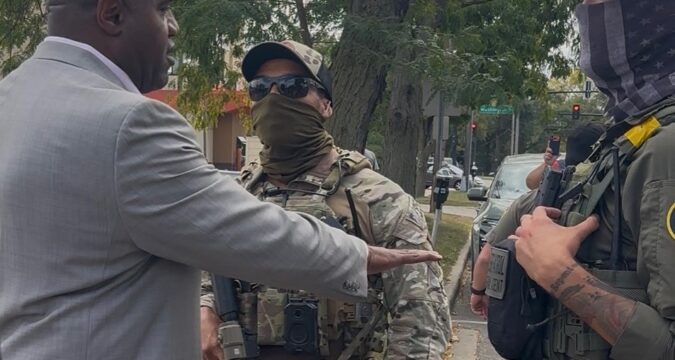
Though he was not arrested, Waukegan Ald. Juian Martinez, 3rd Ward, was approached in his car by first one and then three more Border Patrol agents pointing their guns at him on Nov. 7 after he honked his car horn while stuck in a traffic jam returning to work after lunch.
https://www.chicagotribune.com/2025/12/08/lake-county-immigration-enforcement/


